您的浏览器禁用了JavaScript(一种计算机语言,用以实现您与网页的交互),请解除该禁用,或者联系我们。 [ITIF]:数字婚姻鸿沟:各州在线打结服务排名 - 发现报告

数字婚姻鸿沟:各州在线打结服务排名

文化传媒 2026-02-11 ITIF 曾阿牛
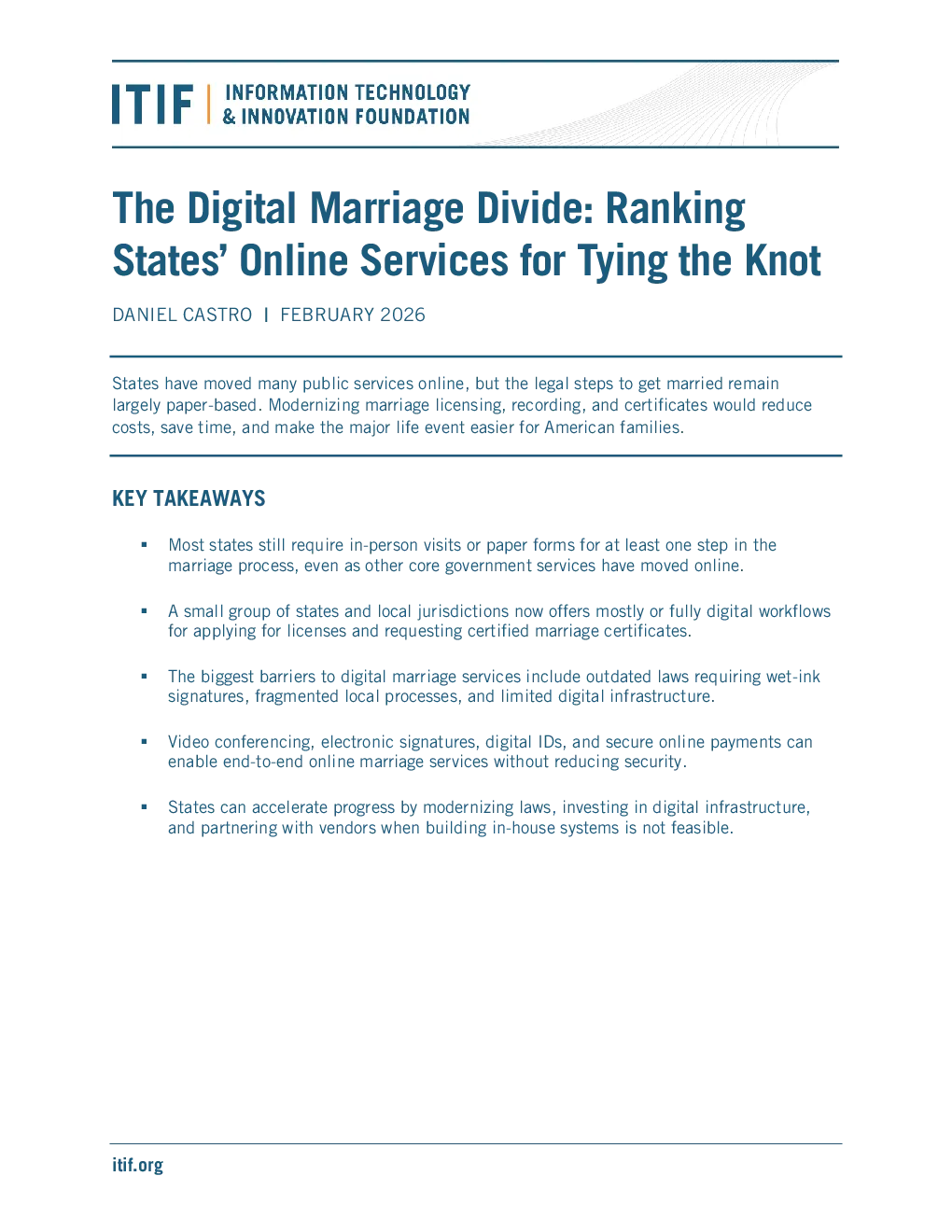
报告封面

DANIEL CASTRO|FEBRUARY 2026 States have moved many public services online, but the legal steps to get married remainlargely paper-based. Modernizing marriage licensing, recording, and certificates would reduce KEY TAKEAWAYS Most states still require in-person visits or paper forms for at least one step in themarriage process, even as other core government services have moved online. A small group of states and local jurisdictions now offers mostly or fully digital workflows The biggest barriers to digital marriage services include outdated laws requiring wet-ink Video conferencing, electronic signatures, digital IDs, and secure online payments canenable end-to-end online marriage services without reducing security. States can accelerate progress by modernizing laws, investing in digital infrastructure,and partnering with vendors when building in-house systems is not feasible. CONTENTS Key Takeaways................................................................................................................... 1Introduction....................................................................................................................... 2Methodology ...................................................................................................................... 3Findings ............................................................................................................................ 3Overall Rankings............................................................................................................. 3Obtaining a Marriage License ........................................................................................... 4Recording a Marriage ...................................................................................................... 6 INTRODUCTION Getting married is a major milestone in many people’s lives. People view marriage in manyways—an act of love, a sacred bond, a civil contract, or a social institution that anchors familylife—but in every case, a marriage in the United States becomes legal only after the governmentproperly records it. In practice, this process typically requires a couple to obtain a marriage Today, many people meet online, and governments increasingly deliver core services digitally. Inmost states, individuals can register to vote, renew a driver’s license, and pay taxes online. Yet,the process of getting married remains largely offline. In many jurisdictions, couples still mustappear in person, complete paper forms, and mail documents to multiple offices. As a result, a Dating has gone digital. Getting legally married, in most states, has not. This report evaluates how digitally accessible the marriage process is across the United States,focusing on three steps: applying for a marriage license, recording a marriage, and obtaining acertified copy of a marriage certificate. The analysis finds significant variation across states. A To close these gaps, state and local governments should prioritize the following actions: ▪Create secure, end-to-end online options for applying for marriage licenses and requestingcertified marriage certificates.▪Allow video conferencing to replace routine in-person appearances when identityverification is required. METHODOLOGY In the United States, each state can set its own marriage laws, and cities and counties oftenestablish additional policies and procedures for issuing marriage licenses and certificates. Foreach state, this analysis assesses how digitally friendly three key processes are for individualsgetting married: (1) applying for a marriage license; (2) recording a marriage with the appropriate The analysis focuses on the largest jurisdictions because those governments can more easilyinvest in digital processes, spread fixed costs across a larger population, and capture greaterefficiency gains from digitalization. The research also identifies notable examples of digitallyfriendly marriage policies and practices in smaller jurisdictions, when relevant. The findingstherefore reflect what individuals are most likely to encounter in the largest city or county in each FINDINGS Dating has gone digital. Getting legally married, in most states, has not. Every state could domore to create a more seamless online process for obtaining a marriage license, recording a Overall Rankings In this report, we group states into one of three categories—E-Lopers (highest), Paper Trailers(mid-tier), and In-Personals (lowest)—based on a composite assessment of how digitally As shown infigure 1, 10 states are leading in implementing digital marriage processes: Alabama,Arizona, Delaware, Hawaii, Illinois, Indiana, Kansas, New Mexico, New York, and Utah. Thesestates generally make it easy both to obtain, complete, and submit a marriage license applicationonline, as well as to go online to request a certified copy of a marriage certificate. These states Other states are less advanced. Almost half—22 stat