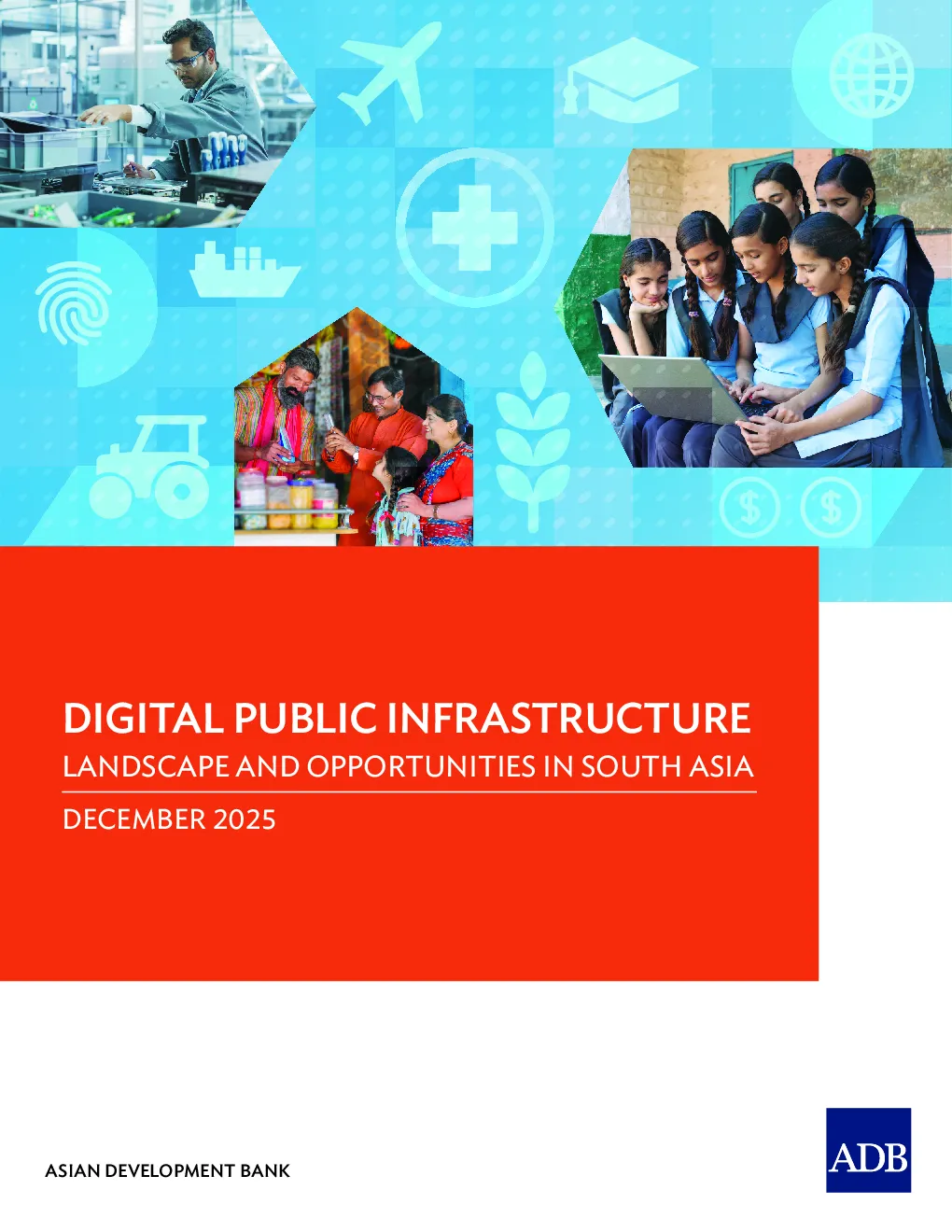
LANDSCAPE AND OPPORTUNITIES IN SOUTH ASIA DECEMBER 2025 DIGITAL PUBLIC INFRASTRUCTURE DECEMBER 2025 Creative Commons Attribution 3.0 IGO license (CC BY 3.0 IGO) © 2025 Asian Development Bank6 ADB Avenue, Mandaluyong City, 1550 Metro Manila, PhilippinesTel +63 2 8632 4444; Fax +63 2 8636 2444www.adb.org Some rights reserved. Published in 2025. ISBN 978-92-9277-635-0 (print); 978-92-9277-636-7 (PDF); 978-92-9277-637-4 (ebook)Publication Stock No. TCS250563-2DOI: http://dx.doi.org/10.22617/TCS250563-2 The views expressed in this publication are those of the authors and do not necessarily reflect the views and policiesof the Asian Development Bank (ADB) or its Board of Governors or the governments they represent. ADB does not guarantee the accuracy of the data included in this publication and accepts no responsibility for anyconsequence of their use. The mention of specific companies or products of manufacturers does not imply that theyare endorsed or recommended by ADB in preference to others of a similar nature that are not mentioned. By making any designation of or reference to a particular territory or geographic area in this document, ADB does notintend to make any judgments as to the legal or other status of any territory or area. This publication is available under the Creative Commons Attribution 3.0 IGO license (CC BY 3.0 IGO)https://creativecommons.org/licenses/by/3.0/igo/. By using the content of this publication, you agree to be boundby the terms of this license. For attribution, translations, adaptations, and permissions, please read the provisionsand terms of use at https://www.adb.org/terms-use#openaccess. This CC license does not apply to non-ADB copyright materials in this publication. If the material is attributedto another source, please contact the copyright owner or publisher of that source for permission to reproduce it.ADB cannot be held liable for any claims that arise as a result of your use of the material. Please contact pubsmarketing@adb.org if you have questions or comments with respect to content, or if you wishto obtain copyright permission for your intended use that does not fall within these terms, or for permission to usethe ADB logo. Corrigenda to ADB publications may be found at http://www.adb.org/publications/corrigenda. Notes:In this publication, “$” refers to United States dollars, “€” refers to euros, “Nu” refers to ngultrum,“W” refers to won, and “₹” refers to rupees.ADB recognizes “Korea” and “South Korea” as the Republic of Korea and “Laos” as the Lao People’s Democratic Republic. Cover design by Maro De Guzman. On the cover: Worker recycling old laptops in India (photo by Gorodenkoff / Shutterstock). School girls learningon a laptop in India (photo by stockpexel / Shutterstock). Indian customer using smartphone for digital payment(photo by NIKS ADS / Shutterstock). Tables and Figuresiv Introduction1Study Context1 Why Digital Public Infrastructure?4What Are Digital Public Infrastructure’s Design Principles?5What Does Digital Public Infrastructure Involve?8Why Is Digital Public Infrastructure Transformational for Development?10What Are Emerging Trends in Digital Public Infrastructure?13What Is the Role of Multilateral Development Banks in Building Digital Public Infrastructure?16 II.State of Digitalization Across the Region18Digitalization Framework18 III.State of Digital Public Infrastructure Maturity and Readiness23Regional Insights on Digital Public Infrastructure Maturity24 IV.Country Summary Reports: Landscape and Opportunities for Digital Public Infrastructure28Bangladesh30Bhutan38India46Maldives56Nepal64Sri Lanka74 V.Learnings from the Region82Opportunities to Deepen Regional Cooperation on Digital Public Infrastructure82 Appendixes 1Methodology852Further Reading on Digital Public Infrastructure903Stakeholder Interview Tables914Digital Public Infrastructure Case Studies94 Bibliography178 Tables 1Approaches to Service Delivery42Example of Digital Public Infrastructure vs Non-Digital Public Infrastructure Approach5to Service Delivery3Regional Insights on Digital Public Infrastructure254Operationalizing the Trust-by-Design Framework83A3.1Stakeholder Interview Table–Bangladesh91A3.2Stakeholder Interview Table–Bhutan91A3.3Stakeholder Interview Table–India92A3.4Stakeholder Interview Table–Maldives92A3.5Stakeholder Interview Table–Nepal93A3.6Stakeholder Interview Table–Sri Lanka93A4.1Content Covered in Case Studies95A4.2Chosen Sectors and Case Studies, and Relevant Links to the Landscape Assessment97A4.3Implementation Progress171 Figures 1Digital Public Infrastructure Design Principles62Layers of Digital Public Infrastructure83Digitalization Framework184Digital Public Infrastructure Maturity Framework235Summary of Bangladesh’s Smart National Identity326Summary of Bangladesh’s Digital Payments (bKash)327Summary of Bhutan’s National Digital Identity System408Summary of India’s Digital Identity Aadhaar499Summary of India’s Digital Payments (U