您的浏览器禁用了JavaScript(一种计算机语言,用以实现您与网页的交互),请解除该禁用,或者联系我们。 [联合国]:2026年1月全球投资趋势监测报告 - 发现报告

2026年1月全球投资趋势监测报告

信息技术 2026-01-19 联合国 王英文
报告封面

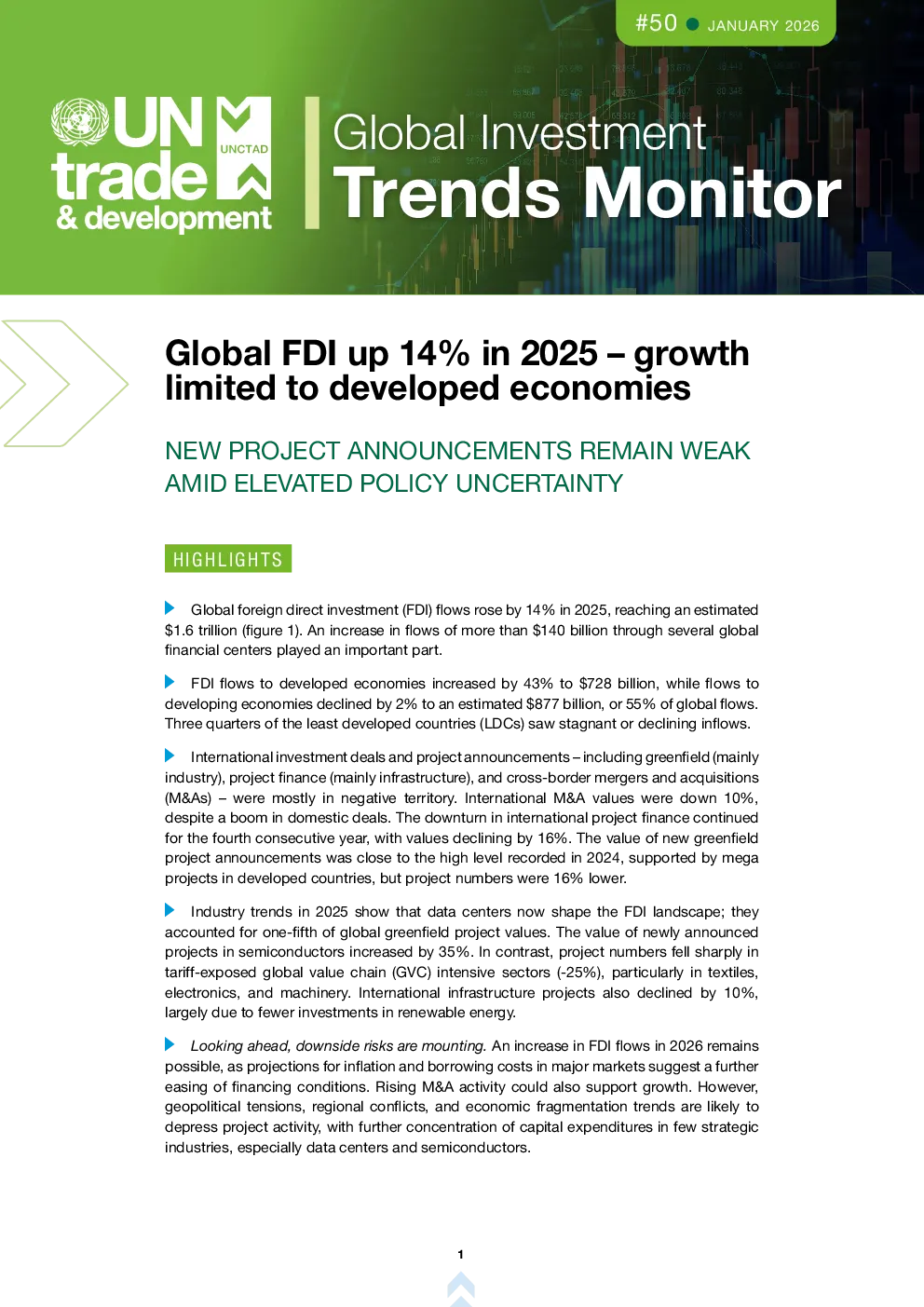
Trends MonitorGlobal Investment Global FDI up 14% in 2025 – growthlimited to developed economies NEW PROJECT ANNOUNCEMENTS REMAIN WEAK H I G H L I G H T S Global foreign direct investment (FDI) flows rose by 14% in 2025, reaching an estimated$1.6 trillion (figure 1). An increase in flows of more than $140 billion through several global FDI flows to developed economies increased by 43% to $728 billion, while flows todeveloping economies declined by 2% to an estimated $877 billion, or 55% of global flows.Three quarters of the least developed countries (LDCs) saw stagnant or declining inflows. International investment deals and project announcements – including greenfield (mainlyindustry), project finance (mainly infrastructure), and cross-border mergers and acquisitions(M&As) – were mostly in negative territory. International M&A values were down 10%,despite a boom in domestic deals. The downturn in international project finance continued Industry trends in 2025 show that data centers now shape the FDI landscape; theyaccounted for one-fifth of global greenfield project values. The value of newly announcedprojects in semiconductors increased by 35%. In contrast, project numbers fell sharply intariff-exposed global value chain (GVC) intensive sectors (-25%), particularly in textiles, Looking ahead, downside risks are mounting.An increase in FDI flows in 2026 remainspossible, as projections for inflation and borrowing costs in major markets suggest a furthereasing of financing conditions. Rising M&A activity could also support growth. However,geopolitical tensions, regional conflicts, and economic fragmentation trends are likely to Trends MonitorGlobal Investment Figure 1 Global investment trends, 2025 vs 2024(Trillions of dollars) UNCTAD’s Global Investment Trends Monitor reports international investment trendsbased on quarterly foreign direct investment (FDI) statistics provided by member •Cross border mergers and acquisitions (M&As) –transactions that directly affectFDI flows. •Greenfield projects – announcement-based data that reflect investment intentionsin the reporting year and signal directional FDI trends ahead. Greenfield projects •International project finance – announcements of large-scale projects involvingmultiple investors and containing a significant debt component. These projects Project data are sourced from The Financial Times, fDi Markets (www.fDimarkets.com) for greenfield and LSEG Data & Analytics for M&As and project finance. Full-year projections in this monitor are based on three quarters. Third quarter FDIdata have been collected for 130 economies covering 95% of global FDI stock. Global trends Global foreign direct investment (FDI) reached an estimated $1.6 trillion in 2025, a 14% increase.However, a significant part of the increase was due to higher flows through several major globalfinancial centers and investment hubs (economies with significant conduit FDI flows), which addedmore than $140 billion to the total, with the United Kingdom, Luxembourg, Switzerland and Ireland The number of greenfield project announcements, primarily in industrial sectors, declined by 16%.Despite this drop, the total value of greenfield projects remained high, largely driven by large-scale International project finance, mainly focused on infrastructure, continued its downward trend,with the number of deals falling 12% and their value declining 16%. This represented the fourthconsecutive year of negative growth, despite slightly lower interest rates in both advanced and Trends by geography FDI flows to developed economies increased by 43% to $728 billion. Flows to developing economiesdeclined by 2% to an estimated $877 billion, or 55% of global flows (figure 2). Aggregate FDI flowsto LDCs increased, but only due to a reversal of negative flows to Angola; with few exceptions,increases in other LDCs were marginal and they were stagnant or declining in three quarters of them. Looking at income levels, FDI rose by 22% in high-income economies and by 4% in middle-incomeeconomies, while it declined by 5% in lower-income countries.1The stagnant trend in lower incomecountries highlights persistent challenges related to financing constraints, risk perceptions, and The rise in FDI tohigh-income economieswas driven in large part by increased flows to financialcenters and investment hubs, but several major recipient economies also registered growth. FDI tothe European Union grew by 56%. Leading FDI recipients – Germany, France, and Italy – recordedhigher inflows, supported by increased cross-border M&A activity. In Germany, FDI recovered toan estimated $50 billion after exceptionally low inflows in 2024. In France, inflows rose by 45% to FDI flows to North America remained broadly stable. The United States – the world’s largest FDIrecipient – recorded a 2% increase in inflows. Cross-border M&A activity declined by 22% to $132billion. While M&A sales decreased across most industries, they ros