AI智能总结
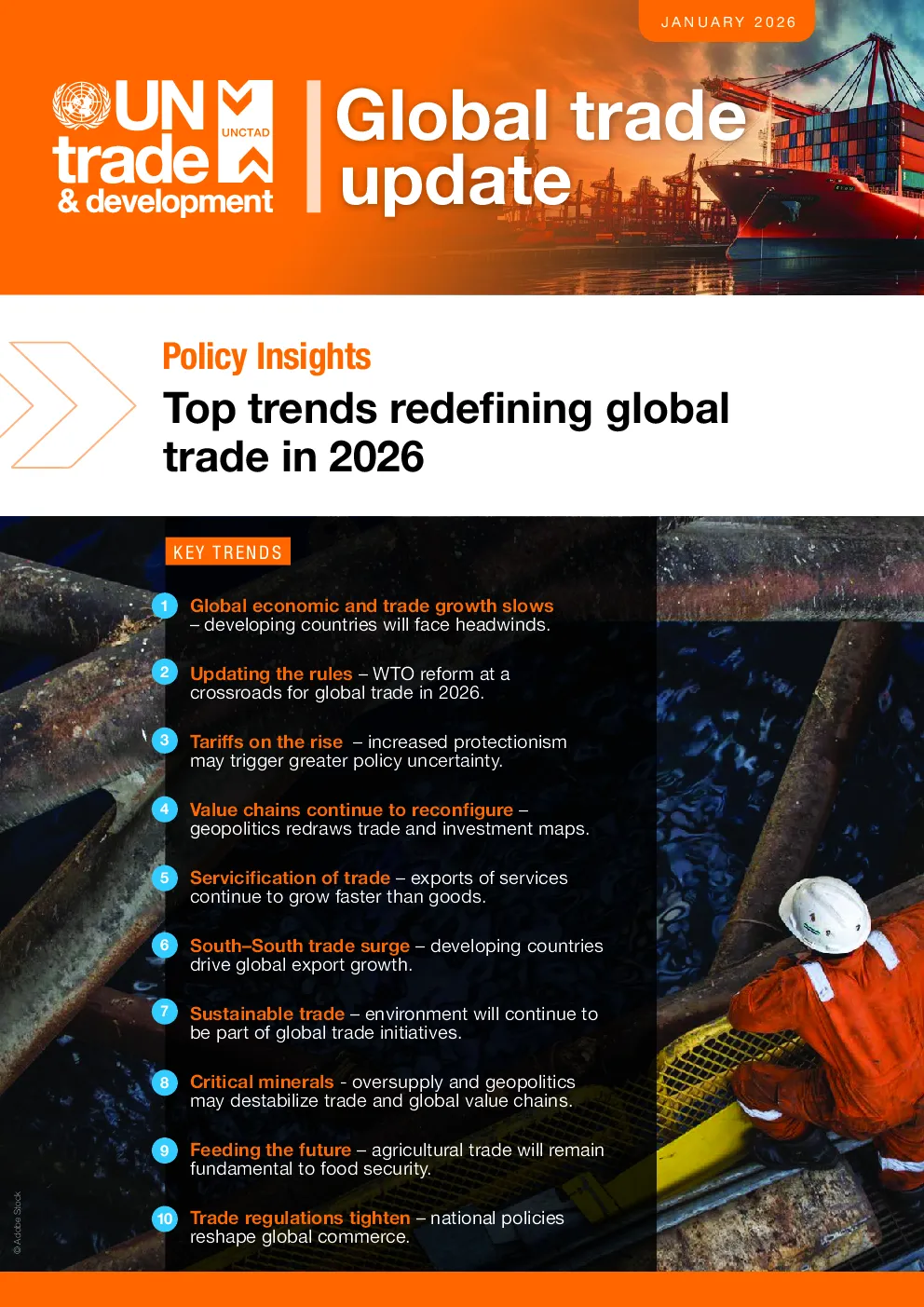
Policy Insights Top trends redefining globaltrade in 2026 K E Y T R E N D S 1Global economic and trade growth slows– developing countries will face headwinds. 2Updating the rules– WTO reform at acrossroads for global trade in 2026. 3Tariffs on the rise– increased protectionismmay trigger greater policy uncertainty. 4Value chains continue to reconfigure–geopolitics redraws trade and investment maps. 5Servicification of trade– exports of servicescontinue to grow faster than goods. 6South–South trade surge– developing countriesdrive global export growth. 7Sustainable trade– environment will continue tobe part of global trade initiatives. 8Critical minerals- oversupply and geopoliticsmay destabilize trade and global value chains. 9Feeding the future– agricultural trade will remainfundamental to food security. 10Trade regulations tighten– national policiesreshape global commerce. Global trade in 2026 is at a critical juncture. Geopoliticalconsiderations, economic headwinds, shifting supply chains,digital breakthroughs, and sustainability imperatives areredefining how countries engage in commerce – with especiallyprofound implications for developing nations. Policymakersface an urgent challenge to navigate this complex landscapewhile ensuring trade continues to drive inclusive andsustainable growth. This report examines ten key trends tofollow in 2026. Global economic and tradegrowth slows– developingcountries will face headwinds Global growth remains sluggish.Global economic growth in 2026 will moderate tradeprospects, investment flows, and policy choices. UNCTAD estimates global growth will remainsubdued at 2.6 per cent in 2025 and 2026, despite potential gains from technologies such asartificial intelligence.1Growth in developing economies (excluding China) is expected to easeslightly to 4.2 per cent in 2026, down from 4.3 per cent in 2025, pointing to a volatile externalenvironment.2 Major economies will also lose momentum.The United States growth is projected at 1.5 percent in 2026, down from 1.8 per cent in 2025, while China—an essential trade and investmentpartner for many developing countries—is expected to expand by 4.6 per cent in 2026, downfrom 5 per cent in 2025. In Europe, fiscal stimulus in countries like Germany may offer limitedsupport, but overall demand will remain modest.3 Slowergrowth affects trade through weaker export demand,tighter financialconditions, and greater exposure to shocks.Commodity-dependent economies may faceheightened price volatility, while access to external finance could become more constrained.Globally, policy volatility may further dampen long-term investment, complicating infrastructureand industrial financing for developing countries. Slowing global growth is affecting allThe impact on developing countries will be significant.Subdued global growth raises thestakes in developing countries by limiting investment and access to finance for infrastructure andindustrialization (figure 1). Policymakers will need to adapt strategies—such as strengtheningregional integration or digital trade—to counter global headwinds and build resilient developmentplans toward 2026. Figure 1 A deteriorating policy environment inhibits growth across the globe.Real gross domestic product (GDP) growth, world and selected Real gross domestic product (GDP) growth, world and selected economies,percentage, 2004–2026economies, percentage, 2004–2026 Updating the rules– WTO reformat a crossroads for global trade in2026 The 14thWTO Ministerial Conference (MC14) will take place in Yaoundé, Cameroon,against a backdrop of geopolitical tensions and trade uncertainties driven by unilateraltariffs, bilateral deals, and economic security concerns. Fordeveloping countries,addressing systemic challenges remains a priority,particularlyreforming the dispute settlement mechanism and restoring a fully-functioning Appellate Body.These reforms are essential to safeguard market access and ensure developing members caneffectively uphold their rights within the multilateral trading system. Preserving policy space and reinforcing Special and Differential Treatment (SDT) willalso be central concerns.SDT provisions are critical for industrialization, value addition, andstructural transformation, enabling developing countries to maximize the benefits of global trade. Developing countries’ interests span several areas.These interests include agricultureand fisheries, with an emphasis on food security and rural livelihoods; electronic commerce,covering regulatory approaches that support digital development strategies, cross-border dataflows, emerging services trade models, and the future of the e-commerce moratorium; and thepotential integration of the plurilateral Investment Facilitation for Development Agreement (IFDA)into the WTO legal framework, aimed at promoting foreign direct investment and facilitatingintegration into global value chains. The intersection of trade and climate policy will remain