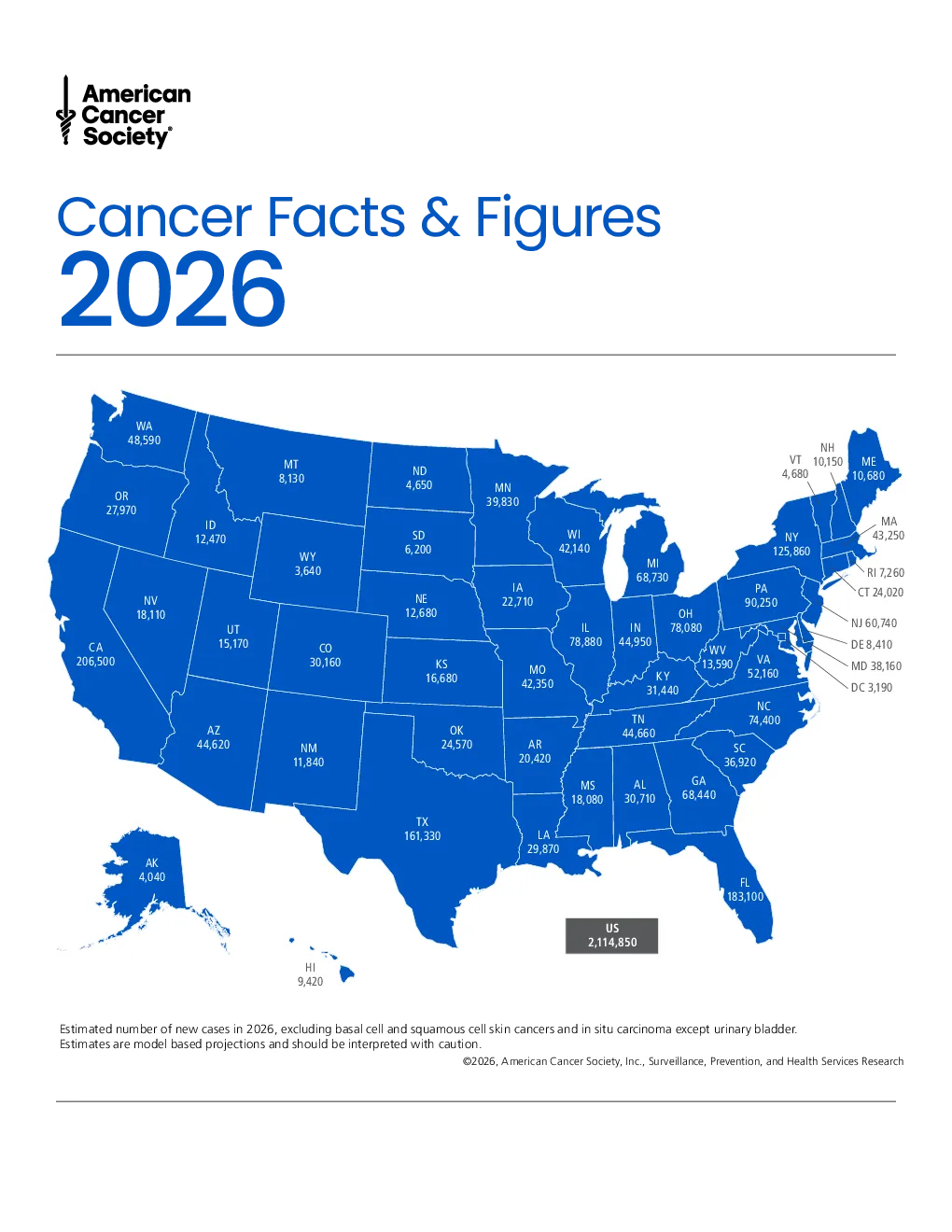
Contents LymphomaOral Cavity and PharynxOvaryPancreasProstateSkinThyroid Basic Cancer Facts Figure 1. Trends in Age-adjusted Cancer Death Rates by Site,Males, US, 1930-2023 Selected Cancers Breast3Figure 2. Trends in Age-adjusted Cancer Death Rates by Site,Females, US, 1930-20233Table 1. Estimated Number of New Cancer Cases and Deathsby Sex, US, 20264Table 2. Estimated Number of New Cases for Selected Cancersby State, US, 20265Table 3. Estimated Number of Deaths for Selected Cancers byState, US, 20266Table 4. Incidence Rates for Selected Cancers by State, US,2018-20227Table 5. Death Rates for Selected Cancers by State,US, 2019-20238Table 6. Probability (%) of Developing Invasive Cancer During Cancer Disparities Table 9. Incidence and Mortality Rates for Selected Cancersby Race and Ethnicity, US29 Cancer Risk Factors Tobacco Use Figure 4. Proportion of Cancer Cases and Deaths Attributableto Cigarette Smoking in Adults 30 Years and Older, US, 201930Nutrition and Physical Activity31Figure 5. Proportion of Cancer Cases and Deaths Attributable The Global Cancer Burden Figure 6. Proportion and Number of Cancer Cases orDeaths Worldwide Attributable to Select Modifiable RiskFactors, 2020-202134 The American Cancer Society Sources of Statistics American Cancer Society Recommendations for the EarlyDetection of Cancer in Average-risk Asymptomatic People44 This publication summarizes current scientific information about cancer. ©2026, American Cancer Society, Inc.All rights reserved, including the right to reproducethis publication or portions thereof in any form.Email the American Cancer Society Legal department Suggested citation:American Cancer Society.Cancer Facts & Figures 2026.Atlanta: American Cancer Society; 2026. Basic Cancer Facts What Is Cancer? estimated new cancer cases and deaths, respectively, in Cancer is a group of diseases characterized by theuncontrolled growth and spread of abnormal cells thatcan result in death if untreated. The cause of mostcancers is unknown, but certain lifestyle factors and How Much Progress Has Been MadeAgainst Cancer? Cancer mortality rates are the best measure of progressagainst cancer because they are less affected by changesin detection practices than incidence (new diagnoses)and survival rates. The age-adjusted cancer death raterose during most of the 20th century because of thesmoking epidemic but has dropped from its peak in 1991by 34% as of 2023, averting approximately 4.8 milliondeaths. This progress, which mostly reflects declines in Can Cancer Be Prevented? Excluding non-melanoma skin cancer, at least 40% ofnewly diagnosed cancers in US adults — about 850,000cases in 2026 — are potentially avoidable, including the19% of cancers associated with cigarette smoking, the8% associated with excess body weight, and the 5%associated with alcohol consumption. SeeProportion andnumber of cancer cases and deaths attributable to potentially Do Cancer Incidence and Death RatesVary Geographically? Cancer rates vary substantially across states, with thelargest differences for cancers that are most preventable,such as lung cancer. For example, male lung cancerincidence varies by 3- to 4-fold, from 21 per 100,000 men How Many People Alive Today HaveEver Had Cancer? As of January 1, 2025, approximately 18.6 millionAmericans had a history of invasive cancer, mostof whom were diagnosed many years ago; seeCancer treatment and survivorship statistics, 2025for Who Is at Risk of Developing Cancer? Everyone is at risk of developing cancer, althoughincidence increases greatly with age; 88% of peoplediagnosed with cancer in the US are 50 years or older,and 59% are 65 or older. In the US, an estimated 39 outof 100 men and women will develop cancer during theirlifetime (Table 6). However, these probabilities are based How Many New Cases and Deaths AreExpected to Occur in 2026? Excluding non-melanoma skin cancers, approximately2.1 million new cancer cases are expected to bediagnosed in the US in 2026, and more than 626,000 What Percentage of PeopleSurvive Cancer? staging system that is standard in presentingpopulation-based cancer registry data and isparticularly useful for tracking trends. According tothis system, if cancer is confined to the layer of cellswhere it began growing, the stage is in situ. If cancercells have penetrated beyond the original layer of The 5-year relative survival rate for all cancers combinedhas reached a milestone 70% for people diagnosed from2015 to 2021, up from 49% in the mid-1970s (Table 7).Relative survival is a measure of life expectancy amongpeople with cancer compared to that among the generalpopulation of the same age, race, and sex. Since the early1960s, 5-year relative survival has increased from 39% to What Are the Costs of Cancer? The costs of cancer are estimated in several ways,including direct medical costs (total of all health careexpenditures) and indirect costs, such as lost earningsfrom missed work due to illnes