AI智能总结
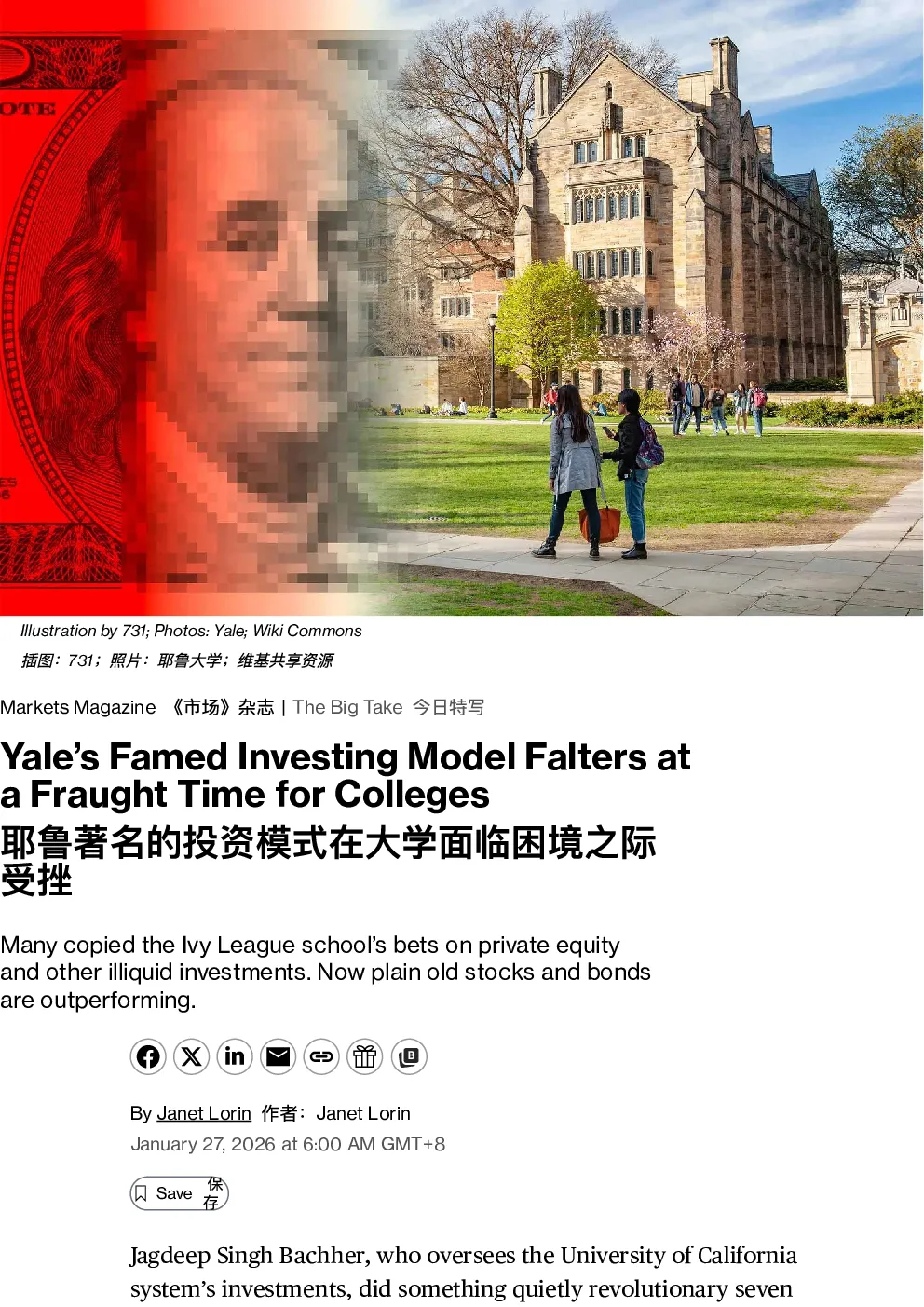
Markets Magazine《市场》杂志|The Big Take今⽇特写 Yale’s Famed Investing Model Falters ata Fraught Time for Colleges耶鲁著名的投资模式在⼤学⾯临困境之际受挫 Many copied the Ivy League school’s bets on private equityand other illiquid investments. Now plain old stocks and bondsare outperforming. ByJanet Lorin作者:Janet LorinJanuary 27, 2026 at 6:00 AM GMT+8 Jagdeep Singh Bachher, who oversees the University of Californiasystem’s investments, did something quietly revolutionary seven years ago. 负责监管加州⼤学系统投资的贾格迪普·⾟格·巴切尔(Jagdeep SinghBachher)在七年前悄然进⾏了⼀场具有⾰命性的尝试。 He shifted a small piece of the schools’endowmentmoney awayfrom the typical choices: costly and complicated private equity,venture capital and hedge funds. Instead he invested in old--fashioned stocks and bonds, through index funds that charge nextto nothing. 他将学校捐赠基⾦中的⼀⼩部分资⾦从典型的选择中转移了出来:即那些成本⾼昂且复杂的私募股权、风险投资和对冲基⾦。取⽽代之的是,他通过收费极低的指数基⾦,投资于传统的股票和债券。 Bachher started with a couple of hundred million in seed money,and ultimately UC’s campuses allocated $5 billion. The result: UC’snew fund, over the three years ended in June, reported a 15%average annual return, thrashing the performance of some of therichest private schools—most notablyYale University, whichpioneered the much-copied model of buying illiquid privateinvestments rather than publicly traded stocks and bonds. 巴切尔最初投⼊了⼏亿美元的种⼦资⾦,最终加州⼤学各校区共拨付了50亿美元。结果显⽰:在截⾄今年6⽉的三年间,加州⼤学的这⽀新基⾦报告了15%的平均年化回报率,这⼀表现击败了⼀些最富有的私⽴名校——尤其是耶鲁⼤学。耶鲁⼤学曾开创了被⼴泛效仿的“耶鲁模式”,即优先购买流动性较差的私募资产,⽽⾮公开交易的股票和债券。 Featured in the February/March issue ofBloomberg Markets.Illustration:Derek Abella for Bloomberg Markets 刊登于《彭博市场》2⽉/3⽉刊。插图:Derek Abella为《彭博市场》创作 UC’s plain-vanilla Blue and Gold Endowment, named after thesystem’s colors, has grown to about $8 billion, making it, on its own,one of higher education’s biggest funds. “Keeping it simple, keepingthe cost low, and luck is a very important part of this entireapproach,” Bachher says. 加州⼤学朴实⽆华的“蓝⾦捐赠基⾦”(以该校系统的代表⾊命名)已增长⾄约80亿美元,使其本⾝就成为了⾼等教育界规模最⼤的基⾦之⼀。“保持简单、保持低成本,以及运⽓,是这整套⽅法中⾮常重要的组成部分,”巴赫尔表⽰。 UC’s strategy shows the travails of the so-calledYale modelofendowment investing, which has grown into a kind of orthodoxysince its advent in the 1980s. Its poor recent results have beenleading some investment professionals to question Yale’s method, also called the “endowment model,” which is also popular amongphilanthropies and pension funds. “It’s not dead,” says Mark Steed,who oversees the $24 billion Arizona Public Safety PersonnelRetirement System, of the Yale model. “But it’s in critical condition.” 加州⼤学(UC)的策略揭⽰了所谓“耶鲁模式”捐赠基⾦投资法所⾯临的困境。⾃20世纪80年代问世以来,该模式已演变为⼀种⾏业正统。然⽽,近期低迷的业绩表现促使⼀些投资专业⼈⼠开始质疑耶鲁模式(亦称“捐赠基⾦模式”),该模式在慈善机构和养⽼基⾦中也⼴受欢迎。负责管理240亿美元亚利桑那州公共安全⼈员退休系统的马克·斯蒂德(Mark Steed)在谈到耶鲁模式时表⽰:“它还没死,但已处于危急状态。” That tactic presupposes higher returns for locking up money for thelong term, something most people can’t do. Ivy League institutionsare planning in centuries. But it turns out universities in fact needmoney now. 这种策略的前提是,通过长期锁定资⾦来换取更⾼的回报,⽽这是⼤多数⼈⽆法做到的。常春藤盟校的规划周期是以世纪为单位的。但事实证明,⼤学现在其实就需要钱。 Some of the wealthiest, including those that benefited most fromthe Yale model, are on the hook for hundreds of millions in newendowment taxesfrom a hostile government, led by PresidentDonald Trump, who also withheld billions infederal funding forresearch—their lifeblood. Yale and Harvard University say theincreased endowment tax alone will cost them each some $300million a year. “In moments of extreme crisis, it is definitely a rainy-day fund,”Leon Botstein, who’s been president of Bard College inAnnandale-on-Hudson, New York, for a half-century, says of thehigher education investment pools. “That’s the privilege of havingan endowment.” ⼀些最富有的⼤学,包括那些从“耶鲁模式”中获益最多的学校,正⾯临着来⾃敌对政府数亿美元的新捐赠基⾦税收压⼒。由总统唐纳德·特朗普领导的政府还扣留了数⼗亿美元的联邦研究资⾦,⽽这正是这些⼤学的命脉。耶鲁⼤学和哈佛⼤学表⽰,仅增加的捐赠基⾦税⼀项,每年就将分别给它们造成约3亿美元的损失。纽约州安嫩代尔-哈德逊巴德学院担任校长半个世纪之久的莱昂·博特斯坦在谈到⾼等教育投资池时表⽰:“在极端危机时刻,这绝对是⼀笔救急基⾦。这就是拥有捐赠基⾦的特权。” Now, universities are dumping private equity funds at discountsfollowing years of poor returns, while public stocks haveoutperformed the asset class. Higher interest rates have made itdifficult for investors to exit private equity—or leveraged buyoutfunds—through public offerings. 如今,由于多年来回报不佳,且公开市场股票表现优于此类资产,各⼤学正折价抛售私募股权基⾦。⾼利率使得投资者难以通过公开上市退出私募股权(或杠杆收购基⾦)。 Last year,Yale unloadedabout $2.5 billion in LBO funds at adiscount. Because the university is such an influential investor, thefund sales, its first in the secondary markets, underscored thebroader struggles of leveraged buyouts. A firm involved in the saleused a code name: “Project Gatsby,” after the 1925 F. Scott Fitzgeraldnovel whose narrator graduated from Yale. 去年,耶鲁⼤学以折扣价抛售了约25亿美元的杠杆收购(LBO)基⾦。由于该⼤学是极具影响⼒的投资者,其⾸次在⼆级市场进⾏的基 ⾦出售凸显了杠杆收购⾏业⾯临的普遍困境。参与此次交易的⼀家公司使⽤了⼀个代号:“盖茨⽐项⽬”(Project Gatsby),取⾃F·斯科特·菲茨杰拉德1925年的⼩说,书中的叙述者毕业于耶鲁⼤学。 PE funds dragged on university returns. Consider Yale. In the threeyears ended on June 30, its endowment generated an averageannualized return of 6.2%, less than half UC’s stock-and-bond fund.It also lagged the