AI智能总结
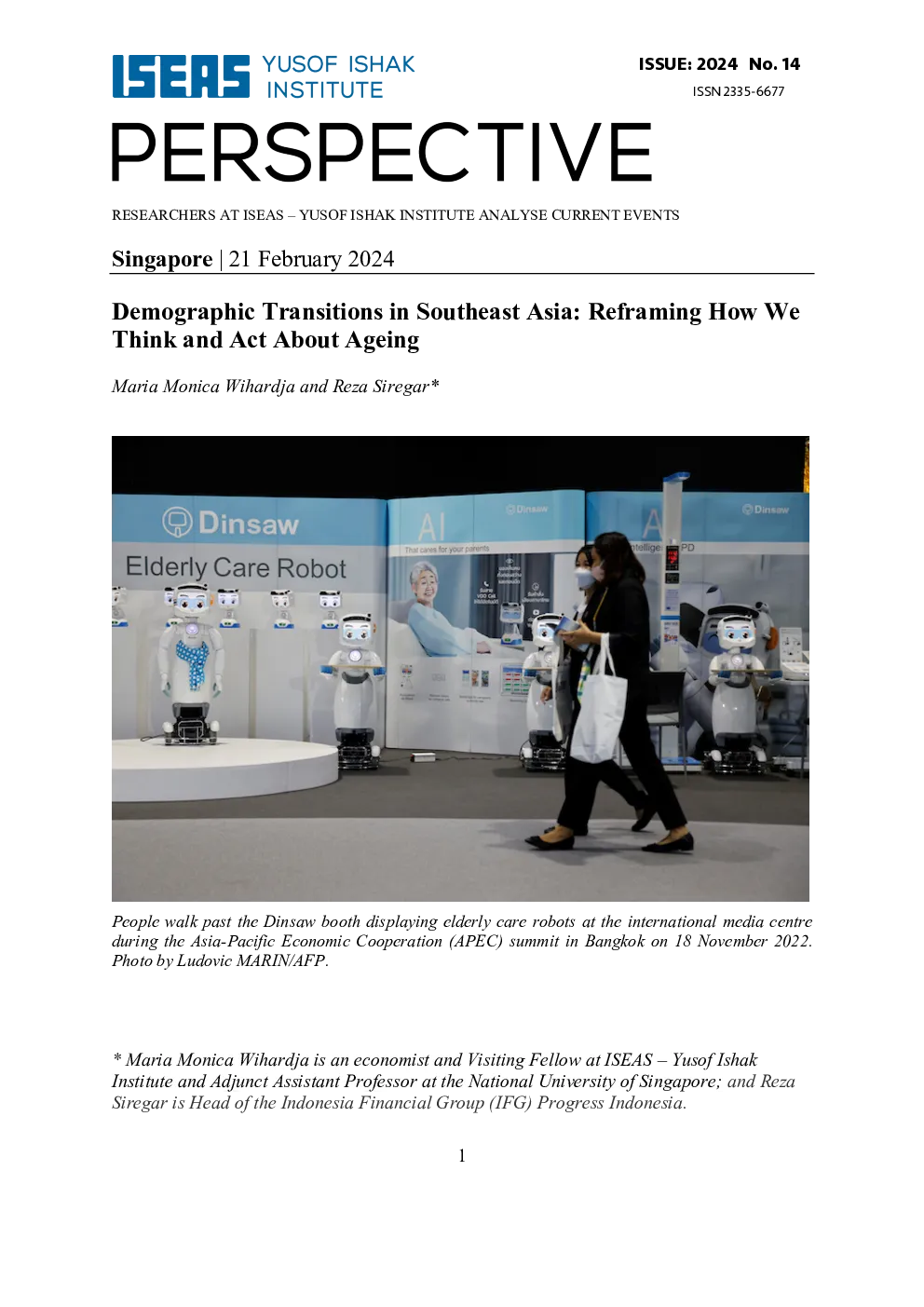
RESEARCHERS AT ISEAS–YUSOF ISHAK INSTITUTE ANALYSE CURRENT EVENTS Singapore|21February2024 Demographic Transitions in Southeast Asia: Reframing How WeThink and ActAbout Ageing Maria Monica Wihardja and Reza Siregar* People walk past the Dinsawbooth displaying elderly care robots at the international media centreduring the Asia-Pacific Economic Cooperation (APEC) summit in Bangkok on 18 November 2022. *Maria Monica Wihardja is an economist and Visiting Fellow at ISEAS–Yusof IshakInstitute and Adjunct Assistant Professor at the National University of Singapore;and RezaSiregar is Head of the Indonesia Financial Group (IFG) Progress Indonesia. No.14ISSUE: 2024ISSN 2335-6677 EXECUTIVE SUMMARY •Population ageing could be a sign of longer lives and healthier old ages, but thisdemographic factor poses both challenges and opportunities at the same time. •Managing the ageing transitions will therefore critically shape the existential conditionsof each demographic stage. •This study maps the Southeast Asian economies into various demographic typologiesand documents policy recommendations that these economies could adopt, for example, No.14ISSUE: 2024ISSN 2335-6677 INTRODUCTION The Southeast Asian (SEA) region is experiencing intense demographic changes. Unlike theircounterparts in Europe and the United States, countries in Eastand Southeast Asia are ageing at record speed, (World Bank, 2019).1While countries in SEA are heterogeneous in theirdemographic profiles–from the already aged population in Singapore to the still very youngpopulation in Cambodia and Lao PDR–none of them is spared from the challenges broughtby an ageing population.2 Although population ageing could be a sign of longer lives and healthier old ages, demographictransitions can be a ticking time bomb and turn out to be disastrous if countries fail to invest innecessary systems and reforms in time. This paper discusses the challenges faced, and suggestspolicy recommendations for SEA countries, focusing on the ten ASEAN countries at different DEMOGRAPHIC TYPOLOGY IN SOUTHEAST ASIA Scholars have conceptualised three forms of “dividends” from demographic changes (WorldBank, 2015). A ‘first demographic dividend’, associated with a growing share for the working-age population, presents opportunities for countries to reap the expandingworking agepopulation, which they can do by investing in human capital, creating enough productive jobsand building institutions conducive to savings and transfers. A ‘second demographic dividend’,associated with a declining share for the working-age population, presents the countries withthe next group of opportunities to benefit from the more sophisticated workforce; this they cando by moving the workforce into higher productivity sectors and jobs and mobilising savings Evidence from East Asia during the 1970-2000 period suggests that the contribution on GDPgrowth from a ‘second demographic dividend’ through a higher productivity growth was 2.2times larger than the contribution from a ‘first demographic dividend’ through a demographicchange (a higher share of working-age population) (World Bank, 2015). Since human capital Table1 summarises various demographic transitions and the channels through whichdemographic dividends can be reaped. Based on this typology, two countries, Singapore andThailand, entered the ‘post-dividend’ demographic transition in 2023, associated with the thirddemographicdividend.Five countries,i.e.,Indonesia,Brunei Darussalam,Malaysia, No.14ISSUE: 2024ISSN 2335-6677 Source:Table 5.1, World Bank, 2015; and authors’ analysis It is not too late for lower-and upper-middle-income SEA countries to prepare and implementnecessaryreforms to reap the demographic dividends associated with their stages ofdemographic transitions, but the progress to reform so far in many ofthese countries has been DEMOGRAPHICS-SENSITIVE POLICIES What types of policy reforms are needed to address demographic shifts? In the followingsections, we will discuss three priority areas that are most salient for SEA countries: (i)facilitatingintra-andinter-generational transfers and equity, (ii) maintaining economic growth Facilitating intra-and inter-generational transfers and equity The importance of intra-and inter-generational transfers and equity can perhaps be bestanalysed by looking at how consumption is financed across one’s lifetime, including throughprivate and public transfers as well as asset-based reallocations (Annex Figure 1). People tendto be net recipients of transfers (consuming more than what is earned from labour income) No.14ISSUE: 2024ISSN 2335-6677 Among the goals of such a life-cycle analysis are to be able to answer the question of howcurrent and future older people (i.e., the young generation today) are being and will besupported, to estimate the potential impact of demographic changes on publicfinance includingthe pension and insurance systems, and to ensure inter-generational equity wher