AI智能总结
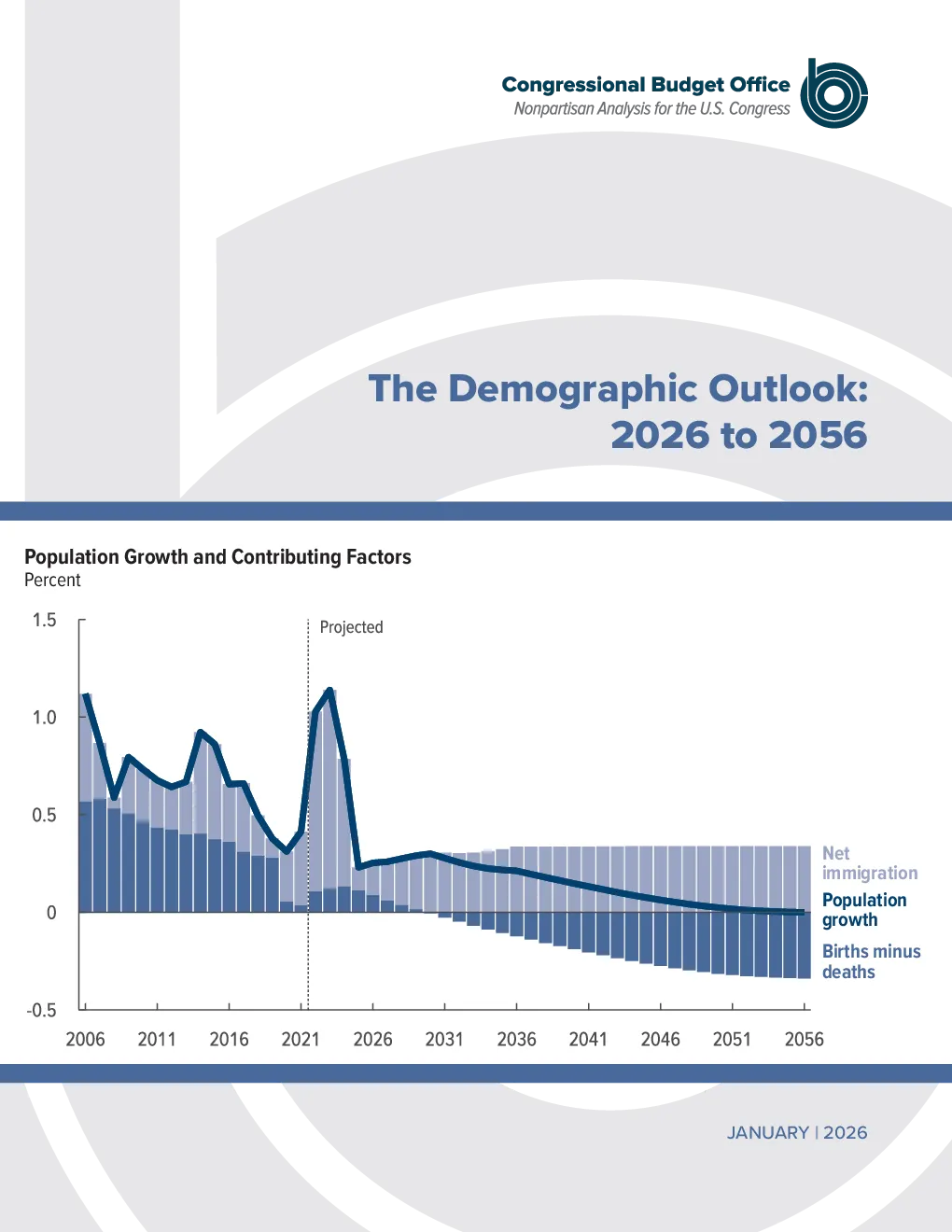
At a Glance The size of the U.S. population and its composition by age and sex have significant implications forthe economy and the federal budget. For example, the number of people at the prime working ages In this report, the Congressional Budget Office describes its population projections, which underliethe baseline budget projections and economic forecast that the agency will publish in February 2026. •Population.The Social Security area population is projected to increase from 349 million peoplethis year to 364 million in 2056. (That measure of the population, which is relevant for estimatingpayroll taxes and benefits for Social Security, includes residents of U.S. states and territories, aswell as U.S. citizens, federal employees, and service members living abroad.) The segment of the •Population Growth.On the basis of recent laws, policies, and demographic trends, CBO projectsthat the rate of population growth will generally slow over the next 30 years, from an average of0.3 percent a yearininthe next decade to an average of 0.1 percent a year from 2037 to 2056. Thetotal population is projected to stop growing in 2056 and remain roughly the same size as in theprevious year. Thereafter, the population is projected to shrink. Net immigration (the number of •Civilian Noninstitutionalized Population.Some of CBO’s economic projections (such as of grossdomestic product and the labor force) depend on the number of people age 16 or older who arenot on active duty with the armed forces or in institutions. CBO produces two projections of that •Changes Since January and September 2025.CBO typically publishes updated demographicprojections early in the calendar year. In 2025, it also released updated projections in September,which reflected laws and policies in place as of July 31. Compared with both of last year’sprojections, the Social Security area population is now projected to grow more slowly over thenext 30 years and to be smaller in 2055 (2.1 percent smaller than projected last January and0.7 percent smaller than projected last September). Since January 2025, CBO has reduced itsprojections of fertility rates because of new information and a change in its methods. CBO has CBO’s projections of fertility, mortality, and net immigration rates are highly uncertain. Small dif-ferences between those projections and actual outcomes could compound over time and significantly Contents The Size and Age Composition of the Population Components of Population GrowthFertilityFertility, by Mother’s Place of BirthMortalityNet ImmigrationNet Immigration, by Category Civilian Noninstitutionalized Population Census Through 2020 Plus CBO ProjectionBLS Through 2025 Plus CBO Projection Changes to Projected Fertility Rates Since January 2025Changes to Projected Mortality Rates Since January 2025Changes to Projected Net Immigration Since January 2025 Changes to Projected Fertility Rates Since September 2025Changes to Projected Mortality Rates Since September 2025Changes to Projected Net Immigration Since September 2025 21 Appendix B: Net Immigration of People in the Other-Foreign-National Category Notes About This Report Unless indicated otherwise, the years referred to in this report are calendar years. When fiscal yearsare mentioned, they are federal fiscal years, which run from October 1 to September 30 and are Numbers in the text and figures may not add up to totals because of rounding. The population projections in this report reflect laws and policies that were in place as ofSeptember 30, 2025. The underlying data for the figures in this report, as well as supplemental population projections,are posted with the report on CBO’s website (www.cbo.gov/publication/61879#data). Terms used in this report are defined inAppendix C. The Demographic Outlook: 2026 to 2056 The outlook for the U.S. economy and the federal budget depends on projected changes in the size and composition ofthe population. Each year, the Congressional Budget Office produces 30-year population projections that are based onexisting laws and policies—in this case, as of September 30, 2025—and recent demographic trends. The projectionsprovide a benchmark for assessing how potential legislation, administrative actions, and judicial decisions would affect To project the U.S. population, CBO starts with recent data and then estimates future rates of fertility, mortality,and net immigration (the number of people who migrate to the United States minus the number who leave). In thisreport, the U.S. population is defined as the population used for estimating Social Security payroll taxes and benefits. In CBO’s projections, the population increases from 349 million people in 2026 to 364 million in 2056. Populationgrowth slows during that period—from an average rate of 0.3 percent a year over the next decade to 0.1 percent a yearthereafter. Through 2029, the population grows because more people are projected to migrate to the United Statesthan