您的浏览器禁用了JavaScript(一种计算机语言,用以实现您与网页的交互),请解除该禁用,或者联系我们。[联合国]:国际投资协定改革:进展情况 - 发现报告

国际投资协定改革:进展情况

金融2026-01-20-联合国一***
AI智能总结
查看更多
国际投资协定改革:进展情况

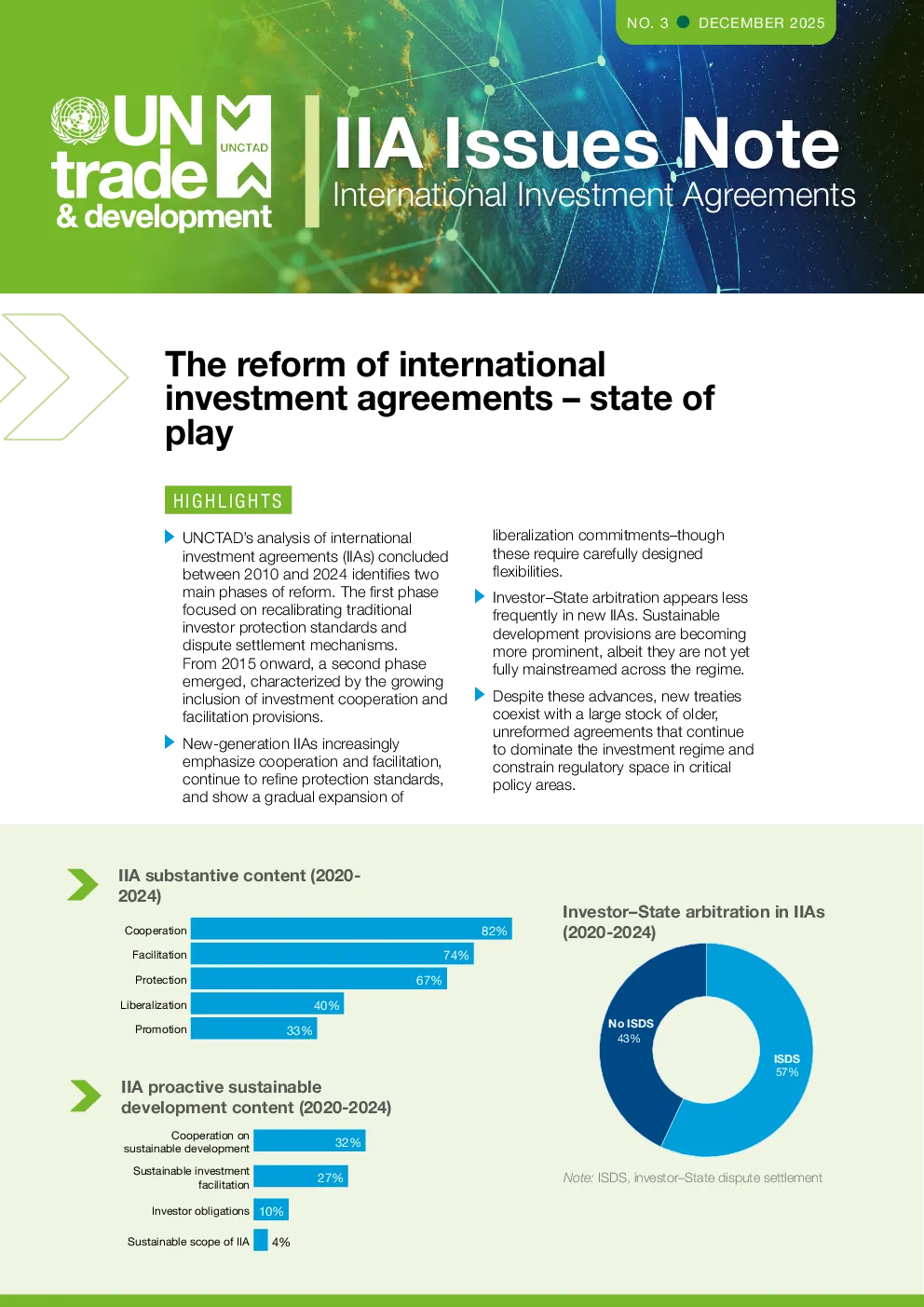
The reform of internationalinvestment agreements – state of H I G H L I G H T S liberalization commitments–thoughthese require carefully designed UNCTAD’s analysis of internationalinvestment agreements (IIAs) concludedbetween 2010 and 2024 identifies twomain phases of reform. The first phasefocused on recalibrating traditionalinvestor protection standards anddispute settlement mechanisms. Investor–State arbitration appears lessfrequently in new IIAs. Sustainabledevelopment provisions are becomingmore prominent, albeit they are not yet Despite these advances, new treatiescoexist with a large stock of older,unreformed agreements that continueto dominate the investment regime and New-generation IIAs increasinglyemphasize cooperation and facilitation,continue to refine protection standards, Note:ISDS, investor–State dispute settlement Conclusion and termination of In 2024, countries concluded at least 17 bilateral investment treaties (BITs) and 13 broader economictreaties with investment provisions (TIPs). This brought the size of the IIA universe to 3,323 (2,843BITs and 480 TIPs). In addition, at least 22 IIAs entered into force and four were terminated, bringing Continuing the trend from previous years, most IIAs concluded in 2024 were implemented alongsideexisting agreements rather than replacing them. This leaves the IIA universe dominated by treatiessigned in the 1990s and 2000s with unrefined protection standards and broad access to investor- Figure 1 Agreements from the 1990s and 2000s continue to dominate the Number and status of agreements by year of signature Developing economies were signatories to all 30 of the IIAs concluded in 2024. The United ArabEmirates concluded at least nine agreements, followed by India (four), Türkiye (four) and China(three). Developed economies concluded 11 agreements. Of those, Australia signed three and the IIA Issues NoteInternational Investment Agreements As in the past four years, in 2024 the importance of TIPs continued to grow, both in terms of numbersand based on the number of new treaty relationships that they created. The regional coverage of the After reaching a high number in 2020–2022 related to the coordinated termination of BITs betweenmember States of the European Union (UNCTAD, 2021; UNCTAD, 2022b; UNCTAD, 2023), theannual number of IIA terminations in the past two years slowed down. Of the four IIAs terminated in This brought the total number of terminations to at least 592 by the end of 2024. About 70 per centof them took place in the last decade (figure 2). Whereas in earlier decades the majority of terminatedIIAs were replaced by new ones, in the last decade only 11 per cent of terminations have led to Of the total number of IIAs terminated without replacement, 52 per cent were terminated by consent,43 per cent were unilaterally denounced and the remaining 4 per cent expired. Terminations byconsentmostly concerned IIAs among developed economies(95 per cent),while unilateral Pursuant to sunset clauses, IIAs may continue to protect investments in existence at the time oftermination or withdrawal and may grant investors access to investor-State dispute settlement (ISDS)for up to 25 years. In view of this risk, most terminations by consent included a provision neutralizing Figure 2 The past decade has seen few replacements of old-generation IIA reform and modernization from2010 to 2024 – state of play Taking stock of the reform process shows an IIA regime in flux. The evolution of IIA content in the In the early 2010s, supported among others by UNCTAD’s Investment Policy Framework forSustainable Development which was first published in 2012 (UNCTAD, 2015), reform efforts focusedon refining traditional protection and dispute settlement provisions, based on policy options slowly Starting from 2015, IIA approaches privileging facilitation and cooperation, as well as alternatives toinvestor–State arbitration added to the first stage of reform efforts. Concurrently, more agreementsstarted to include refined protection standards and reformed ISDS provisions (UNCTAD, 2017), a The evolution manifests in five salient features. 1.IIAs increasingly incorporate more proactive commitments aimed at cooperation, facilitationand promotion of investment.2.Investment protection standards are becoming more refined. Figure 3 The focus of investment agreements is in flux Agreements signed by type of provision, 2020–2024 (Percentage) Cooperation, facilitation and promotion IIAs concluded in the period between 2020 and 2024 incorporated more proactive provisions onfacilitation, cooperation and promotion compared with old-generation IIAs, which typically focused Cooperation Over 80 per cent of IIAs concluded since 2020 contain cooperation provisions that often establisha committee which meets regularly to exchange information, review implementation and promotecooperation on investment matters. This reflects an upward trend that began in the earl