人工智能专业人员的劳动力市场和工作流动性
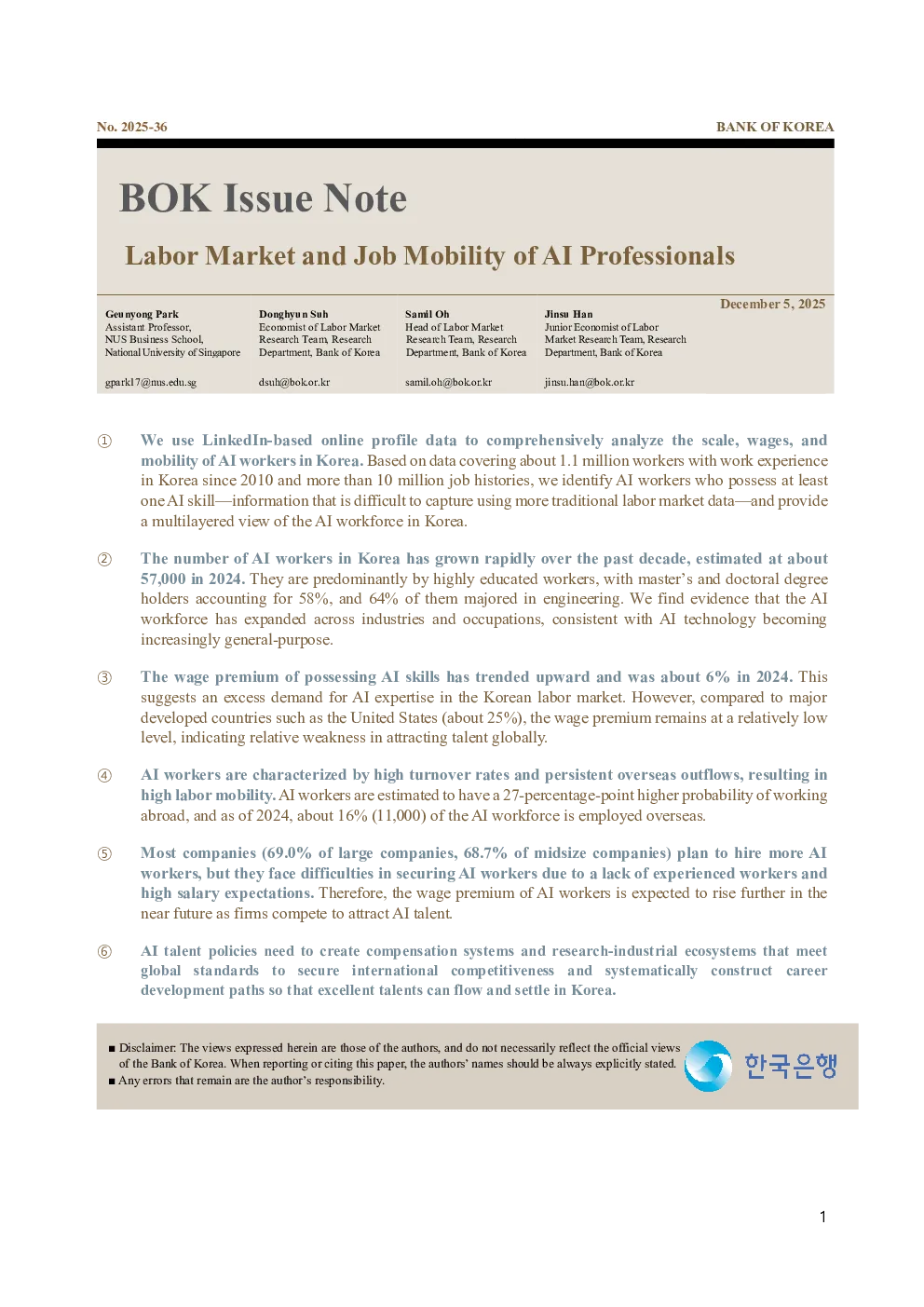
Labor Market and Job Mobility of AI Professionals December 5, 2025 dsuh@bok.or.kr jinsu.han@bok.or.kr samil.oh@bok.or.kr ①We use LinkedIn-based online profile data to comprehensively analyze the scale, wages, andmobility of AI workers in Korea.Based on data covering about 1.1 million workers with work experiencein Korea since 2010 and more than 10 million job histories, we identify AI workers who possess at leastone AI skill—information that is difficult to capture using more traditional labor market data—and provide ②The number of AI workers in Korea has grown rapidly over the past decade, estimated at about57,000 in 2024.They are predominantly by highly educated workers, with master’s and doctoral degreeholders accounting for 58%, and 64% of them majored in engineering. We find evidence that the AI ③The wage premium of possessing AI skills has trended upward and was about 6% in 2024.Thissuggests an excess demand for AI expertise in the Korean labor market. However, compared to majordeveloped countries such as the United States (about 25%), the wage premium remains at a relatively low ④AI workers are characterized by high turnover rates and persistent overseas outflows, resulting inhigh labor mobility.AI workers are estimated to have a 27-percentage-point higher probability of working ⑤Most companies (69.0% of large companies, 68.7% of midsize companies) plan to hire more AIworkers, but they face difficulties in securing AI workers due to a lack of experienced workers andhigh salary expectations.Therefore, the wage premium of AI workers is expected to rise further in the ⑥AI talent policies need to create compensation systems and research-industrial ecosystems that meetglobalstandards to secure international competitiveness and systematically construct career ■Disclaimer: The views expressed herein are those of the authors, and do not necessarily reflect the official viewsof the Bank of Korea. When reporting or citing this paper, the authors’ names should be always explicitly stated. Ⅰ. Introduction 1. Competition in artificial intelligence (AI) development is fierce worldwide. With its high versatility andpotential to transform the entire economy, as well as its nature as a digital technology, AI entails the possibilityof winner-takes-all outcomes.Accordingly, many firms have made substantial investments in AI development to gain 2. The advancement and adoption of AI require not only infrastructure such as data centers and power plants,but also specialized personnel capable of effectively utilizing the technology.Therefore, understanding the basiccharacteristics, distribution, and dynamics of AI-related talent in the labor market is essential for formulating strategiesand policies to remain competitive internationally. While major economies such as the United States and European 3. This paper uses LinkedIn-based online profile data to conduct an in-depth analysis of the labor marketconditions and mobility of AI professionals in Korea.Specifically, we examine qualitative characteristics of AItalent, including educational attainment and fields of study, as well as their distribution across industries andoccupations. We estimate wage premiums associated with AI skill possession to assess labor market supply and II. Data – Revelio Job Profile 4. This study utilizes the “Revelio Job Profile” database provided by Revelio Labs, a global firm specializing inworkforce data analytics.Built on publicly available profiles from LinkedIn, the world’s largest professionalnetworking platform, the database contains extensive labor market information on individual workers, includingeducational background, career history, skills, job roles, and employer information. Recent economic studies (Curtis 5. For the analysis, we extracted a sample of Korean workers who had work experience in Korea between 2010and 2024 from this database, yielding information on approximately 1.1 million workers and more than 10million job histories.In particular, the core strength of this data lies in its provision of detailed information on thespecific skills held by workers. To identify whether workers possess AI-related competencies—features that cannot bereadily captured using conventional industrial or occupational classification codes alone—we select a set of core AI- 6. Table 1 presents summary statistics of the Revelio Job Profile data.Compared to other workers, AI professionalsare more likely to hold graduate-level degrees and to have majored in STEM (Science, Technology, Engineering, andMathematics) fields. They also tend to have longer career experience on average, with substantially higher shares ofmaster’s and doctoral degree holders. In addition, their estimated salary levels exceed those of non-AI workers,reflecting a labor market characterized by highly skilled and highly educated individuals. Although online platform III. Status of AI Workers Quantitative Trends in AI Workers 7. The number of AI workers in Kor