低健康素养正在损害健康
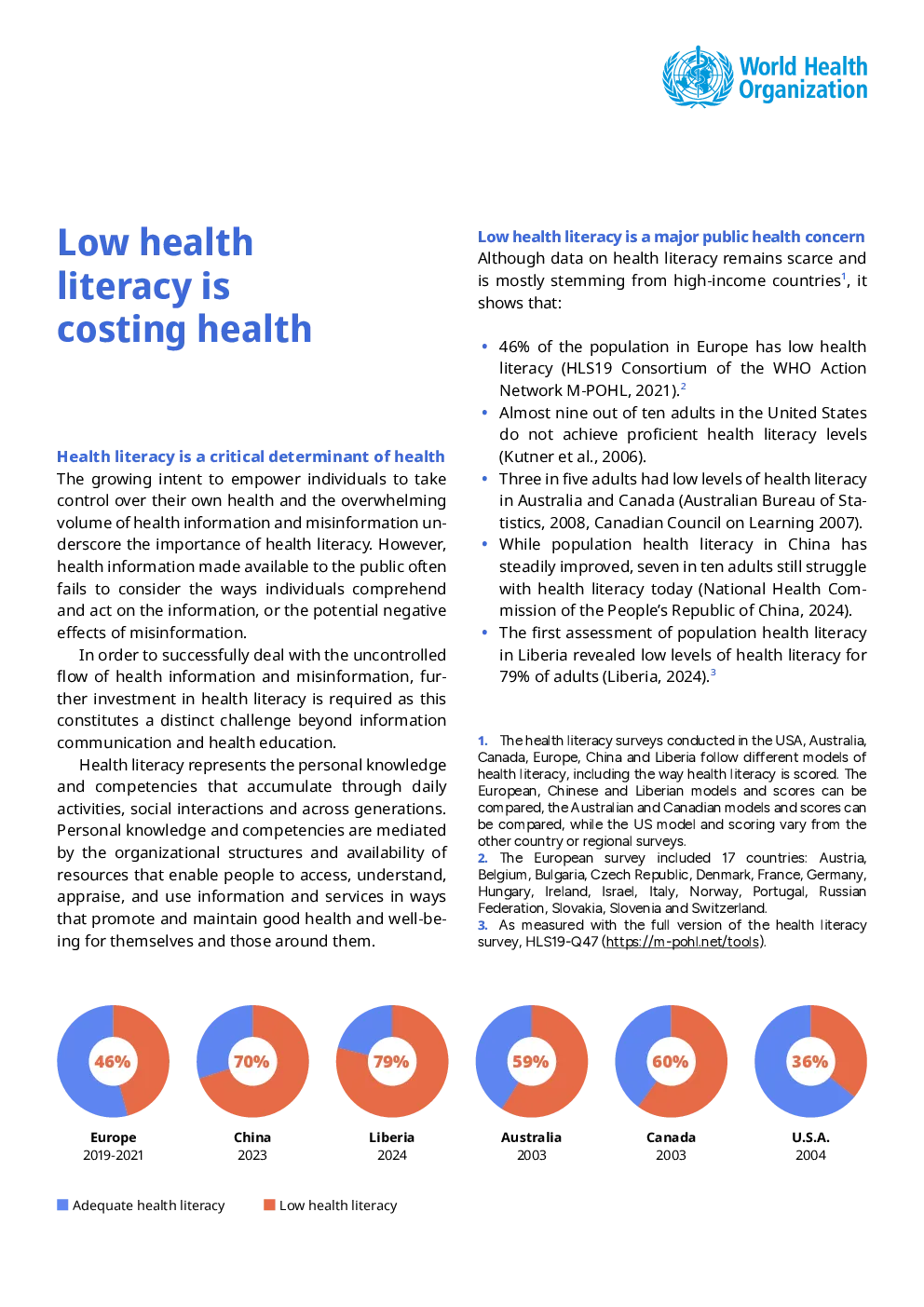
Low health literacy is a major public health concernAlthough data on health literacy remains scarce andis mostly stemming from high-income countries1, itshows that: •46% of the population in Europe has low healthliteracy (HLS19 Consortium of the WHO ActionNetwork M-POHL, 2021).2•Almost nine out of ten adults in the United Statesdonot achieve proficient health literacy levels(Kutner et al., 2006).•Three in five adults had low levels of health literacyin Australia and Canada (Australian Bureau of Sta-tistics, 2008, Canadian Council on Learning 2007).•While population health literacy in China hassteadily improved, seven in ten adults still strugglewith health literacy today (National Health Com-mission of the People’s Republic of China, 2024).•The first assessment of population health literacyin Liberia revealed low levels of health literacy for79% of adults (Liberia, 2024).3 Health literacy is a critical determinant of health The growing intent to empower individuals to takecontrol over their own health and the overwhelmingvolume of health information and misinformation un-derscore the importance of health literacy. However,health information made available to the public oftenfails to consider the ways individuals comprehendand act on the information, or the potential negativeeffects of misinformation. In order to successfully deal with the uncontrolledflow of health information and misinformation, fur-ther investment in health literacy is required as thisconstitutes a distinct challenge beyond informationcommunication and health education. 1.The health literacy surveys conducted in the USA, Australia,Canada, Europe, China and Liberia follow different models ofhealth literacy, including the way health literacy is scored. TheEuropean, Chinese and Liberian models and scores can becompared, the Australian and Canadian models and scores canbe compared, while the US model and scoring vary from theother country or regional surveys.TheEuropean survey included 17 countries:Austria, Health literacy represents the personal knowledgeandcompetencies that accumulate through dailyactivities, social interactions and across generations.Personal knowledge and competencies are mediatedby the organizational structures and availability ofresources that enable people to access, understand,appraise, and use information and services in waysthat promote and maintain good health and well-be-ing for themselves and those around them. 2.Belgium, Bulgaria, Czech Republic, Denmark, France, Germany,Hungary,Ireland,Israel,Italy,Norway,Portugal,RussianFederation, Slovakia, Slovenia and Switzerland.3.As measured with the full version of the health literacy survey, HLS19-Q47 (https://m-pohl.net/tools). Generally,high-income countries where data onhealth literacy is available recognize that health lit-eracy is important. However, the low levels of healthliteracy are a demonstration that current efforts areinadequate and unless improved, public health willremain suboptimal. administrationcosts(Accenture,2018).Due todeclining health system literacy, this has risen to$10 billion a year (Accenture, 2021). •Another estimate shows that $47 billion could besaved every year in terms of medical costs if un-necessary emergency room visits by people withlow health literacy decreased to the level of thosewith adequate health literacy (Accenture, 2021). •A 2007 study (Vernon et al.) estimated the cost oflow health literacy for the US economy as rangingbetween $106 billion and $236 billion annually. Addressing the rise of health care costs While it is difficult to make a direct association be-tween health literacy and health care cost, researchshows that low levels of health literacy add up toadditional costs. Global spending on health reachedUS$9.8 trillion in 2021, or 10.3% of global gross do-mestic product (GDP). While investment in accessibili-ty and quality of health care is non-negotiable, effortscan be made to reduce unnecessary spending andsupport people with low health literacy, which haveconsistently found to have: Public health and health literacy interventionscan bring high returns of investment While no comprehensive evidence exists around thereturn on investment of health literacy interventions,an economic analysis of a health literacy intervention“Better Beginnings, Better Futures” programme inOntario, Canada suggests promising benefits. Theeconomic analysis in this project revealed that for ev-ery $1 spent on health literacy in schools $2.30 couldbe saved. (McDaid, 2017). •higher rates of avoidable emergency room atten-dance, greater prescription expenditure•prolonged recovery periods from illness•increased illness complications (Betz et al., 2008;Berkman et al., 2011; Rasu et al., 2015). Investing in health literacy is expected to: •reduce frequent visits to care providers, shortenhospital stays, improve self-reported health statusand increase health knowledge (Speros 2005).•generate long-term economic benefits andimprove