AI智能总结
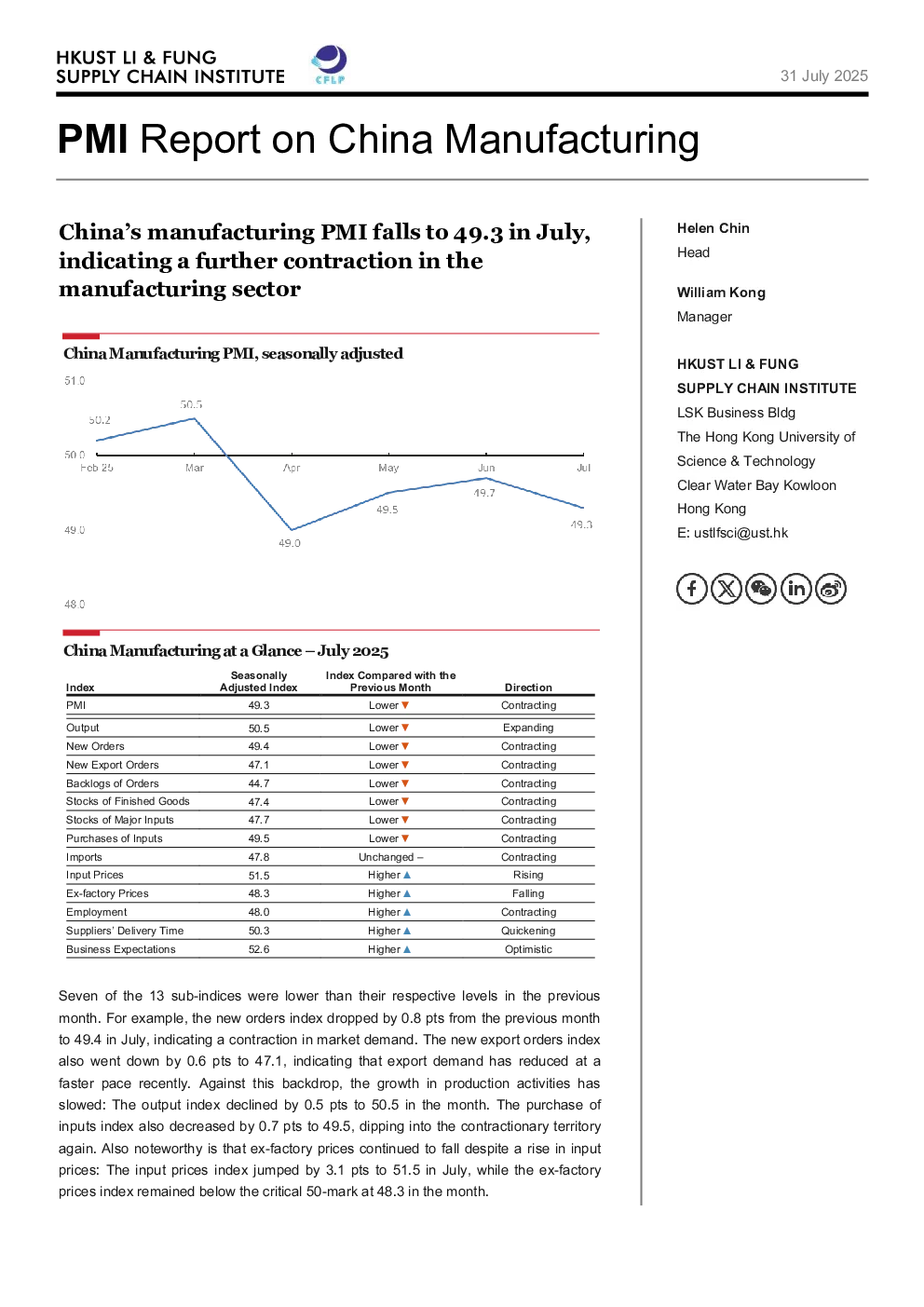
China’s manufacturing PMIfalls to 49.3inJuly, Helen ChinHead William KongManager HKUST LI & FUNGSUPPLY CHAIN INSTITUTELSK Business Bldg Sevenof the 13 sub-indices werelowerthan their respective levels inthe previousmonth.For example, the new orders index dropped by 0.8pts from the previous monthto 49.4in July, indicating acontraction in market demand.The new export orders indexalsowent downby0.6pts to 47.1, indicatingthat export demand hasreducedat afasterpace recently.Against this backdrop, the growth in production activities has By size of enterprises,the PMI of ‘large enterprises’wentdownto50.3 in July from51.2in June. The PMI of ‘medium enterprises’increasedto49.5 in July from48.6 in June. The output indexdeclinedto50.5 in July from51.0 in June.The outputindicesof ‘largeenterprises’and‘medium enterprises’stayedabove theneutral level of 50,registering52.1 and 50.8 respectivelyinJuly.Meanwhile, theoutputindexof‘small enterprises’ The new orders indexfellto49.4 in July from50.2 in June.The new ordersindicesof‘large enterprises’and‘medium enterprises’stayed intheexpansionaryzone,registering The new export ordersindexdroppedto47.1 in Julyfrom47.7 in June.The new exportordersindicesof‘largeenterprises’,‘medium enterprises’and‘small enterprises’all The backlogs of orders indexwent downto44.7 in July from45.2 in June.Thebacklogsof orders indicesof‘large enterprises’, ‘medium enterprises’and ‘small enterprises’all The stocks of finished goods indexdecreasedto47.4 in July from48.1 in June.Thestocks of finished goods indicesof‘largeenterprises’, ‘medium enterprises’ and ‘small The stocks of major inputs indexdeclinedto47.7 in July from48.0 in June. Themajorinputsindicesof‘largeenterprises’,‘medium enterprises’and‘smallenterprises’all The purchases of inputs indexfellto49.5 in July from50.2 in June.Thepurchases ofinputsindicesof‘large enterprises’and‘medium enterprises’stayed inthe expansionaryzone,registering50.9 and 51.1 respectivelyin July.Meanwhile, the purchases of inputs The imports indexstayed flat at47.8 in July, the same as in the previous month.Theimports indicesof‘large enterprises’and‘mediumenterprises’remainedbelow the The input prices indexroseto51.5 in July from48.4 in June. Theinput prices indicesof‘large enterprises’,‘medium enterprises’and‘small enterprises’allroseabovethecritical Theex-factory prices indexreboundedto48.3 in Julyfrom46.2 in June.1Theex-factoryprices indicesof‘largeenterprises’,‘mediumenterprises’and‘small enterprises’all The employment indexedged up to 48.0 in July from47.9 in June.Theemploymentindicesof‘largeenterprises’,‘medium enterprises’and ‘small enterprises’all stayedin The suppliers’ delivery time indexcame in at50.3 in July, up from50.2 in June.Areading above 50 implies faster delivery; below 50, slower delivery. The suppliers’delivery time indices of ‘large enterprises’, ‘medium enterprises’ and ‘small enterprises’ The business expectations indexclimbedto52.6 in July from52.0in June.2Thebusiness expectations indices of ‘large enterprises’,‘medium enterprises’and ‘small CFLP 中國物流與採購聯合會 China Federation of Logistics & Purchasing (CFLP) is the logistics and purchasing industryassociation approved by the State Council. CFLP’s mission is to push forward the developmentof the logistics industry and the procurement businesses of both government and enterprises, NBS 國家統計局 The National Bureau of Statistics (NBS), an agency directly under the State Council in China, isin charge of the country’s statistics. It is responsible for formulating statistical policies andestablishing the national statistical system, drafting and enforcing the statistical laws and China Manufacturing PMI 中國製造業採購經理指數 China Manufacturing Purchasing Managers’ Index (PMI) provides an early indication eachmonth of economic activities in theChinese manufacturing sector. It is jointly published by Every month questionnaires are sent to 3,000 manufacturing enterprises all over China. Thedata presented herein is compiled fromthe enterprises’ responses about their purchasingactivities and supply situations. CFLP makes no representation regarding the datacollection 3,000 manufacturing enterprises in 31 industries from Eastern, Northeastern, Central andWestern China are surveyed. Thesampling of the enterprises involves the use of ProbabilityProportional to Size Sampling (PPS), which means the selection ofenterprises surveyed is There are 13 sub-indicators in the survey: Output, New Orders, New Export Orders, Backlogs ofOrders, Stocks of Finished Goods,Purchases of Inputs, Imports, Input Prices, Stocks of MajorInputs, Ex-factory Prices, Employment, Suppliers’ Delivery Time andBusiness Expectations. An The PMI is a composite index based on the seasonally adjusted indices for five of the sub-indicators with varying weights: NewOrders—30%; Output—25%; Employment—20%;Suppliers’ Delivery Time—15%; and Stocks of Major Inputs—10%. A PMI readingabove 50 Currently there are more than twenty count