XT…以史蒂夫·乔布斯的方式创新
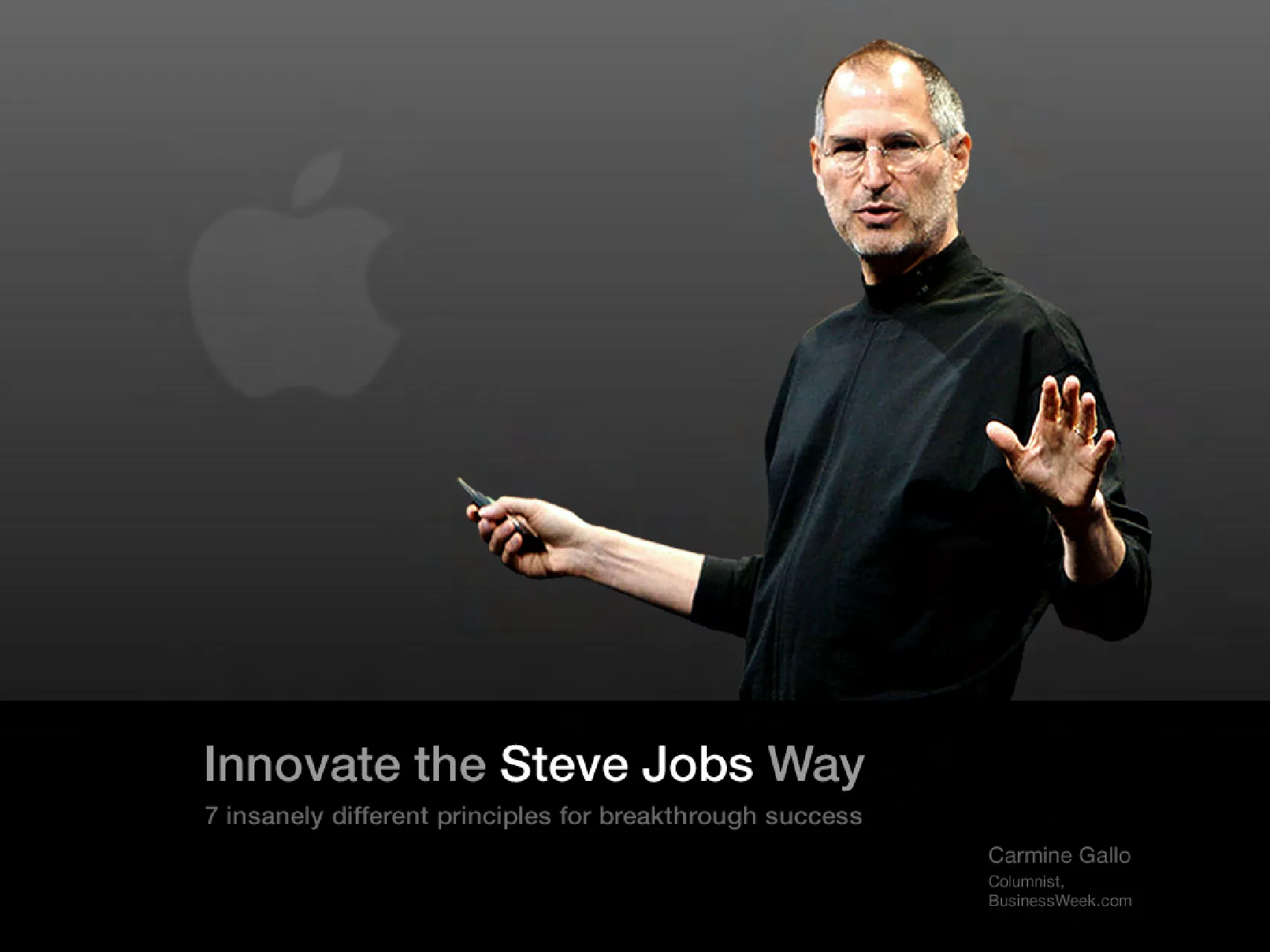
7 insanely different principles for breakthrough success C a r m in eG a lloColumnist,BusinessWeek.com Introduction There are very few people in the world today more closely associated with innovation than Apple co-founder, SteveJobs. He is the classic American entrepreneur — starting his company in the spare bedroom of his parents’ houseand pioneering the development of the first personal computer for everyday use. Jobs was fired from the companyhe had started but he returned in 1997 . It was 12 years later, and Apple was close to bankruptcy . Jobs not onlysaved the company but in the next 10 years reinvented not just one industry but four — computing, music,telecommunications and entertainment (let’s not forget he’s the CEO of a little company called Pixar). In 2010, Fortune magazine named Jobs the CEO of the Decade. Also, the famed New York Times columnist ThomasFriedman wrote a column in which he declared America needs more jobs — Steve Jobs. He meant that innovationand creativity must be nurtured and encouraged to help the United States and other countries emerge from theglobal recession. Everyone wants to learn more about Steve Jobs, yet very few journalists have identified the core principles thatdrive Jobs and his success. Until now, that is. My book The Innovation Secrets of Steve Jobs (McGraw-Hill, 2010)reveals the 7 principles that are largely responsible for his breakthrough success; principles that have guided Jobsthroughout his career and, more important, principles you can adopt today to “think different” and reinvent yourcompany, product or service. Principle One: Do what you love. In 2005, Steve Jobs told Stanford University’s graduating class that thesecret to success is having “the courage to follow your heart andintuition.” Inside, he suggested, you “already know what you truly wantto become.” Jobs has followed his heart his entire career, and thatpassion, he says, has made all the difference. It’s very difficult to comeup with new, creative ideas that move society forward if you are notpassionate about the subject. “I think you should go get a job as a busboy or something until you findsomething you’re really passionate about,” Jobs once said. “I’mconvinced that about half of what separates successful entrepreneursfrom the non successful ones is pure perseverance. . . Unless you havea lot of passion about this, you’re not going to survive. You’re going togive up.” How to do find your passion? Passions are those ideas that don’t leaveyou alone. They are the hopes, dreams and possibilities that consumeyour thoughts. Follow those passions despite skeptics and naysayers,who do not have the courage to follow their dreams. Principle Two: Put a dent in the universe. Steve Jobs attracts evangelists who share his vision and who help turn hisideas into world-changing innovations. He has never underestimated thepower of vision to move a brand forward. In 1976, Steve Wozniak wascaptivated by Jobs’ vision to “put a computer in the hands of everydaypeople.” Wozniak was the engineering genius behind the Apple I and theApple II, but it was Jobs’ vision that inspired Wozniak to focus his skills onbuilding a computer for the masses. Jobs’ vision was intoxicating becauseit had four components that all inspiring visions share: It was 1) bold, 2)specific, 3) concise, and 4) consistently communicated. In 1979, Jobs took a tour of the Xerox research facility in Palo Alto,California. There he saw a new technology that let users interact with thecomputer via colorful graphical icons on the screen instead of enteringcomplex line commands. It was called a “graphical user interface.” In thatmoment, Jobs knew that this technology would allow him to fulfill hisvision of putting a computer in the hands of everyday people. He wentback to Apple and refocused his team on building the computer that wouldeventually become the Macintosh and forever change the way we talkedto computers. Jobs later said that Xerox could have “dominated” thecomputer industry but instead its “vision” was limited to building anothercopier. Innovation — the kind with a big “I” that moves society forward — doesn’thappen without a bold vision. What vision do you have for your career oryour company? Yes, you need to follow your gut and do something you arepassionate about. But while passion fuels the rocket, vision points therocket to its ultimate destination. Principle Three: Kick start your brain. Creativity leads to innovative ideas. For Steve Jobs, creativity isconnecting things. He believes that a broad set of experiences expandsour understanding of the human experience. A broader understandingleads to breakthroughs that others may have missed. Breakthrough innovation requires creativity, and creativity requires thatyou think differently about…the way you think. Scientists who study theway the brain works have discovered that innovators like Jobs do thinkdifferently, but they use a technique available to all of us — they seek o