您的浏览器禁用了JavaScript(一种计算机语言,用以实现您与网页的交互),请解除该禁用,或者联系我们。[韩国央行]:国民总收入:2025年第三季度(初步) - 发现报告

国民总收入:2025年第三季度(初步)

2025-12-03-韩国央行福***
AI智能总结
查看更多
国民总收入:2025年第三季度(初步)

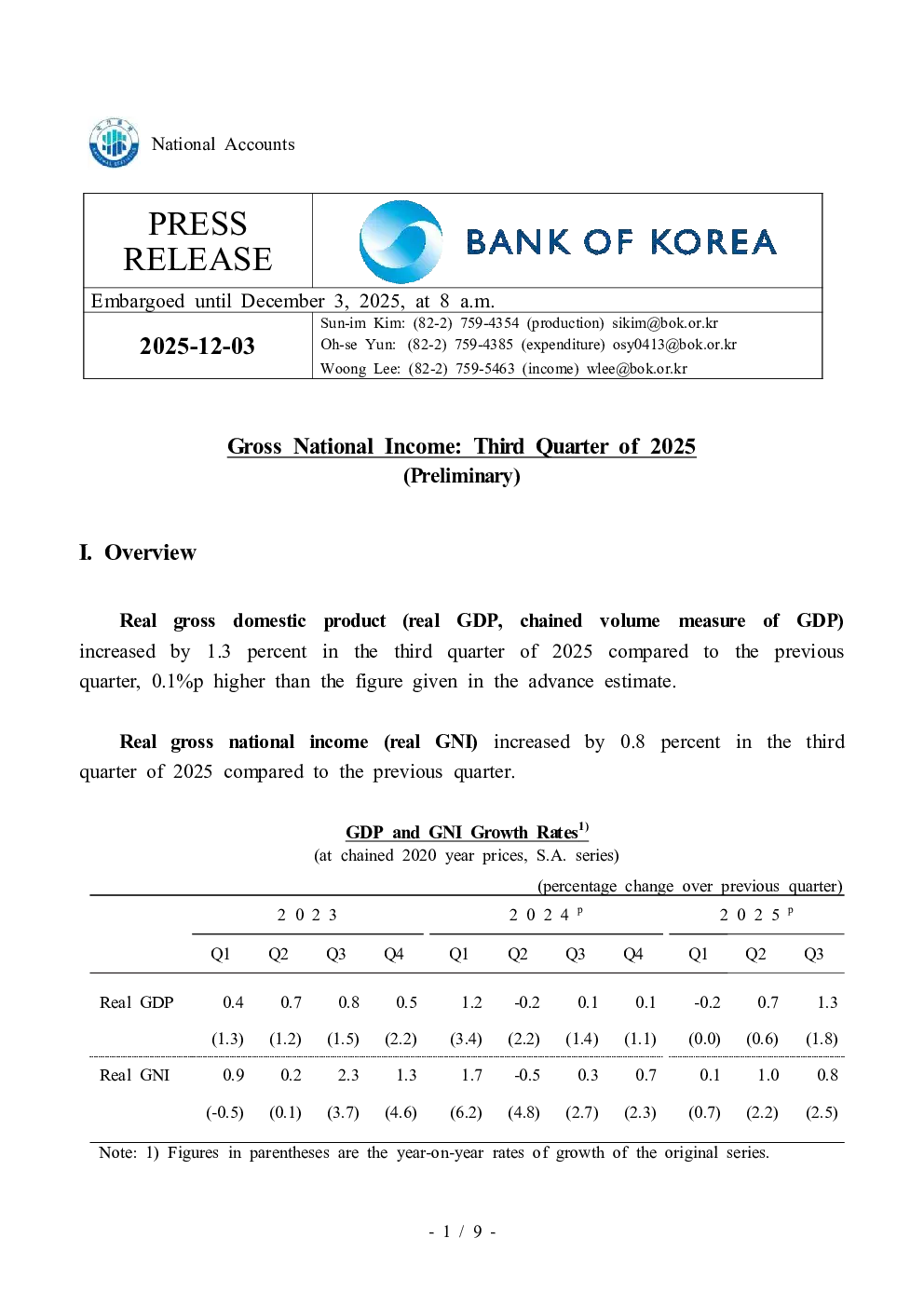
Ⅰ. Overview Realgross domestic product(real GDP,chained volume measure of GDP)increasedby 1.3 percent in the third quarter of 2025 compared to the previousquarter,0.1%p higher than the figure given in the advance estimate. Realgross national income(real GNI)increased by 0.8 percent in the thirdquarter of 2025 compared to the previous quarter. Ⅱ. Real Gross Domestic Product Quarter-on-quarter Onthe production side,manufacturing increased by 1.5 percent,mainly due toincreases in transportation equipment and computer, electronic & optical products. Construction increased by 0.7 percent, mainly due to civil engineering. Servicesincreased by 1.4 percent,led by increases in wholesale&retail trade,accommodation & food services, transportation & storage, and finance & insurance. Onthe expenditure side,private consumption increased by 1.3 percent,asexpenditureson goods(e.g.,motor vehicles,communication equipment)and services(e.g., restaurants, health services) both increased. Government consumption rose by 1.3 percent, mainly due to expenditures on goodsand health care benefits. Constructioninvestment grew by 0.6 percent,led by an increase in civilengineering. Facilitiesinvestment increased by 2.6 percent,mainly due to an increase inmachinery (e.g., semiconductor manufacturing equipment). Exports increased by 2.1 percent, as exports of semiconductors and motor vehiclesincreased.Imports were up by 2.0 percent,mainly due to increases in machinery&equipment and motor vehicles. Real GDPincreased by 1.8 percent year-on-year in the third quarter of 2025. Ⅲ. Nominal Gross Domestic Product and GDP Deflator Nominalgross domestic product (nominal GDP)increased by 0.7%in the thirdquarter of 2025 compared to the previous quarter. On the income side, compensation of employees increased by 1.0%, driven by theincrease in finance & insurance. Thegross operating surplus increased by 0.8%,mainly due to increases in thesemiconductor manufacturing and wholesale & retail trade sectors. TheGDP deflatorrose by 2.7% year-on-year. Ⅳ. Gross National Income and Gross Saving & Investment Ratios Nominal GNIdecreased by 0.3 percent in the third quarter of 2025 compared tothe previous quarter, lagging behind the increase in nominal GDP (0.7%), as nominalnet factor income from the rest of the world decreased. Real GNIincreased by 0.8% compared to the previous quarter, lagging behind thegrowth rate of real GDP (1.3%), as real trading losses expanded due to a deterioration inthe terms of trade and as real net factor income from the rest of the world decreased. Real personal grossdisposable income(real PGDI)increased by 3.1%comparedto the previous quarter. Thegross savings ratio(gross savings/gross national disposable income)stood at34.4%, 1.2%p lower than in the previous quarter. Thehousehold net saving ratiostood at 8.9%, 0.1%p higher than in the previousquarter. Thegross domestic investment ratio(gross capital formation/gross nationaldisposable income) was 28.6%, 0.2%p lower than in the previous quarter. ※ Further statistics may be found at Bank of Korea's Economic Statistics System website(https://ecos.bok.or.kr). National Income Statistics 1. Scope of Measurement Thenational income statistics estimate total economic activity in Korea(e.g.,theproduction and expenditures of all economic agents, including households, enterprises, and thegovernment). Production boundary: goods are counted as output even when they are not meant for sale(e.g., when they are for self-consumption), whereas in the case of services, non-paid domesticworkand personal services(e.g.,for self-consumption)are excluded from the productionboundary. Illegaleconomic activities,such as smuggling,gambling,and prostitution,are likewisecurrently not included in national income, even though they should be captured as productionactivities for a comprehensive measurement of production and expenditures. 2. Methods of Measurement Estimationunder the output approach(production-side national income)is carried out asfollows. Nominalvalue-added is derived by first estimating the values of output and intermediateinput and then subtracting the value of intermediate input from that of output. If the value ofthe intermediate input cannot be determined separately, it is calculated using the value-addedratioobtained from the Bank of Korea’s quarterly and annual financial statement analysisreports. Statisticsunder the expenditure approach(expenditure-side national income)are estimateddirectly using a variety of raw data on the amounts of money spent on final products. Statisticsunder the income approach(income-side national income)are estimated using avarietyof raw data on the distribution of nominal value-added generated by production.Operatingsurplus,in contrast,is calculated by subtracting compensation of employees andother components from the nominal value-added calculated under the production-side approach. Thethree sets of national income statistics,one esti