您的浏览器禁用了JavaScript(一种计算机语言,用以实现您与网页的交互),请解除该禁用,或者联系我们。[CEPR]:特朗普第二届政府的经济后果:初步评估 - 发现报告

特朗普第二届政府的经济后果:初步评估

金融2025-12-17CEPR~***
特朗普第二届政府的经济后果:初步评估

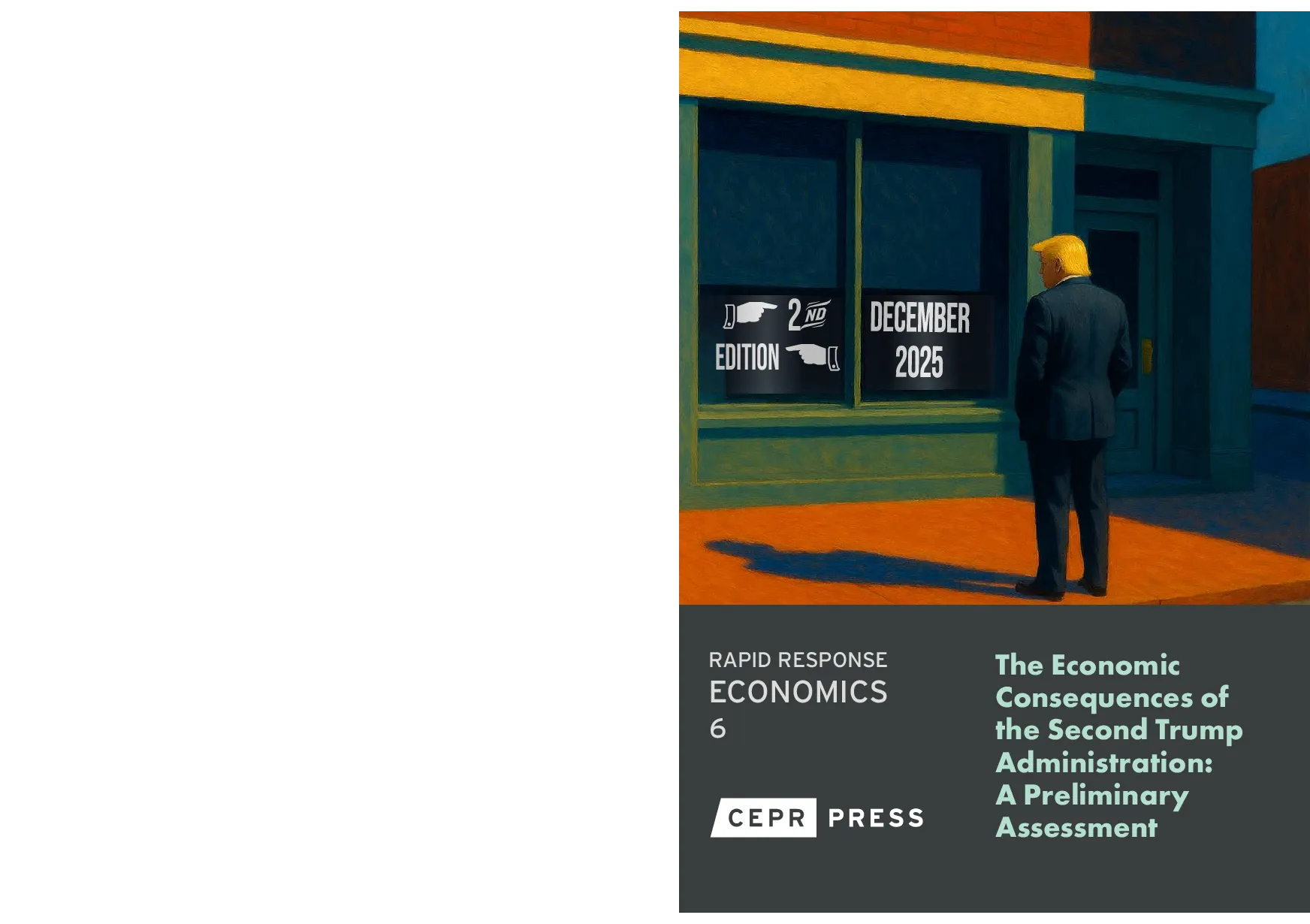
The EconomicConsequences ofthe Second TrumpAdministration:A PreliminaryAssessment The Economic Consequencesof the Second TrumpAdministration: A Preliminary Assessment 2nd Edition CEPR PRESS Centre for Economic Policy Research187 boulevard Saint-Germain75007, Paris, France 2 Coldbath SquareLondon EC1R 5HL, UK Tel: +44 (0)20 7183 8801Email: cepr@cepr.orgWeb: www.cepr.org ISBN: 978-1-912179-99-2 Copyright © CEPR Press The Economic Consequencesof the Second TrumpAdministration: A Preliminary Assessment 2nd Edition Edited by Gary Gensler, Simon Johnson,Ugo Panizza and Beatrice Weder di Mauro CENTRE FOR ECONOMIC POLICY RESEARCH (CEPR) The Centre for Economic Policy Research (CEPR) is a network of almost 1,900 researcheconomists based mostly in European universities. The Centre’s goal is twofold: to promoteworld-class research, and to get the policy-relevant results into the hands of key decision-makers. CEPR’s guiding principle is ’Research excellence with policy relevance’. It wasfounded in the UK in 1983, where it is a Charity, and in November 2019 CEPR initiated thecreation of an Association under French law, in order to provide a vehicle for an expansionin France. The members of the Conseil d’Administration of the Association are identicalto the UK Board of Trustees. CEPR is independent of all public and private interest groups. It takes no institutionalstand on economic policy matters and its core funding comes from its InstitutionalMembers, projects that it runs and sales of publications. Because it draws on such a largenetwork of researchers, its output reflects a broad spectrum of individual viewpoints aswell as perspectives drawn from civil society. CEPR research may include views on policy,but the Trustees/members of the Conseil d’Administration of the Association do not giveprior review to its publications. The opinions expressed in this report are those of theauthors and not those of CEPR. Sir Charlie BeanRichard PortesBeatrice Weder di MauroMaristella BotticiniAntonio FatásUgo PanizzaHélène ReyTessa Ogden Chair of the BoardFounder and Honorary PresidentPresidentVice Presidents Chief Executive Officer Contents Foreword 1 The economic consequences of the second Trump administration:Key assessments1Gary Gensler, Simon Johnson, Ugo Panizza, and Beatrice Weder di Mauro Part I: Economic transformation in the United States 2 The rule of law33John Coates 3 Presidential supremacy over administrative agencies53Gary Gensler and Lev Menand 4 Immigration and border policies71Anna Maria Mayda and Giovanni Peri 5 The economic effects of rapid federal downsizing99Josh Bivens 6 Will the United States continue to lead in science?*117David Baker and Simon Johnson 7 Artificial intelligence development and policy landscapeGary Gensler 129 8 The (non) effect of tariffs on manufacturing employment*145Michael R. Strain 9 Fiscal policy and debt sustainability159Antonio Fatás and Ugo Panizza 10 The financial sector and global dollar system177Gary Gensler, Lev Menand and Joshua Younger 11 The Federal Reserve, the new administration, and the outlook for theeconomy and monetary policyWilliam B. English 195 12 Dollar dominance and the Trump administration205Steven B. Kamin 13 Consumer financial protection219Neale Mahoney *Indicates chapter is unaltered from the first edition of this volume. 14 Cryptocurrency under the Trump administration227Richard Portes15 Competition policy237Jonathan B. Baker16 Health care*249Jonathan Gruber17 Downsizing the National Oceanic and Atmospheric Administration*257Valerie J. Karplus and Costa Samaras18 Changes in federal climate policy263John E.T. Bistline19 Rural economies and communities*279Mary K. Hendrickson and David J. Peters20 Measuring by executive order291Alberto Cavallo and Roberto RigobonPart II: Reshaping the international economic system21 The global public good301Barry Eichengreen22 From MFN to “reciprocal tariffs”*309Kevin Hjortshøj O’Rourke23 Trumpian tariffs: What, why, what next?315Richard Baldwin24 The aftermath of tariffs323Kimberly A. Clausing25 Second estimations of the effects of reciprocal tariffs335Antoine Bouët, Balthazar de Vaulchier, Houssein Guimbard, Cristina Mitaritonnaand Yu Zheng26 Who pays for US tariffs?349Marcelo Olarreaga and Sara Santander27 Seven questions about tariffs that everyone should know the answers to363Arnaud Costinot and Andrés Rodríguez-Clare28 National security tariffs on the auto industry373Keith Head, Thierry Mayer, Vincent Vicard and Pauline WibauxPart III: Spillovers to advanced economies29 Strategic autonomy for Europe requires economic growth393Luis Garicano 403 30 Trade wars and European monetary policyPaul Bergin and Giancarlo Corsetti 31 Rethinking the governance and funding of European rearmament425Armin Steinbach,Guntram Wolff, and Jeromin Zettelmeyer 32 Economic principles for European rearmament441Alain Quinet, Xavier Jaravel, Moritz Schularick and Jeromin Zettelmeyer 33 The economics of the