冰川到农场:区域项目总结(英)
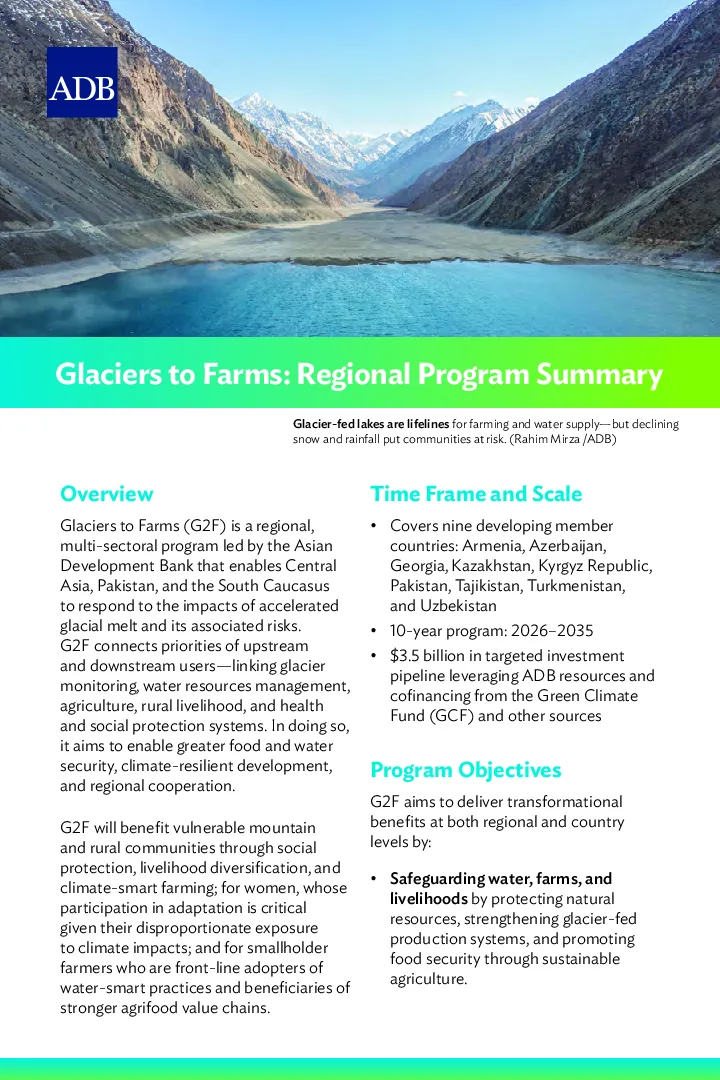
Glacier-fed lakes are lifelinesfor farming and water supply—but decliningsnow and rainfall put communities at risk. (Rahim Mirza /ADB) Time Frame and Scale Overview Glaciers to Farms (G2F) is a regional,multi-sectoral program led by the AsianDevelopment Bank that enables CentralAsia, Pakistan, and the South Caucasusto respond to the impacts of acceleratedglacial melt and its associated risks.G2F connects priorities of upstreamand downstream users—linking glacier •Covers nine developing membercountries: Armenia, Azerbaijan,Georgia, Kazakhstan, Kyrgyz Republic,Pakistan, Tajikistan, Turkmenistan,and Uzbekistan•10-year program: 2026–2035 Program Objectives G2F aims to deliver transformationalbenefits at both regional and country G2F will benefit vulnerable mountainand rural communities through socialprotection, livelihood diversification, andclimate-smart farming; for women, whoseparticipation in adaptation is criticalgiven their disproportionate exposureto climate impacts; and for smallholder •Safeguarding water, farms, andlivelihoodsby protecting naturalresources, strengthening glacier-fed •Building climate resilienceacross water, agriculture, energy,and social sectors, with targetedsupport for vulnerable mountain •Working togetherby deepeningregional cooperation andtransboundary water governance and Partners •Planning for the futureby helpinggovernments and local institutions •National governments•Regional organizations•International development financeinstitutions •Scaling proven solutionsbymobilizing funding and partnershipsto expand climate-smart technologiesand infrastructures, nature-basedsolutions, and agrifood value chain Glaciers to Farms River Basins The G2F Program will be implemented in four glacier-dependent river basins, wherehigh-mountain river systems are vital for agriculture, energy, and livelihoods. •Kura–Aras Basin—spanning Armenia, Azerbaijan, and Georgia, this is the primarywater source for Azerbaijan and critical for irrigation, hydropower, and urban watersupply; with 75% glacier loss in Azerbaijan since 2000, rising temperatures threaten •Naryn Basin—a major tributary of the Syr Darya and critical for irrigation, energy,and rural livelihoods throughout Central Asia; glacier loss of 17%–23% since •Pyanj Basin—the principal headwater of the Amu Darya, forming part of the borderbetween Afghanistan and Tajikistan, with around 4,650 square kilometers of glaciercover; glacial retreat and widespread permafrost degradation substantially increased •Swat Basin—in northern Pakistan, this monsoon-snowmelt basin sustainsagriculture, hydropower, and rural livelihoods in Punjab and Sindh; with 512 glaciers,temperature increases of over 5ºC by 2085, and reduced winter precipitation andmonsoon increases, climate change is driving higher flood risks, GLOFs, and water Efficient food supply chains.Modern logistics andadaptive agriculture help rural economies withstandclimate pressures on glacier-fed natural resources. Resilient agro-food systemsconnect climate smartfarming with storage and transport, reducing losses, andstrengthening markets. G2F builds resilience where it is mostneeded: in glacier-dependent landscapes.It protects natural capital—especiallywater resources—by linking upstreammonitoring with downstream adaptation.It also strengthens agrifood value chains, Why G2F Matters Glacier-fed river systems are lifelines forhydropower, irrigation, drinking water,and food systems. But accelerated glacialmelt is reshaping Central and West Asia’swater cycle, putting 380 million peopleat risk of unreliable natural resources thatare essential to their health, livelihoods,and safety. Global science underscoresurgency. The IntergovernmentalPanel on Climate Change warns thatglaciers and snow cover are shrinkingworldwide and will continue to declinethis century, reducing water supplies forfarming, hydropower, and households Program Structure G2F operates through ADB’s existingcountry programming and projectpreparation processes to identify andsupport country-driven subprojects These investments will form part of theADB pipeline over the program period.The program is built on four closelylinked components, each reinforcing theothers to deliver a coherent, impactful,and scalable response to climate change •Component 2: Investment Solutions.Puts the insights from Component 1into practices through climate-resilientinfrastructure, watershed restoration, •Component 1: Science-basedPlanning and Programming. Generates glacier and climate data,early warning information, andpolicy planning tools. These provide Water under pressure.Climate-smart irrigation and storage are essential as glacier melt accelerates and seasonalflows shift and become more unpredictable. More Information Watch:ADB. 2024.Glaciers to Farms: Working Together for Food Security inCentral and West Asia. Video:https://tinyurl.com/2dmxsja4 Read:ADB Launches Major Initiative to Build Resilience to Melting Glaciers.News