2026年亚洲宏观展望:投资者观点
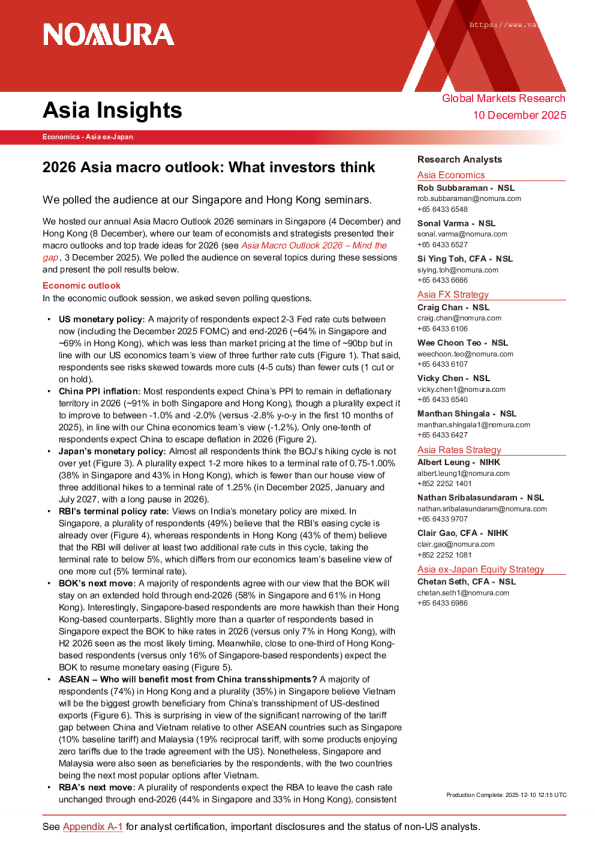
Global Markets Research Asia Insights 10 December 2025 Economics - Asia ex-Japan Research Analysts 2026 Asia macro outlook: What investors think Asia Economics Rob Subbaraman - NSLrob.subbaraman@nomura.com+65 6433 6548 We polled the audience at our Singapore and Hong Kong seminars. We hosted our annual Asia Macro Outlook 2026 seminars in Singapore (4 December) andHong Kong (8 December), where our team of economists and strategists presented theirmacro outlooks and top trade ideas for 2026 (seeAsia Macro Outlook 2026 – Mind thegap, 3 December 2025). We polled the audience on several topics during these sessions Sonal Varma - NSLsonal.varma@nomura.com+65 6433 6527 Si Ying Toh, CFA - NSLsiying.toh@nomura.com+65 6433 6666 Economic outlookIn the economic outlook session, we asked seven polling questions. Asia FX Strategy Craig Chan - NSLcraig.chan@nomura.com+65 6433 6106 US monetary policy:A majority of respondents expect 2-3 Fed rate cuts betweennow (including the December 2025 FOMC) and end-2026 (~64% in Singapore and~69% in Hong Kong), which was less than market pricing at the time of ~90bp but inline with our US economics team’s view of three further rate cuts (Figure 1). That said, Wee Choon Teo - NSLweechoon.teo@nomura.com+65 6433 6107 Vicky Chen - NSLvicky.chen1@nomura.com+65 6433 6540 China PPI inflation:Most respondents expect China’s PPI to remain in deflationaryterritory in 2026 (~91% in both Singapore and Hong Kong), though a plurality expect itto improve to between -1.0% and -2.0% (versus -2.8% y-o-y in the first 10 months of2025), in line with our China economics team’s view (-1.2%). Only one-tenth of Manthan Shingala - NSLmanthan.shingala1@nomura.com+65 6433 6427 Japan’s monetary policy:Almost all respondents think the BOJ’s hiking cycle is notover yet (Figure 3). A plurality expect 1-2 more hikes to a terminal rate of 0.75-1.00%(38% in Singapore and 43% in Hong Kong), which is fewer than our house view ofthree additional hikes to a terminal rate of 1.25% (in December 2025, January and Asia Rates Strategy Albert Leung - NIHKalbert.leung1@nomura.com+852 2252 1401 Nathan Sribalasundaram - NSLnathan.sribalasundaram@nomura.com+65 6433 9707 RBI’s terminal policy rate:Views on India’s monetary policy are mixed. InSingapore, a plurality of respondents (49%) believe that the RBI’s easing cycle isalready over (Figure 4), whereas respondents in Hong Kong (43% of them) believethat the RBI will deliver at least two additional rate cuts in this cycle, taking the Clair Gao, CFA - NIHKclair.gao@nomura.com+852 2252 1081 Asia ex-Japan Equity Strategy BOK’s next move:A majority of respondents agree with our view that the BOK willstay on an extended hold through end-2026 (58% in Singapore and 61% in HongKong). Interestingly, Singapore-based respondents are more hawkish than their HongKong-based counterparts. Slightly more than a quarter of respondents based inSingapore expect the BOK to hike rates in 2026 (versus only 7% in Hong Kong), with Chetan Seth, CFA - NSLchetan.seth1@nomura.com+65 6433 6986 ASEAN – Who will benefit most from China transshipments?A majority ofrespondents (74%) in Hong Kong and a plurality (35%) in Singapore believe Vietnamwill be the biggest growth beneficiary from China’s transshipment of US-destinedexports (Figure 6). This is surprising in view of the significant narrowing of the tariffgap between China and Vietnam relative to other ASEAN countries such as Singapore RBA’s next move:A plurality of respondents expect the RBA to leave the cash rateunchanged through end-2026 (44% in Singapore and 33% in Hong Kong), consistent Production Complete: 2025-12-10 12:15 UTC with our house view. Our Singapore-based respondents see risks being skewedtowards rate hikes, whereas their Hong Kong counterparts see risks as being largelybalanced. Among those that expect a rate hike in 2026, most think it will happen in H2 Source: Nomura. Source: Nomura. Source: Nomura. Source: Nomura. Source: Nomura. Source: Nomura. Source: Nomura. Market strategy In the FX, rates, equity and credit strategy sessions, we asked our audience fourquestions. In FX,a majority (57%) of all our Singapore and Hong Kong-basedrespondents expected DXY to be lower in the next six months. Interestingly, weobserved a difference between the Hong Kong and Singapore-based respondents thatsuggested that market conviction on the broad USD direction may still be somewhatdivided. In Asia rates,the respondents appeared to view Singapore and Korea rates the next six months, with46% expecting DXY to be “lower by 2-5%”and11%expecting DXY to be more than 5% lower. Interestingly, we observed a dichotomy,witha majority of the Hong Kong-based respondents (65%) voting for DXY to be“lower by 2-5%”compared with a majority of theSingapore-based respondents Rates:Our question was about which 5y Asia swaps will rise the most in Q1 2026.For the Singapore-based respondents, Singapore swaps were by far the mostpopular ch