您的浏览器禁用了JavaScript(一种计算机语言,用以实现您与网页的交互),请解除该禁用,或者联系我们。[韩国央行]:韩国经济展望(2025年11月) - 发现报告

韩国经济展望(2025年11月)

2025-11-27-韩国央行D***
AI智能总结
查看更多
韩国经济展望(2025年11月)

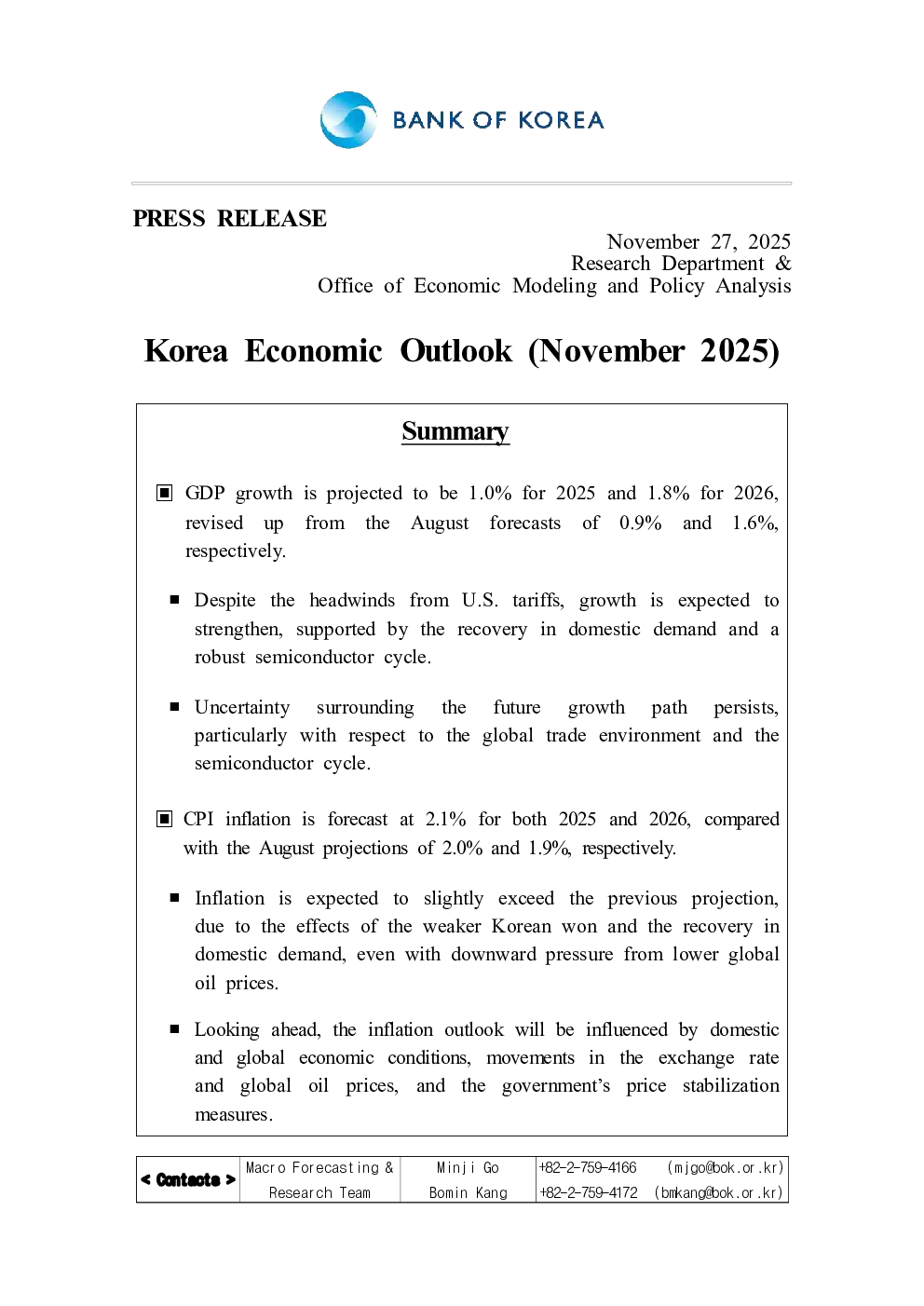
November 27, 2025Research Department &Office of Economic Modeling and Policy Analysis Korea Economic Outlook (November 2025) Summary ▣GDP growth is projected to be 1.0% for 2025 and 1.8% for 2026,revisedup from the August forecasts of 0.9%and 1.6%,respectively. ■Despite the headwinds from U.S.tariffs,growth is expected tostrengthen,supported by the recovery in domestic demand and arobust semiconductor cycle. ■Uncertaintysurroundingthefuturegrowthpathpersists,particularlywith respect to the global trade environment and thesemiconductor cycle. ▣CPIinflation is forecast at 2.1% for both 2025 and 2026,comparedwith the August projections of 2.0% and 1.9%, respectively. ■Inflation is expected to slightly exceed the previous projection,due to the effects of the weaker Korean won and the recovery indomestic demand, even with downward pressure from lower globaloil prices. ■Looking ahead, the inflation outlook will be influenced by domesticandglobal economic conditions,movements in the exchange rateandglobal oil prices,and the government’s price stabilizationmeasures. Korea Economic Outlook Indigo Book November 2025 Ⅰ.Ⅰ.Ⅰ.EconomicEconomicEconomicConditionsConditionsConditions.............................................111 Ⅱ.Ⅱ.Ⅱ.Economic OutlookEconomic OutlookEconomic Outlook.................................................444 Ⅲ. Risks to the OutlookⅢ. Risks to the OutlookⅢ. Risks to the Outlook..........................................777 Appendix 1. Forecast SummaryAppendix 2. Quarterly Forecasts for the One-Year-Ahead Horizon ▸Korea's economy is expected to grow by 1.0% in 2025 and 1.8% in 2026,bothhigher than the previous forecast.Despite the headwinds from U.S.tariffs, the recovery in domestic demand and a robust semiconductor cyclesince the second half of this year will likely support overall growth. ▸CPI inflation is forecast at 2.1% in both 2025 and 2026, as the downwardpressure from lower global oil prices is more than offset by the effects ofthe weaker Korean won and an easing of subdued domestic demand. Ⅰ. Economic ConditionsⅠ. Economic ConditionsⅠ. Economic Conditions Ⅰ-Ⅰ-Ⅰ-1. Global Developments1. Global Developments1. Global Developments ▢The global economy is forecast to grow better than expected,supported byexpansionary policy stances in major countries and robust global AI investment,whiletrade uncertainties have eased somewhat following progress in tradeagreements between the U.S. and major economies. §The United States economy is expected to grow at around 2%, bolstered by expansionarymonetary and fiscal policies and increased investment mainly in AI infrastructure, despite theslowdown in employment.The euro area is likely to continue its gradual improvement ingrowth,supported by eased financial conditions and fiscal expansion,including increaseddefensespending.Although China’s growth is expected to be stronger than anticipated asU.S.-China trade tensions ease, its underlying momentum is likely to weaken gradually due tothe subdued recovery in domestic demand. §Despite trade diversification efforts by major economies, growth in global trade is expectedto slow, given the normalization of pre-tariff front-loading and the persistent effects of thetariffincreases.Intheglobalsemiconductorindustry,strongdemandforbothhigh-performanceand general-purpose chips is likely to continue on the back of robustAI-related investment. The possibility of U.S. tariffs on IT devices and semiconductors, as wellas concerns over potential overinvestment in AI, still represent risk factors. §Global oil prices(Brent crude) are projected to decline for some time amid increased supplyfrom major oil-producing countries and to rise moderately starting in the second half of nextyear as global oil demand picks up. Ⅰ-Ⅰ-Ⅰ-2. Domestic Economic Conditions2. Domestic Economic Conditions2. Domestic Economic Conditions ▢Domestic economic conditions are expected to remain favorable,supported bystrongeconomic sentiment and fiscal expansion.However,housing prices andvolatility in financial markets remain key risk factors. * Composite Consumer Sentiment Index: Jan.-Apr. 2025 avg.: 93.4→May: 101.8→Aug.: 111.4→Nov.: 112.4 §Nominal wage growth is expected to remain subdued for the time being, before graduallyrecovering from next year as service-sector conditions improve. §Corporate bond rates have increased amid heightened concerns over financial stability andexpectationsof better economic conditions.The Won to U.S.dollar exchange rate hasremainedunder upward pressure reflecting the expansion of resident overseas investment.Housingprices in the Seoul metropolitan area picked up again but have since moderatedfollowing the government‘s stabilization measures announced on October 15. Assumptions on the U.S. Tariff Policy ▢It is assumed that U.S. tariff policy will maintain its current schedule, including, for Korea, a15% reciprocal tariff, a 15% tariff on automobiles, and a 50% tariff on steel*. *Reflecting developm