废水和环境监测:一系列呼吸道病毒的总结
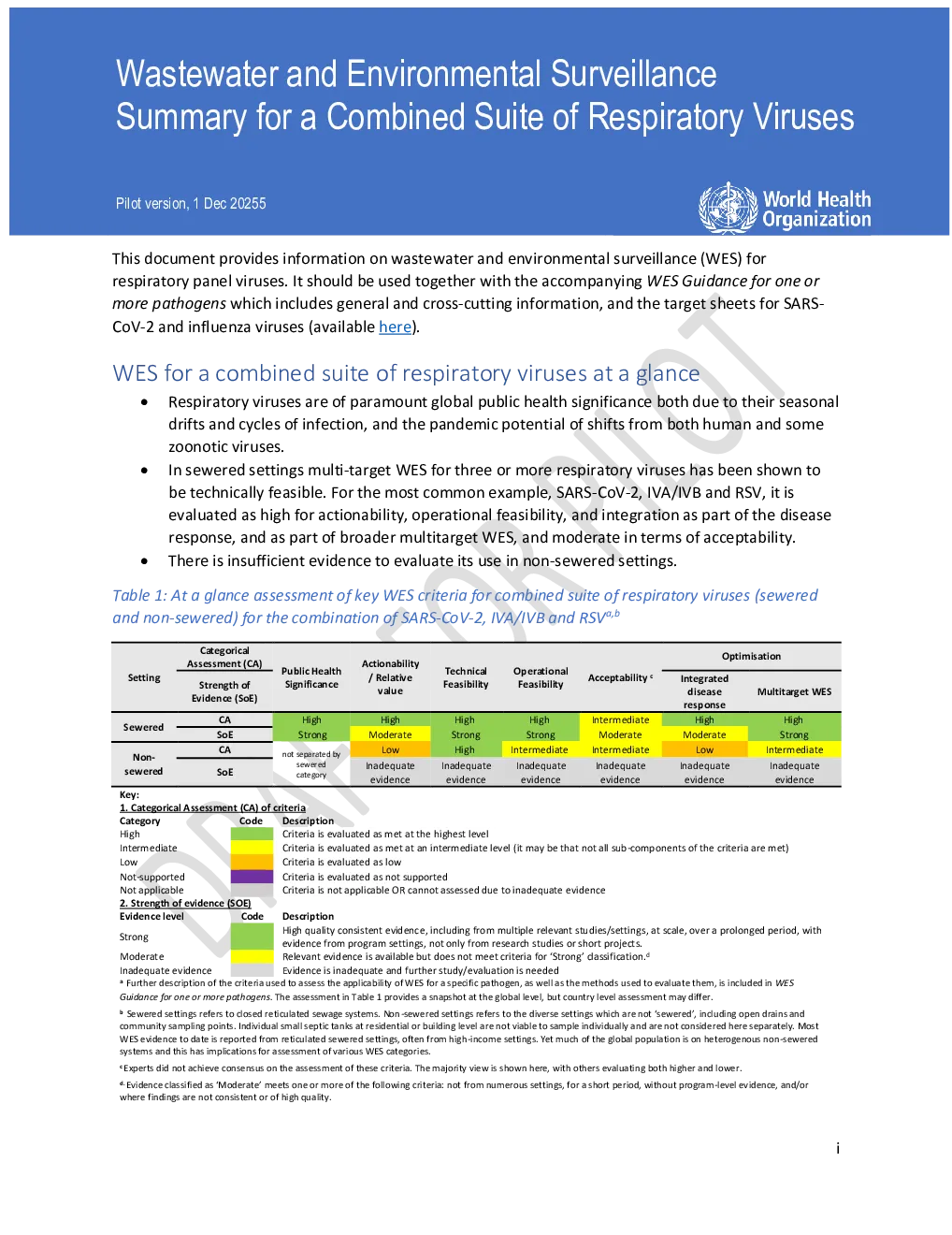
Pilotversion,1 Dec 20255 This document provides information on wastewater and environmental surveillance (WES) forrespiratory panel viruses.It should be used together with the accompanyingWES Guidance for one or WES foracombined suite ofrespiratory virusesat a glance •Respiratory viruses are of paramount global public health significance both due to their seasonaldrifts andcyclesof infection,and the pandemic potential ofshifts fromboth human and some •In sewered settingsmulti-targetWESfor three or more respiratory viruseshas been shown tobe technically feasible. For the most common example, SARS-CoV-2, IVA/IVB and RSV,itisevaluated ashighforactionability, operational feasibility,andintegration as part of thediseaseresponse,and as part ofbroadermultitarget WES,and moderate in terms of acceptability. Wastewater andenvironmentalsurveillance:Summary foracombined suite of respiratory viruses Summary Key features of WES formultiple respiratoryviruses •Respiratory viruses areahighlysignificantongoingglobal public health threat withverysignificant global pandemic potential.The viruses have the potential to rapidly evolve andspread globally, within periods of weeks.Seasonal drifts in these pathogens allows them toevade prior immunity, whether natural or vaccine-derived, with new viruses circulating annuallyand, in some cases, seasonally (e.g. outside of tropical areas).•Allare predominantly human-to-humanrespiratorypathogens, but sometypesofinfluenzaandcoronaviruses can be transmitted to humans from animals, leading to new pandemics.Some ofthese pathogens can spillover from wild and domestic animals that can cause human infectionsand, in some cases, zoonotic and human pandemics. •Thepathogens aretypicallyvaccine-preventable,butmostvaccinesaretargeted tohigh-riskgroups, or during outbreaks. Immunity once acquired islimited, often to one season,due toviralmutations, with vaccines needing to be modified seasonally in many cases. •Global, regional and national agencies have disease monitoring and management programs,based on clinical testing and notification, which WES could support. WES forrespiratory viruses •Thereis good experience testing sewage forWESfor multiple respiratory viruses, but nottestingenvironmental waters.Most experience builds on thatfromSARS-CoV-2 as a target. •Some high-income countries have integrated the monitoring of multiple respiratory viruses insewered settings. Thisprovidesevidenceof operational feasibilityto use WES to measure •Studies show varying correlations between WES and clinical results, with WES signals typicallyleading clinical signalsofannual orseasonal diseasesby 1to3 weeks, and lagging by several •Whilstno standard methods having emerged,somestandardizedmethods have beendeveloped, including both open source and commercial kits, for SARS-CoV-2, IAV/IBV and RSV. •Most studies collect samples from raw or primary liquid wastewater, and some collect samplesof solids, from wastewater treatment plants. Environmental waters in non-sewered areas are •There aresomeexamples of WES beingutilizedto inform public health actions. No universaltriggers for public health action have been developed, but studies suggestways forestablishinga baseline,andthenalocalthreshold for public health action. •Routinemultiple respiratory virusWEScan be incorporatedinto existing WES programs sinceadditionalviruses can be readily monitored at low marginal cost simply by testing theviral •Key questions to test with future research are: oIn addition to what has emerged as the core suite (SARS-CoV-2, IAV/IBV and RSV), what arethe next tier prioritiesamongthe many respiratory virusesthat could be targeted?oWhat are the preferred sampling, analysis and bioinformatics workflows and how sensitiveand specific are they?oWhat are the demonstrated health-impactful use cases to respond to WES evidence? oTo what extent do animalinputshamper interpretation ofIAVWES? Contents WES for a combined suite of respiratory viruses at a glance.....................................................................iSummary.................................................................................................................................................ii1General information........................................................................................................................11.1The viruses, associated diseases, and risk factors....................................................................11.2Global burden and geographic distribution.............................................................................11.3Routes of transmission...........................................................................................................2 2.1Potential inputs to wastewater and environmental waters.....................................................32.2Target persistence, degradation and risk of infectious virus....................................................3 3Respiratory viru