AI智能总结
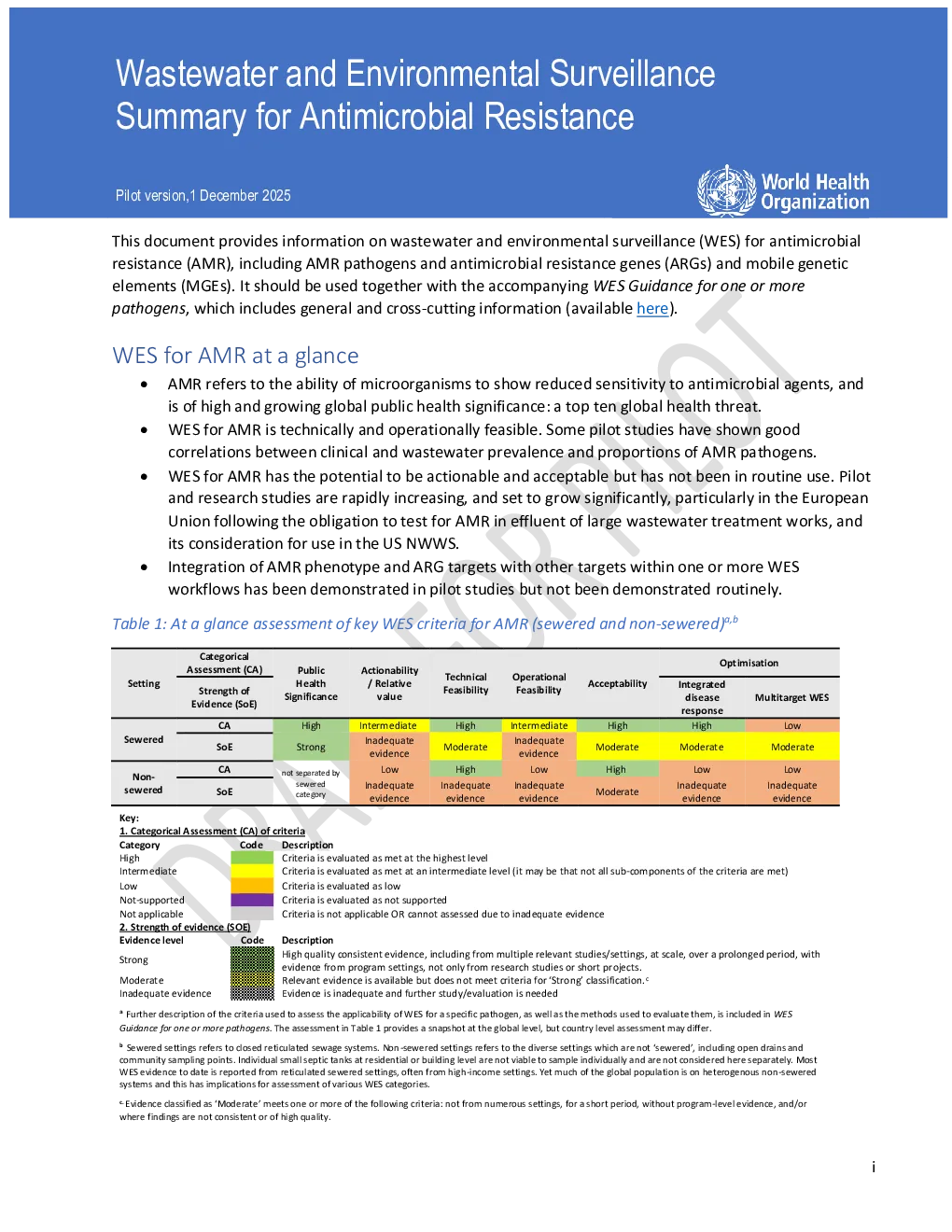
Pilotversion,1 December2025 This document provides information on wastewater and environmental surveillance (WES) forantimicrobialresistance(AMR), including AMR pathogens and antimicrobial resistance genes (ARGs) and mobile geneticelements (MGEs).It should be used together with the accompanyingWES Guidance for one or more WES forAMRat a glance •AMRrefers to the ability of microorganisms toshowreduced sensitivity to antimicrobial agents, andisof highand growingglobal public health significance: atop ten global health threat.•WES forAMRistechnically and operationally feasible.Some pilot studies have shown goodcorrelationsbetween clinicalandwastewater prevalence and proportions ofAMRpathogens.•WES forAMRhas the potential to beactionableand acceptablebut has not been in routine use.Pilot Sewered settings refers to closed reticulated sewage systems. Non-sewered settings refers to the diverse settings which are not ‘sewered’, including open drains andcommunity sampling points. Individual small septic tanks at residential or building levelare not viable to sample individually and are not considered here separately. MostWES evidence to date is reported from reticulated sewered settings, often from high-income settings. Yet much of the global population is on heterogenous non-seweredsystems and this has implications for assessment of various WES categories. Summary Key features of WES for this target suite •AMR is a globally significant property ofcirculatingmicroorganisms(primarily bacteria, but also fungi,parasites, and viruses)whereby those microorganisms become less sensitive to one or moreantimicrobials, makingpathogenic microorganismsharder to treat. •AMR pathogens and ARG arewidely dispersed,andmoresoin settings that use more antimicrobials(e.g.medicineandagriculture). •Whilst AMR is notdirectlyvaccine-preventable,vaccinesmay be effective against someAMRpathogens,and can begiven to at-risk groups and in response to outbreaksifwarranted. •Global, regional and national agencieshave monitoring and management programs, based on clinicaltestingwhich WES couldsupport. •WES for AMR should be undertaken in the context ofbroaderAMR surveillance to support thoseexisting efforts, and within the One Health context due to animaland environmentalreservoirs. •There are decades of experience with sampling and testing of wastewater,andto a lesser extentenvironmental waters,for AMR pathogens and ARGs. •Most studies are pilot or‘proof of concept’, with no standard methodshaving emerged. •Manystudiesshowedgood correlations between wastewater and clinical results, particularly inhospital wastewater. Others have poorer correlations, possibly due to confounding factors, such asanimal inputs, infectionsin humans that are not diagnosed, or microbial ecological drivers of AMR.Environmental waters in non-sewered areas are poorly studied. •Resultsare not currently being utilised to inform public health actions, withroutine WES AMRprograms not established, andtriggers for action not having been developed. •Mostof the ‘proof of concept’ studies arerelated to just asmall number ofAMR pathogens andARGs, albeit these include most of the highest priority pathogen-antimicrobial combinations. •There are noexamples ofroutineWESwithhealth-impactfulactionsin multiple independent settingsto support aprogramor providea supporting benefit-cost analysis.•The target sheetdoesnotpresentroutine WES or standard methods, use cases, or approaches.Rather, itsets outprioritizationprocesses to determine the pathogen-antimicrobial combinations totarget, pilot studies to help prove methods and their sensitivity and specificity, and develop triggersfor public health actionincluding antimicrobial stewardship.•Key questions to testwith future researchare: oWhat pathogens-antimicrobial combinationsare highest prioritiesfor each setting.oWhatare the preferred sampling, analysis and bioinformatics workflows andhow sensitiveand specificare they? Contents WES for AMR at a glance..........................................................................................................................i 1.1Global burden and geographic distribution of antimicrobial resistance...................................11.2Zoonotic transmission and potential reservoirs.......................................................................1 2AMR and wastewater and environmental waters.............................................................................2 2.1Potential inputs to wastewater and environmental waters.....................................................22.2Target persistence, degradation and risk of infectious AMR pathogens or transmissible ARG..22.3AMR WES experience.............................................................................................................3 3AMR surveillance overview..............................................................................................................4 3.1Purpose of AMR surveillance..