AI智能总结
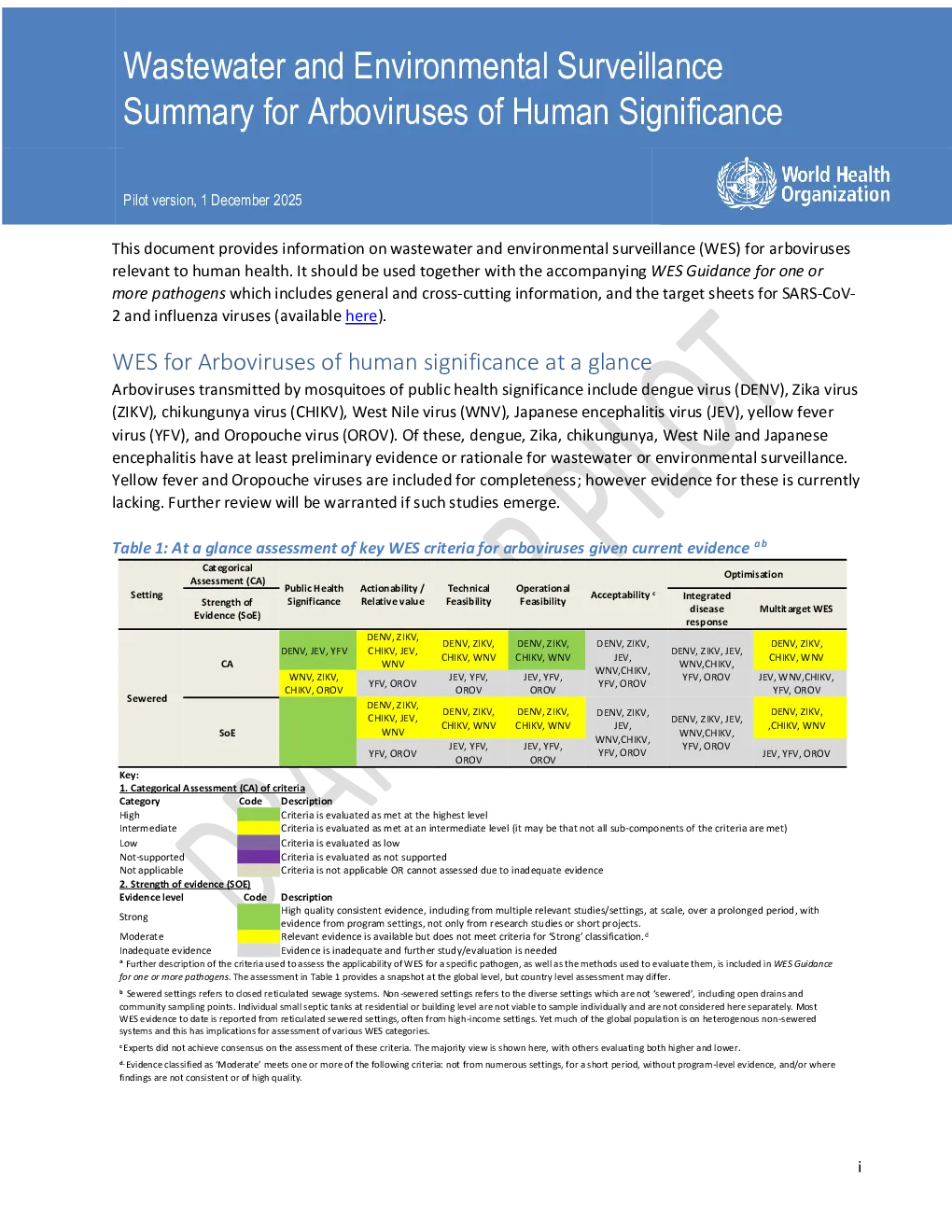
Pilot version,1 December2025 This document provides information on wastewater and environmental surveillance (WES) forarbovirusesrelevant to human health. It should be used together with the accompanyingWES Guidance for one or WES forArboviruses ofhumansignificanceat a glance Arboviruses transmitted by mosquitoes ofpublic health significance include dengue virus (DENV), Zika virus(ZIKV), chikungunya virus (CHIKV), West Nile virus (WNV), Japanese encephalitis virus (JEV), yellow fevervirus (YFV), and Oropouche virus (OROV). Of these, dengue, Zika, chikungunya, WestNile and Japaneseencephalitis have at least preliminary evidence or rationale for wastewater or environmental surveillance. Wastewater andenvironmentalsurveillance: Summary forArboviruses of human significance Summary Arboviral WEShas been demonstratedfor ZIKV(in onesetting),there islimited operational evidence forDENV,CHIKVand WNV,early proof-of-concept evidence forJEVandnone yet for YFV, or OROV. Currentevidencesupportscautiousoptimismof thepotentialof WESto strengthen existing surveillanceandunderscorestheneedtoevaluate and optimisemethodsas part of integrated arboviralinitiativesat the •Public health importance: Arboviruses of greatest concernfor human healthincludeDENV, ZIKV,CHIKV, WNV, JEV, YFV and OROV. Together they cause millions of cases annually, with varying severityand global/regional impact. •Drivers of risk: Climate change, urbanisation, mobility, and vector expansion increasepopulations atrisk andoutbreak frequency, scale, and pandemic potential, particularly forAedes-mosquitoborne •Humanshedding:Low-level, short-duration RNA shedding inurinefollowing acute infection(+/-upperrespiratoryor genital secretions), no evidence for chronic shedding (with exceptionofWNV)-which •Feasibility: Arboviruses are shed atmuchlower levelsthanestablishedentericandrespiratory targetsused in WESprograms; detectionlikelyrequires largersamplevolumes,and use of sensitiveconcentration andmolecularassays.Sequencinguse may be limited givenitssuccess depends on •WES implementation evidence: oDENV:Detectionsin various contexts (outbreak/non-endemic and endemic).oCHIKV:Detections in high and low prevalence non-outbreak settings.oZIKV:Detections in Singapore outbreakswith public health utility.oJEV:Proof-of-concept detection in Australia during small outbreak.oWNV:Proof-of-concept detection in USA in outbreak. •Optimization:Integration into multi-pathogen WES workflows (e.g. with polio, SARS-CoV-2and formultiple arboviruses) is practical at low marginal cost. Compared with case-based and entomologicalsurveillance, WES can provide a relatively low-cost, population-level signal when embedded in existing •Publichealth use cases /Applications:Not currently recommendedforarboviral surveillance.However early adoptersexist (eg ZIKV in Singapore).Given gaps in current surveillance methods, pilotresults suggesttheremay bepotentialvalueof WES,includingforearly warningand in enhancedsurveillance in response to outbreaks.Multi-targetWEShas potential toidentify multiple circulating •Keyresearch questions •In which contextsand howcouldWESadd value toarboviralsurveillance?•What sampling, concentration, and analytical workflows maximise sensitivity and specificity forRNAdetection of targeted arboviruses? Contents WES for a Arboviruses of Human Significance at a glance.............................................................iSummary.....................................................................................................................................ii 1.1.The pathogens and associated diseases......................................................................11.2.Global burden, geographic distribution & risk factors.................................................11.3.Pandemic potential....................................................................................................3 2.Information Related to Arboviruses and Wastewater..........................................................4 2.1.Potential inputs to wastewater and environmental waters.........................................42.2.Target persistence and degradation in water..............................................................5 3.1.Global strategies for control.....................................................................................103.2.Surveillance and early warning.................................................................................10 5.1.General considerations.............................................................................................135.2.Sampling approaches................................................................................................135.3.Laboratory methods.................................................................................................145.4.Reporting and communication..................................................................................15 6.Integrated surveillance and