您的浏览器禁用了JavaScript(一种计算机语言,用以实现您与网页的交互),请解除该禁用,或者联系我们。[ACT]:7-9年级学生ACT成绩标准 - 发现报告

7-9年级学生ACT成绩标准

文化传媒2025-12-03ACTD***
AI智能总结
查看更多
7-9年级学生ACT成绩标准

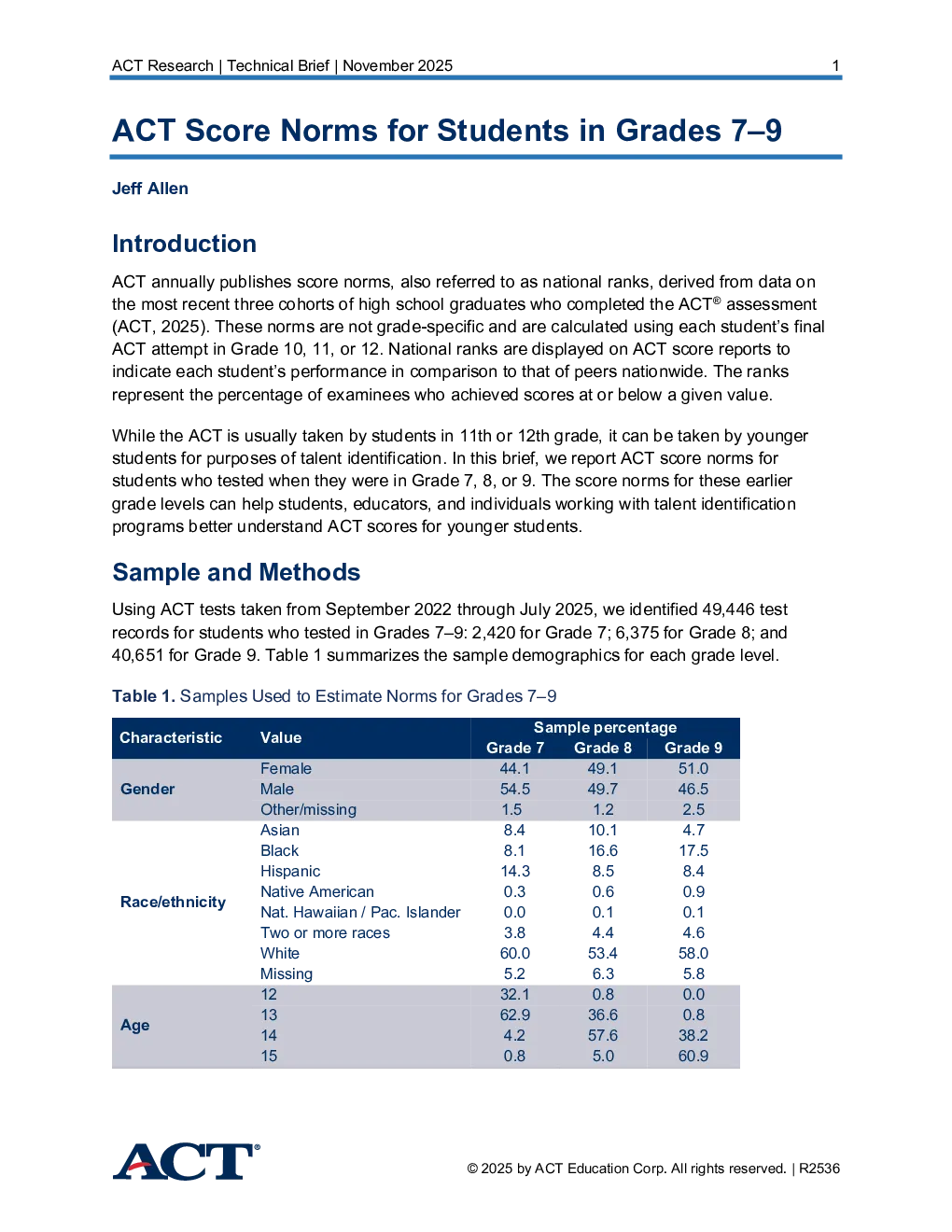
Jeff Allen Introduction ACT annually publishes score norms, also referred to as national ranks, derived from data onthe most recent three cohorts of high school graduates who completed the ACT®assessment(ACT, 2025). These norms are not grade-specific and are calculated using each student’s finalACT attempt in Grade 10, 11, or 12. National ranks are displayed on ACT score reports to While the ACT is usually taken by students in 11th or 12th grade, it can be taken by youngerstudents for purposes of talent identification. In this brief, we report ACT score norms forstudents who tested when they were in Grade 7, 8, or 9. The score norms for these earliergrade levels can help students, educators, and individuals working with talent identification Sample and Methods Using ACT tests taken from September 2022 through July 2025, we identified 49,446 testrecords for students who tested in Grades 7–9: 2,420 for Grade 7; 6,375 for Grade 8; and For each grade level, we estimated norms for the following ACT scores: English, math, reading,science, STEM (average of the math and science scores), the legacy Composite score (basedon English, math, reading, and science), and the new Composite score (based on English,math, and reading). The new Composite score is reported for all ACT tests effective September Interpreting ACT Score Norms for Grades 7, 8, and 9 Tables 2–4 report the norms for the three grade levels. The norms are based on cumulativeranks and indicate the percentage of students who scored at or below a given score. The tables The norms summarize the performance of younger students who took the ACT test in Grades 7,8, and 9. We refer to the norms asuser normsrather thannationally representative norms.Younger students who take the ACT test are not representative of the general population of From Tables 2–4, we see that the average ACT Composite score (without science) was 18.6 forGrade 7, 19.9 for Grade 8, and 19.1 for Grade 9. These averages can be compared to results •The average PreACT 8/9®Composite score was 15.9 for 8th graders tested in the falland 16.6 for those tested in the spring (Shin & Xu, 2025a).•The average PreACT®Composite score was 16.4 for 9th graders tested in the fall and17.0 for those tested in the spring (Shin & Xu, 2025b).•The average ACT Composite score was 19.2 for the latest ACT national normingsample, which mostly consists of students tested in Grades 11 and 12 (ACT, 2025). We can conclude that the students who took the ACT in Grades 7–9 are more representative ofhigher-achieving students in those grades. Prior research suggests that students who take theACT test in 7th grade improve their ACT Composite score by 9.4 points, on average, when they Prior research also suggests that ACT scores steadily increase with more instructional time(Camara & Allen, 2017), and we would expect average ACT scores to increase across Grades7–9 if the same sample were assessed across grade levels. We note that the 9th-grade sampleis much larger than the samples for Grades 7 and 8 and likely represents a more diverse mix of References ACT. (2025).ACT score national ranks.https://www.act.org/content/dam/act/unsecured/documents/ACT-Score-National-Ranks- Allen, J. (2016).How do 7th graders who take the ACT test score as 11th or 12th graders?[Technical brief]. ACT.https://www.act.org/content/dam/act/unsecured/documents/How- Camara, W., & Allen, J. (2017).Does testing date impact student scores on the ACT?(Technical Brief R1643). ACT.https://www.act.org/content/dam/act/unsecured/documents/R1643-test-date-impact-on- Shin, M., & Xu, J.-R. (2025a).The 2025 PreACT 8/9 norming study(Technical Brief R2526).https://www.act.org/content/dam/act/secured/documents/R2429-the-PreACT-8-9-2025- Shin, M., & Xu, J.-R. (2025b).The 2025 PreACT norming study(Technical Brief R2525).https://www.act.org/content/dam/act/secured/documents/R2430-the-PreACT-2025- ABOUT ACT ACT is transforming college and career readinesspathways so that everyone can discover and fulfill theirpotential. Grounded in more than 65 years of research,ACT’s learning resources, assessments, research, andwork-ready credentials are trusted by students, job