您的浏览器禁用了JavaScript(一种计算机语言,用以实现您与网页的交互),请解除该禁用,或者联系我们。 [韩国央行]:特定行业的资源配置效率与生产率 - 发现报告

特定行业的资源配置效率与生产率

2025-07-29 - 韩国央行 在路上
报告封面

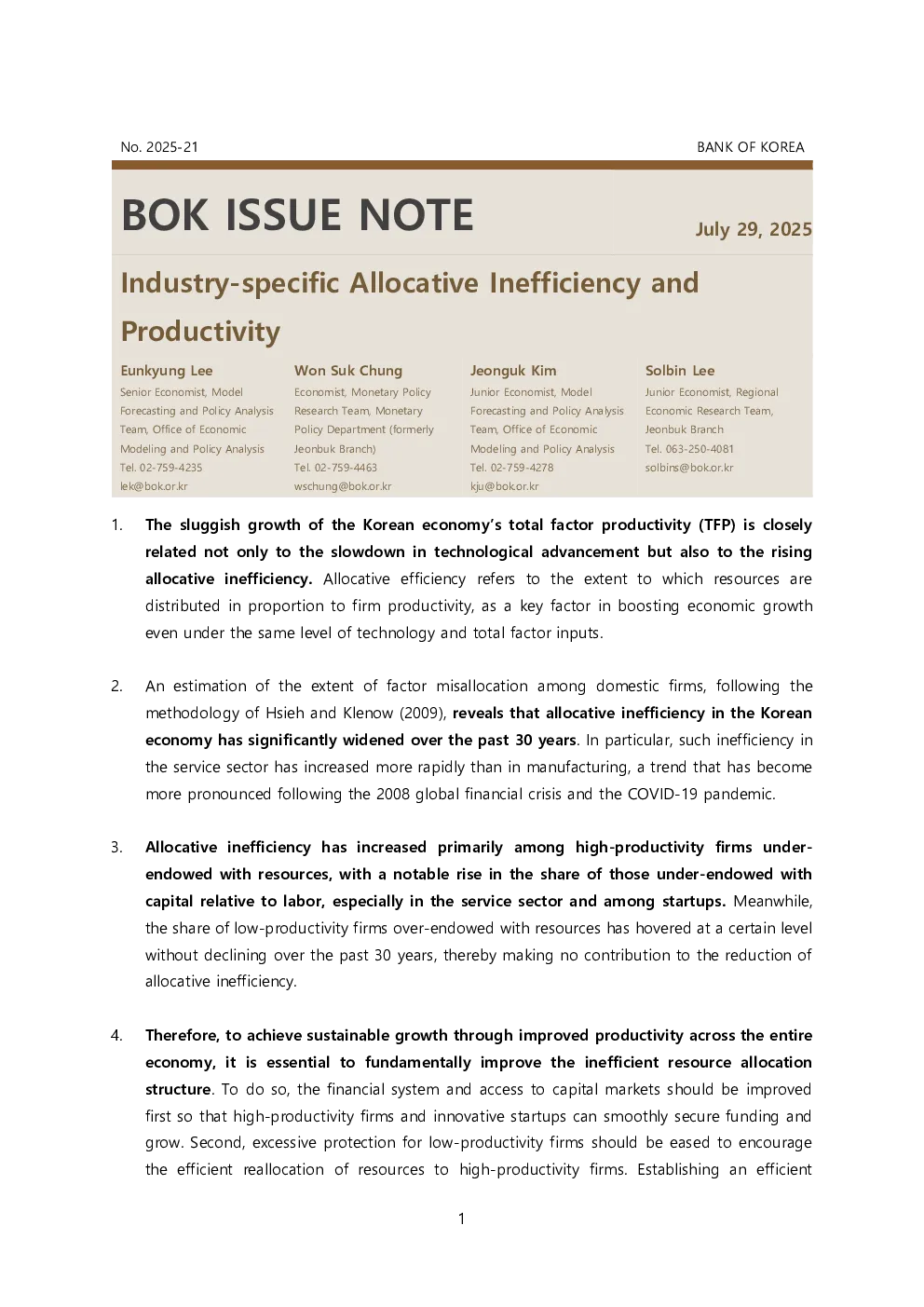
July 29, 2025 Industry-specificAllocativeInefficiencyand Productivity JeongukKim Won SukChung SolbinLee EunkyungLeeSeniorEconomist,ModelForecasting and Policy AnalysisTeam,Office of EconomicModelingand Policy AnalysisTel. 02-759-4235lek@bok.or.kr Economist,Monetary PolicyResearch Team, MonetaryPolicyDepartment(formerly Junior Economist,ModelForecasting and Policy AnalysisTeam,Office of Economic 1.Thesluggish growth of the Korean economy’stotal factor productivity (TFP) is closelyrelated not only tothe slowdown in technologicaladvancementbut also to the rising 2.Anestimation of the extent of factor misallocation among domestic firms,following themethodologyofHsieh and Klenow (2009),revealsthat allocativeinefficiencyin the Korean 3.Allocativeinefficiency has increased primarily among high-productivity firms under-endowed with resources, with anotable risein the share ofthoseunder-endowed with 4.Therefore, to achieve sustainable growth throughimprovedproductivityacross the entireeconomy,it is essential to fundamentally improve the inefficient resource allocation resource allocation structure through these measures will enhanceaggregateTFPinthe Korean ■Disclaimer:The views expressed herein are those of the authors, and do not necessarily reflect the official ■Wewould like to express our appreciationtoJungickLee,Head of the Office of Economic Modelingand Policy Analysis,KyounghoonPark, Head ofthe ModelForecastingand Policy Analysis Team, and I.Introduction Generally, in the early stages of economicgrowth,thequantitativeexpansionofproductionfactors(such as labor and capital)istheprimarydriver of growth. However, as aneconomymatures,the efficiency with whichthese resources are utilizedbecomes the keydeterminant ofsustainable growth. Totalfactorproductivity(TFP),a key indicator of this TFPis determined by various factors,including technologicaladvancement,allocativeefficiency,and social infrastructure.Amongthese,allocativeefficiencyserves as a key driverthat can enhance economic growth evenunderthe same level of technology andtotalfactorinputs. It refers to the extent to which morecapitaland labor are allocated to high- crisis, compared with OECD countries,has beenfound to beattributable primarily to a decline inefficiencyin the Korean economy hassteadilyincreased over thepast 30 years. Specifically,byindustry, such inefficiencyamong firms in theservice sectorhas widened more significantlythanin the manufacturing sector,with thistrendbecomingevenmorepronouncedfollowingthe 2008 global financial crisis andthe2020 pandemic.Allocative inefficiency Existingdomestic studies on allocativeefficiencyhave primarily focused on themanufacturingsector,while comparisons ofallocativeinefficiencies across industries andanalyses of such inefficiency in the servicesector remain relatively scarce(Chung GuCheeand Won SukChung, 2015; Kim et al., 2017; This paper isorganizedas follows.SectionⅡ estimates theextentof allocativeinefficiencyas a cause of the slowdown in TFP growth. The and factorsof productionare allowed tomovefreely.A larger TFP gain indicates greaterpotentialfor improving resource allocation,therebyindicating a higher level of allocative II.Estimation 1. Estimation Methodologyand Data 1.1Methodology This paper,in line withChung GuCheeandWonSuk Chung(2015),estimates allocativeinefficiency using the Hsieh and Klenow (2009)methodology(hereafter,the“HK model”).3TheHK model is based on the assumption thatin 1.2 Data Toestimate allocative inefficiency byindustry,microdata from Statistics Korea'sMiningand Manufacturing Survey and firm-levelfinancial data5 from Value-Search were TheMining and Manufacturing Surveyprovides extensive data on establishments with10or more employees nationwide,but itscoverageis confined to the manufacturing Themodel measures the extent ofallocative inefficiency through total factor manufacturingand service sectors,therebyenablingcross-industrycomparisons.Accordingly, the results of analysis using theValue-Search data are more useful for the 2.Estimation Results Theestimatedtrendofallocativeinefficiency in the Korean economybased onthe above model and data shows that suchinefficiencyhas steadilywidenedover the past Specifically, the firm-leveldata used in theanalysisincludesthe(four-digit)Korean Standard Industrial Classification(KSIC)codes,9valueadded,10 year of establishment,laborcosts,11 tangible fixed assets, and rent. Laborinput was measured using labor costs instead Note: 1)Allocative inefficiency measured by TFP gains.Source:Mining and Manufacturing Survey;authors’ and Ramos, 2015; Dias et al., 2020; Benkovskis,2018), and aregenerally attributed to structuralfactors,such as price and labor market rigiditiesanda high share of informal and small firms,as The trend of industry-specific allocativeinefficiencyin themanufacturing sectorreveals Note: 1) Allocative inefficiency measured by TFP gains.Source: Mining and Manufacturing Survey; authors’ Note: 1)Alloca