您的浏览器禁用了JavaScript(一种计算机语言,用以实现您与网页的交互),请解除该禁用,或者联系我们。 [腾易科技]:金融资产增加推动中国汽车市场高质量增长 - 发现报告

金融资产增加推动中国汽车市场高质量增长

交运设备 2025-11-11 - 腾易科技 严宏志19905053625
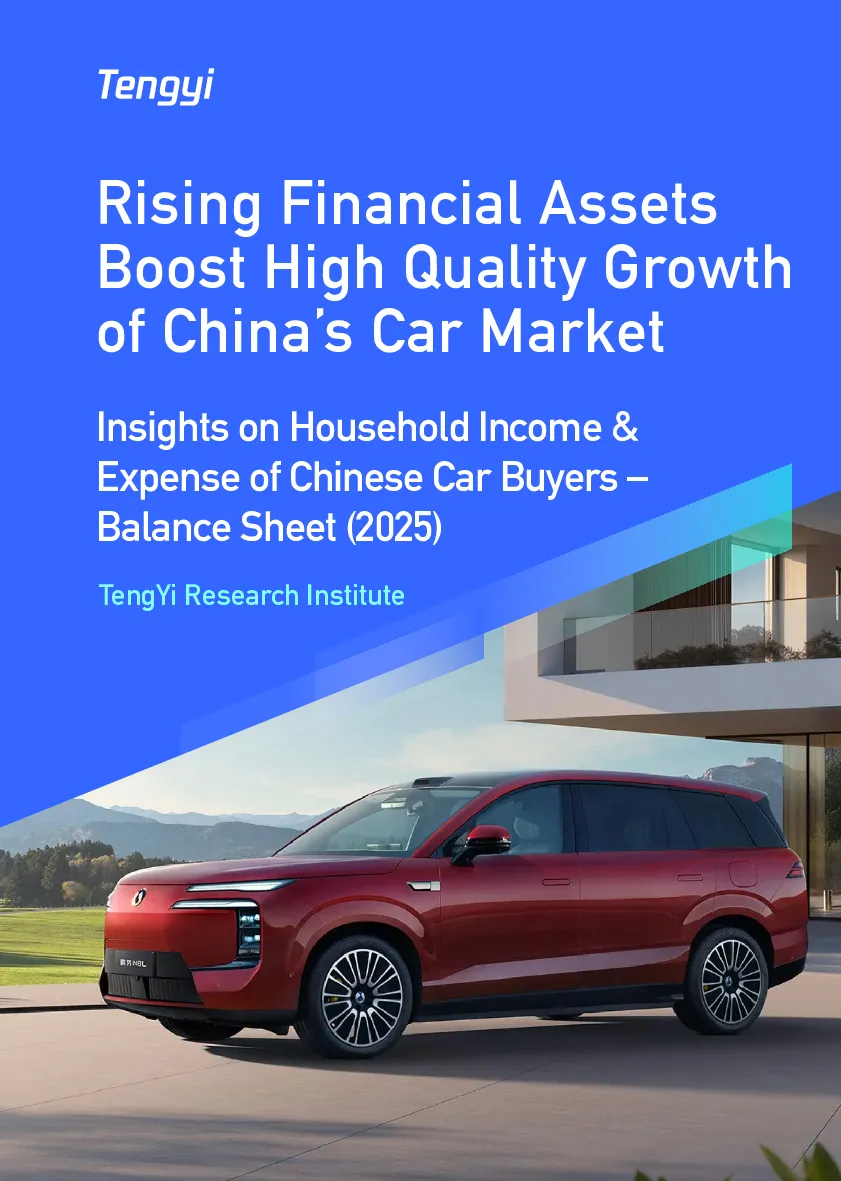
报告封面

Rising Financial AssetsBoost High Quality Growthof China’s Car Market Insights on Household Income &Expense of Chinese Car Buyers –Balance Sheet (2025) TengYi Research Institute Authors Lijun Zhou Director/Chief Analystzhoulijun1@yiche.com Benya Shi Industry Analystshibenya@yiche.com In 2024, the average annual income of Chinese car-buying house-holds exceeded RMB 200,000, while annual spending dropped toRMB 140,900, resulting in a balance that surged to RMB 64,000,setting the stage for a new phase of growth in China’s car market Despite ongoing macroeconomic pressure, the disposable income of Chinese car-buying householdshas continued to climbsurpassing RMB 200,000 and reaching RMB 204,900 in 2024.This steadyrise is driven primarily by internal structural shiftsmost notably, older buyers and more middle-classbuyers. In 2024, the average age of car buyers exceeded 40, while middle-class householdsaccounted for over 45% of the market. Compared with the earlier base of younger, blue collar buyers,today’s middle-aged, middle-class buyers possess significantly higher earning power. Post-pan-demic trendsincluding the rebound of China’s equity markets and a surge in gold priceshavefurther lifted the incomes of financially asset-rich middle-aged families; For more than a decade, mortgage payments have been the biggest expense for car-buying house-holds. Following the pandemic, to revive the property sector and reduce household leverage, policy-makers sharply lowered mortgage rates from around 56% to 34%, easing monthly burdens andpushing total household spending down slightly to RMB 140,900 in 2024; Under the dual effect of rising income and declining expenses, household’s surpluses rose sharply toRMB 64,000setting the stage for the next growth phase of China’s car market. ChinaMortgageRates2015-2024 Chinese PassengerVehicle (New Car)Market Shareby Social Status2014-2024 Over the past decade, mortgage debt has weighed heavily onChinese car-buying households–but as the burden eases, thecar market is poised to become a new pillar of domestic demand Over the past decade, policymakers have sought to expand domestic demand, yet consumption has oftenresembled a sleeping lion–no matter how hard one calls, it simply refuses to wake up. The main constraint haslong been the heavy burden of mortgage debt. In 2020, mortgage payments consumed more than half ofmany households’ total spending, leaving little room for other discretionary expenditures; In recent years, however, the government has firmly upheld the principle that “housing is for living, notfor speculation.” Through proactive measures such as lowering mortgage interest rates, these policieshave yielded significant results. The debt structure of Chinese car-buying households has shifteddramatically: the share of households still repaying mortgages has dropped sharply, from over 70% atits 2019 peak to 56.46% in 2024. From 2022 to 2024, the proportion of households that fully repaid theirmortgages ahead of schedule rose rapidly, approaching 20%. Between 2021 and 2024, the share of carbuyers without any mortgage obligations (including those who no longer need to purchase housing)also climbed swiftly, surpassing 10%; Together, these structural shifts have eased mortgage pressure across China’s car-buying popula-tion. Between 2020 and 2024, their average annual mortgage expenditure fell from over RMB 70,000 toslightly above RMB 50,000, while its share of total household spending declined from more than 50% tobelow 40%. Although mortgage payments remain the single largest expenditure item–accounting for36.27% in 2024–the burden has dropped significantly from previous years when they consumed overhalf of total expenses; As mortgage payments and their relative share continue to decline, households are finally regainingfinancial flexibility to spend more on vehicles, travel, leisure and other forms of consumption. This revivalin discretionary spending is essential to reactivating China’s domestic demand–and the car market ispoised to serve as its leading engine. Indeed, many families are now waiting for the moment theirmortgage burden lightens–or disappears entirely–before rewarding themselves with their long-await-ed “dream car”. Evolution of Mortgage Payment Actionsof Chinese Car-Buying Households 2015-2024 Mortgage Payment & Share ofTotal Expenditure of ChineseCar-Buying Households2020-2024 (RMB 10,000) Share of Major ExpenditureItems of Chinese Car-BuyingHouseholds 2024 During the era when mortgage payments dominated householdspending, car consumption remained coarse–but as child-rearingbecomes the primary expense from 2025 to 2030, family andchild-friendly vehicles are poised to become the core of China’scar market demand In recent years, the financial weight of child-rearing has continued to rise among Chinese car-buyinghouseholds. By 2024, over 64% of such families spent more than 15% of their total expenses on raisingchildren, while the overall