AI智能总结
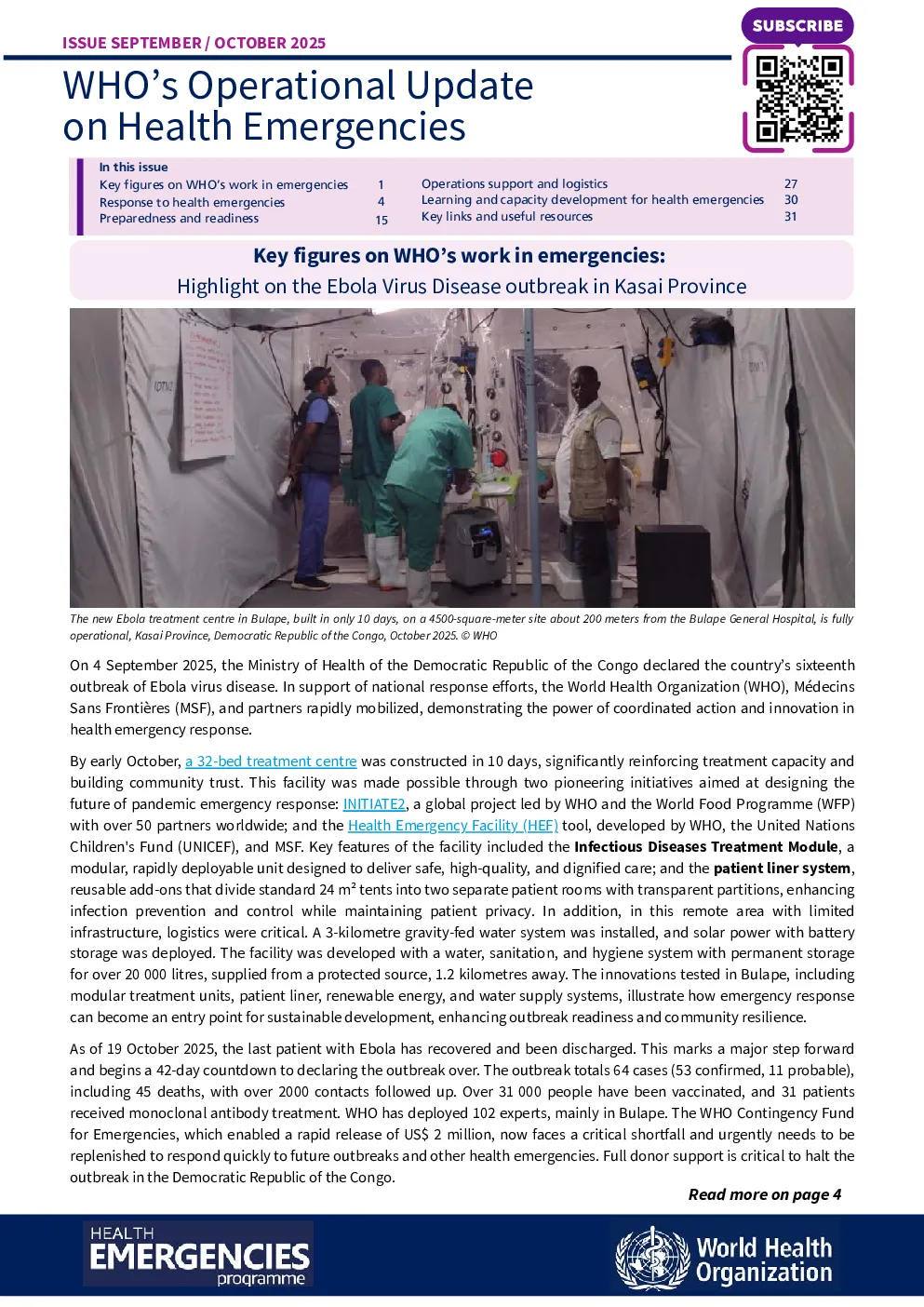
1154 Learning and capacity development for health emergencies Key figures on WHO’s work in emergencies: Highlight on the Ebola Virus Disease outbreak in Kasai Province On 4 September 2025, the Ministry of Health of the Democratic Republic of the Congo declared the country’s sixteenthoutbreak of Ebola virus disease. In support of national response efforts, the World Health Organization (WHO), Médecins By early October,a 32-bed treatment centrewas constructed in 10 days, significantly reinforcing treatment capacity andbuilding community trust. This facility was made possible through two pioneering initiatives aimed at designing the future of pandemic emergency response:INITIATE2, a global project led by WHO and the World Food Programme (WFP)with over 50 partners worldwide; and theHealth Emergency Facility (HEF)tool, developed by WHO, the United NationsChildren's Fund (UNICEF), and MSF. Key features of the facility included theInfectious Diseases Treatment Module, amodular, rapidly deployable unit designed to deliver safe, high-quality, and dignified care; and thepatient liner system,reusable add-ons that divide standard 24 m² tents into two separate patient rooms with transparent partitions, enhancing infection prevention and control while maintaining patient privacy. In addition, in this remote area with limitedinfrastructure, logistics were critical. A 3-kilometre gravity-fed water system was installed, and solar power with battery As of 19 October 2025, the last patient with Ebola has recovered and been discharged. This marks a major step forwardand begins a 42-day countdown to declaring the outbreak over. The outbreak totals 64 cases (53 confirmed, 11 probable),including 45 deaths, with over 2000 contacts followed up. Over 31,000 people have been vaccinated, and 31 patientsreceived monoclonal antibody treatment. WHO has deployed 102 experts, mainly in Bulape. The WHO Contingency Fundfor Emergencies, which enabled a rapid release of US$ 2 million, now faces a critical shortfall and urgently needs to be Key figures on WHO’s work in emergenciesCumulative number from 1 January to 15 October 2025 WHO responded to44 graded emergencies in 76*countries and territories,including23Grade 3requiring the highest level of Organization-wide US$25 millionContingencyFund for Emergenciesreleased for20 emergenciesin28countries and 97 Standby Partnersdeployments55 GOARNdeployments through the OperationalSupport Team US$ 39 millionof goodsdispatchedto 77countries and territories >281 783 plays, 9235+hours viewed, 116 topics, 18diseases, 25 languages of freeOpenWHOcourses Explore more:WHOhealthemergencies.int More about key figures on WHO’s work in emergencies(1 January -15 October 2025) Graded emergencies Standby Partners As of 15 October 2025, there have been 97Standby Partners As of 15 October WHO responded to 44 gradedemergencies. Of these, 23 are Grade 3—the highestlevel—reflecting situations triggering a three-level deployments,77 of which have started since 1 January2025. These deployments are providing support across 21graded emergencies and have been facilitated by 8 StandbyPartners: NORCAP (the Norwegian Capacity), part of theNorwegian Refugee Council, the Netherlands (Kingdom ofthe), CANADEM (the Canadian Association for the United comprehensiveresponse system based on theEmergency Response Framework. 20 are Grade 2emergencies requiring moderate support beyondcountry office capacity, while one is a Grade 1emergency, managed primarily at the country levelwith minimal external support. These classificationsreflectthe operational scale and coordination required, as defined in WHO’s Emergency ResponseFramework. Nine of the Grade 3 emergencies are GOARN From January to 15 October 2025, the Global Outbreak Alert and Response Network (GOARN) played a key role insupporting global emergency operations. Leveraging the capacity of its partner institutions,GOARNcontributed toresponses to 17 public health events in 2025, includinginfectiousdisease outbreaks,natural disasters,andprotractedhumanitarian emergencies in 16 countries.Following the lifting of the Public Health Emergency ofInternational Concern on 6 September 2025,the MpoxOperational Surge Dashboard, developed by the GOARN Contingency Fund for Emergencies These rapidly deployable and flexible resourceshave enabled WHO to scale up responses to ongoingmpox and cholera outbreaks across Africa; delivermedicines and medical supplies after the Myanmarearthquake;respond to Marburg in the UnitedRepublicof Tanzania and Sudan Virus Diseaseoutbreaks in Uganda; provide emergency healthcarein crises in Haiti, Myanmar, Sudan and Yemen; Logistics Since the beginning of the year, WHO has dispatched 39million goods to 77 countries and territories to supporthealthemergency preparedness and response.Keyrecipients include the occupied Palestinian territory, theDemocraticRepublic of the Congo,the Syrian ArabRepublic, and countries responding to global outbreak