您的浏览器禁用了JavaScript(一种计算机语言,用以实现您与网页的交互),请解除该禁用,或者联系我们。[世界卫生组织]:突发卫生事件学习词汇表:能力建设方法的术语和概念 - 发现报告

突发卫生事件学习词汇表:能力建设方法的术语和概念

2025-06-09世界卫生组织G***
突发卫生事件学习词汇表:能力建设方法的术语和概念

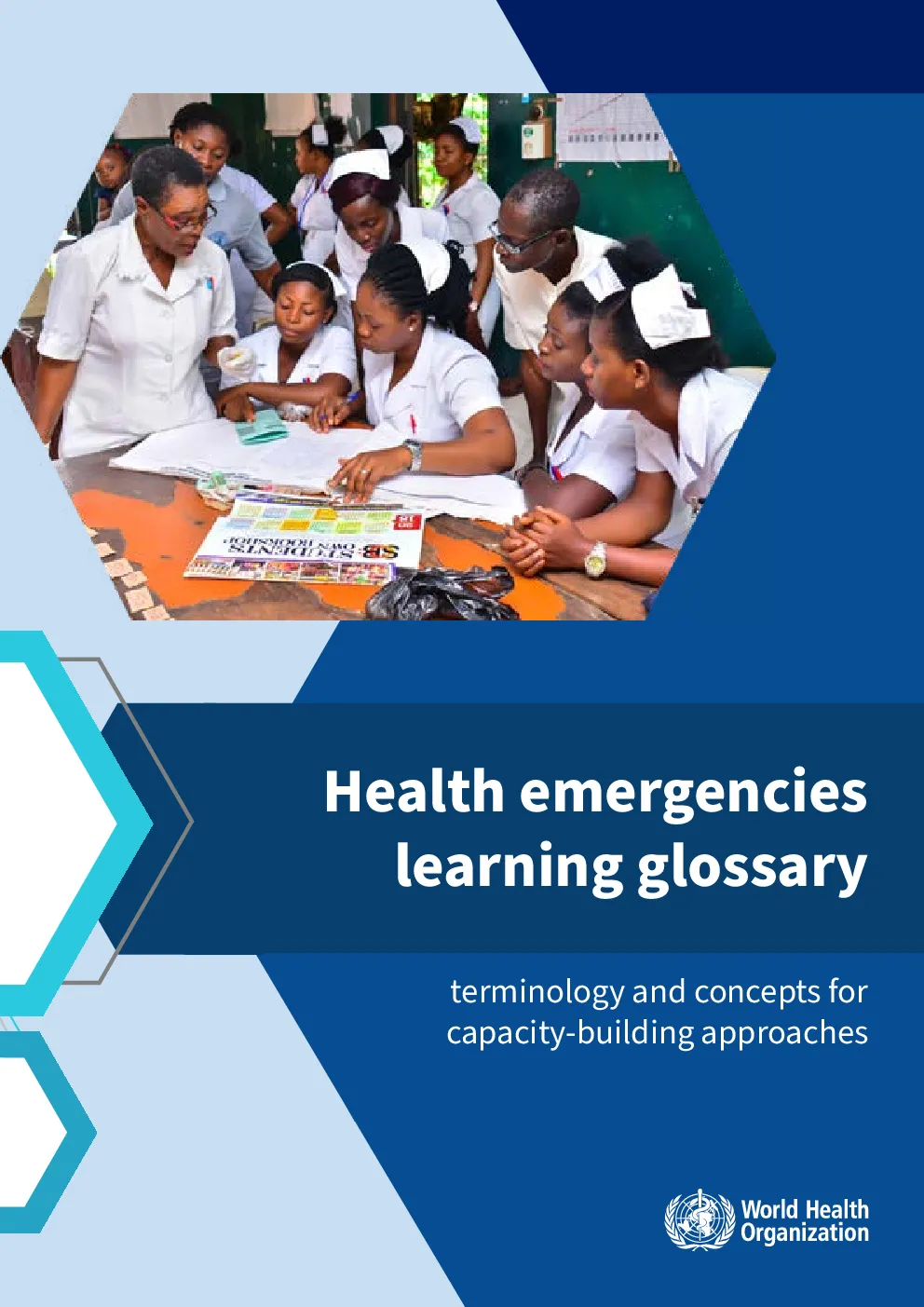
terminology and concepts forcapacity-building approaches Health emergencieslearning glossary terminology and concepts forcapacity-building approaches Health emergencies learning glossary: terminology and concepts for capacity-building approaches ISBN 978-92-4-010822-6 (electronic version)ISBN 978-92-4-010823-3 (print version) © World Health Organization 2025Some rights reserved. This work is available under the Creative Commons Attribution-NonCommercial- ShareAlike 3.0 IGO licence (CC BY-NC-SA 3.0 IGO; https://creativecommons.org/licenses/by-nc-sa/3.0/igo). Under the terms of this licence, you may copy, redistribute and adapt the work for non-commercialpurposes, provided the work is appropriately cited, as indicated below. In any use of this work, there shouldbe no suggestion that WHO endorses any specific organization, products or services. The use of the WHOlogo is not permitted. If you adapt the work, then you must license your work under the same or equivalentCreative Commons licence. If you create a translation of this work, you should add the following disclaimeralong with the suggested citation: “This translation was not created by the World Health Organization (WHO).WHO is not responsible for the content or accuracy of this translation. The original English edition shall bethe binding and authentic edition”. Any mediation relating to disputes arising under the licence shall be conducted in accordance with themediation rules of the World Intellectual Property Organization (https://www.wipo.int/amc/en/mediation/rules/). Suggested citation.Health emergencies learning glossary: terminology and concepts for capacity-buildingapproaches. Geneva: World Health Organization; 2025. Licence CC BY-NC-SA 3.0 IGO. Cataloguing-in-Publication (CIP) data.CIP data are available at https://iris.who.int/. Sales, rights and licensing.To purchase WHO publications, see https://www.who.int/publications/book-orders. To submit requests for commercial use and queries on rights and licensing, see https://www.who.int/copyright. Third-party materials.If you wish to reuse material from this work that is attributed to a third party, such astables, figures or images, it is your responsibility to determine whether permission is needed for that reuseand to obtain permission from the copyright holder. The risk of claims resulting from infringement of anythird-party-owned component in the work rests solely with the user. General disclaimers.The designations employed and the presentation of the material in this publicationdo not imply the expression of any opinion whatsoever on the part of WHO concerning the legal statusof any country, territory, city or area or of its authorities, or concerning the delimitation of its frontiers orboundaries. Dotted and dashed lines on maps represent approximate border lines for which there may notyet be full agreement. The mention of specific companies or of certain manufacturers’ products does not imply that they areendorsed or recommended by WHO in preference to others of a similar nature that are not mentioned. Errorsand omissions excepted, the names of proprietary products are distinguished by initial capital letters. All reasonable precautions have been taken by WHO to verify the information contained in this publication.However, the published material is being distributed without warranty of any kind, either expressed orimplied. The responsibility for the interpretation and use of the material lies with the reader. In no eventshall WHO be liable for damages arising from its use. Cover photo: WHO support to the Nigerian government in strengthening human systems by increasing resources forhealth, 2024. A group of young Nigerian nurses complete the health facility registry, supervised by thehead nurse © WHO / Blink Media - Bart Verwei Contents ForewordivPrefacevAcknowledgementsvi Introduction1Objective3Methods and development5Criteria for existing glossaries selection6Stages of development6 Glossary of terms Foreword In an increasingly complex world, where emergencies can strike with little warning, the ability to respondswiftly and effectively is critical. At the World Health Organization, we are committed to ensuring that countries,communities, and health workers are equipped with the knowledge and tools they need to respond to healthemergencies in real-time. ThisHealth emergencies learning glossary: terminology and concepts for capacity-building approachesis a reflection of that commitment. Designed as more than just a reference tool, this glossary serves as a vital resource that complements theWHOimplementation guidance on emergencies capacity-building. Simplifying complex terms and concepts it ensuresthat our approaches to just-in-time learning are accessible to all who need them, from frontline health workersto decision-makers in critical moments. We believe that learning, when streamlined and readily available, cansave lives, and this glossary plays a key role in that m