您的浏览器禁用了JavaScript(一种计算机语言,用以实现您与网页的交互),请解除该禁用,或者联系我们。[世界卫生组织]:世界卫生组织关于突发卫生事件的最新行动——2025年7月和8月 - 发现报告

世界卫生组织关于突发卫生事件的最新行动——2025年7月和8月

AI智能总结
查看更多
世界卫生组织关于突发卫生事件的最新行动——2025年7月和8月

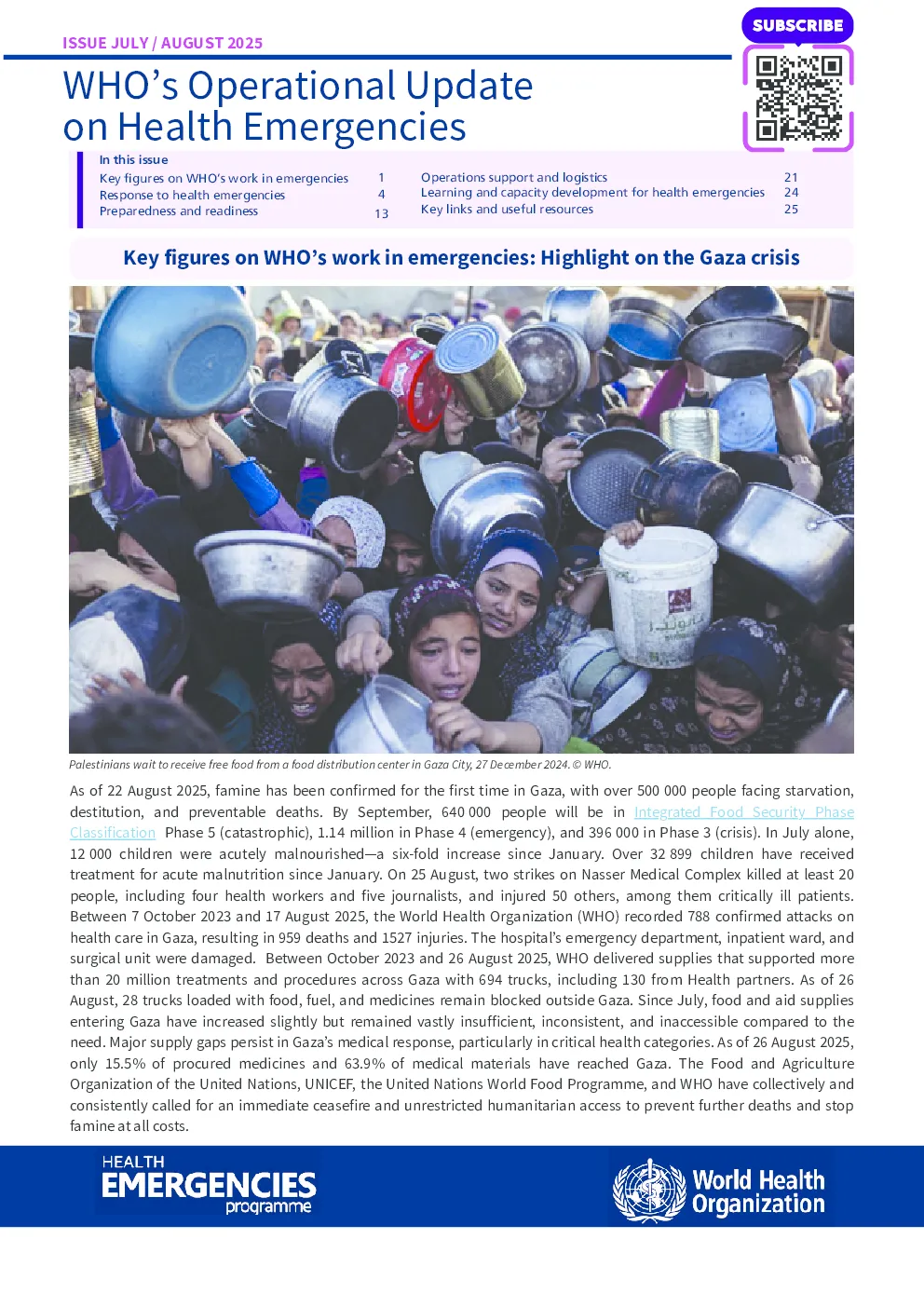
In this issue Key figures on WHO’s work in emergenciesResponse to health emergenciesPreparedness and readiness Learning and capacity development for health emergenciesKey links and useful resources2425Operations support and logistics21 1134 Key figures on WHO’s work in emergencies: Highlight on the Gaza crisis As of 22 August 2025, famine has been confirmed for the first time in Gaza, with over 500,000 people facing starvation,destitution, and preventable deaths. By September, 640,000 people will be in Integrated Food Security PhaseClassificationPhase 5 (catastrophic), 1.14 million in Phase 4 (emergency), and 396,000 in Phase 3 (crisis). In July alone,12,000 children were acutely malnourished—a six-fold increase since January. Over 32,899 children have receivedtreatment for acute malnutrition since January. On 25 August, two strikes on Nasser Medical Complex killed at least 20people, including four health workers and five journalists, and injured 50 others, among them critically ill patients.Between 7 October 2023 and 17 August 2025, the World Health Organization (WHO) recorded 788 confirmed attacks onhealth care in Gaza, resulting in 959 deaths and 1527 injuries. The hospital’s emergency department, inpatient ward, andsurgical unit were damaged. Between October 2023 and 26 August 2025, WHO delivered supplies that supported morethan 20 million treatments and procedures across Gaza with 694 trucks, including 130 from Health partners. As of 26August, 28 trucks loaded with food, fuel, and medicines remain blocked outside Gaza. Since July, food and aid suppliesentering Gaza have increased slightly but remained vastly insufficient, inconsistent, and inaccessible compared to theneed. Major supply gaps persist in Gaza’s medical response, particularly in critical health categories. As of 26 August 2025,only 15.5% of procured medicines and 63.9% of medical materials have reached Gaza. The Food and AgricultureOrganization of the United Nations, UNICEF, the United Nations World Food Programme, and WHO have collectively andconsistently called for an immediate ceasefire and unrestricted humanitarian access to prevent further deaths and stopfamine at all costs. Key figures on WHO’s work in emergencies Cumulative number from 1 January to 15 August 2025 WHO responded to41 graded emergencies,including19Grade 3/ Protracted 3;21Grade 2/ Protracted 2, and1Grade 1/ Protracted 1*. >US$ 22 millionContingency Fund for Emergenciesreleased to27 countries and territories 67 Standby Partnersdeployments51 GOARNdeployments through the OperationalSupport Team US$ 13.84 million of goodsdispatchedto62 countries and territories >222 681 plays, 7349+ hours viewed, 113 topics, 18diseases, 21 languages of free OpenWHO courses Explore more:WHOhealthemergencies.intExploremore:WHOhealthemergencies.int Explore more:WHOhealthemergencies DashboardExploremore:WHOhealthemergenciesDashboard More about key figures on WHO’s work in emergencies(1 Jan. - 15 Aug. 2025) Graded emergencies Standby Partners As of 15 August 2025, there have been 67StandbyPartnersdeployments, 49 of which have started since 1January 2025. These deployments are providing supportacross 18 graded emergencies and have been facilitatedby8 Standby Partners:NORCAP(the NorwegianCapacity), part of the Norwegian Refugee Council, theNetherlands (Kingdom of the), CANADEM (the CanadianAssociation for the United Nations), RedR Australia (theRegistered Engineers for Disaster Relief Australia), theSwiss Agency for Development and Cooperation, UK-Med, iMMAP (Information Management and Mine ActionPrograms), and MSB (the Swedish Civil ContingenciesAgency ). Between1 January and 15 August 2025,WHOresponded to 41 graded emergencies. Of these, 19 areGrade3—the highest level—reflecting situationstriggering a three-level comprehensive response systembasedon the Emergency Response Framework.Twenty-oneare Grade 2 emergencies requiringmoderate support beyond country office capacity, whileone is a Grade 1 emergency, managed primarily at thecountry level with minimal external support. Theseclassificationsreflect the operational scale andcoordination required, as defined in WHO’s EmergencyResponse Framework. Nine of the Grade 3 emergenciesare protracted, having lasted over six months. WHOcontinuouslymonitors and updates these gradesthrough its incident management system to ensureresources match evolving needs. The highest grading isdisplayed when an event is regraded multiple timeswithin a year. To respond effectively, WHO urgentlyrequiresUS$1.5 billion in 2025to protect the world’smost vulnerable populations and sustain life-savinghealth operations. GOARN From January to 15 August 2025, the Global OutbreakAlert and Response Network (GOARN) played a key role insupporting global emergency operations. Leveraging thecapacity of its partner institutions, GOARN contributed toresponses to 12 public health events in 2025, includinginfectiousdisease outbreaks,natural disasters,andprotracted human