将边缘推到净零
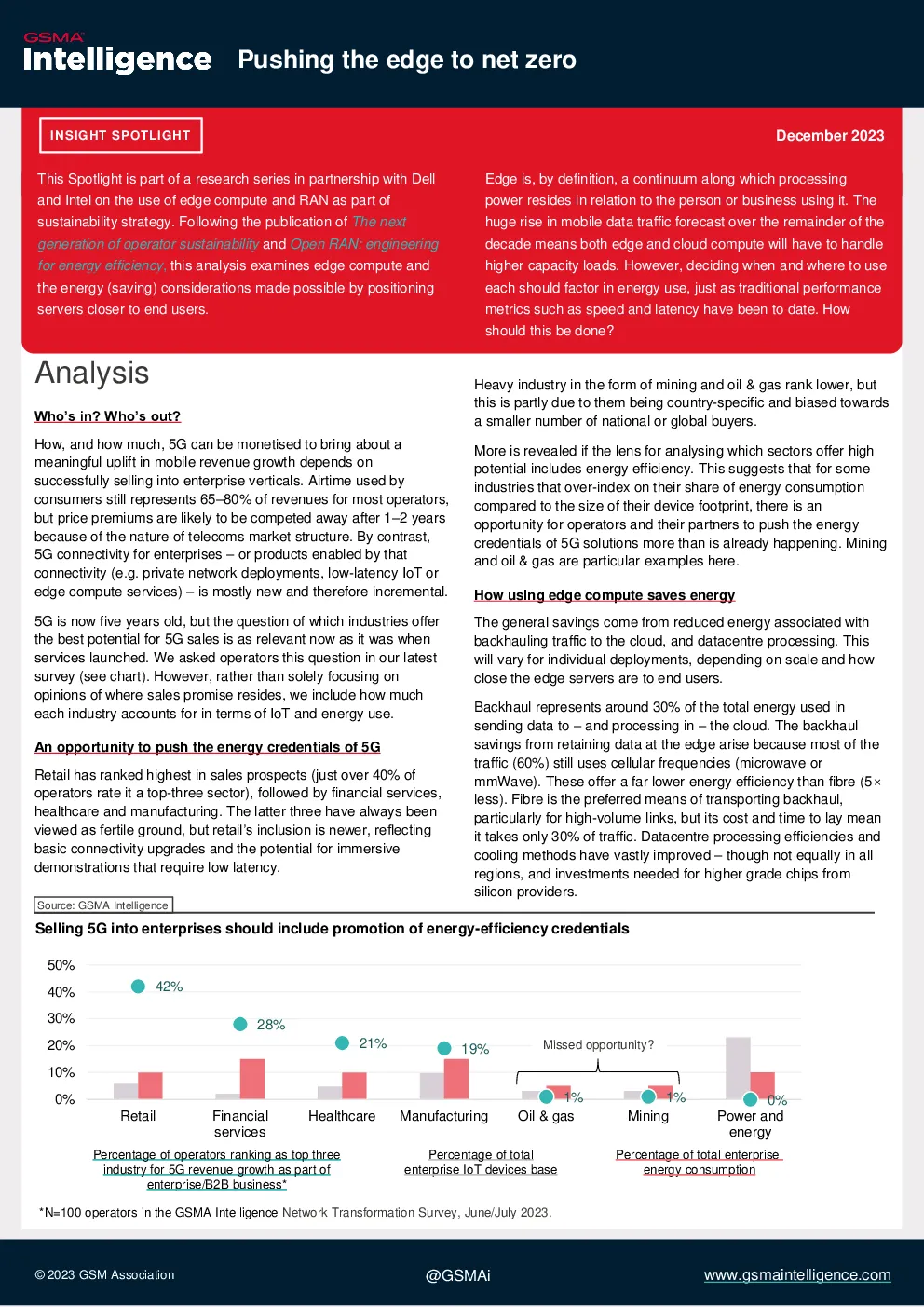
December 2023 INSIGHT SPOTLIGHT Edge is, by definition, a continuum along which processingpower resides in relation to the person or business using it. Thehuge rise in mobile data traffic forecast over the remainder of thedecade means both edge and cloud compute will have to handle This Spotlight is part of a research series in partnership with Delland Intel on the use of edge compute and RAN as part of sustainability strategy. Following the publication ofThe nextgeneration of operator sustainabilityandOpen RAN: engineeringfor energy efficiency,this analysis examines edge compute and Analysis Heavy industry in the form of mining and oil & gas rank lower, but this is partly due to them being country-specific and biased towardsa smaller number of national or global buyers. Who’s in? Who’s out? How,and how much,5G can be monetised to bring about ameaningful uplift in mobile revenue growth depends onsuccessfully selling into enterprise verticals. Airtimeused byconsumers still represents 65–80% of revenues for most operators,but price premiums are likely to be competed away after 1–2 years More is revealed if the lens for analysing which sectors offer highpotential includes energy efficiency. This suggests that for someindustries that over-index on their share of energy consumptioncompared to the size of their device footprint, there is an How using edge compute saves energy 5G is now five years old, but the question of which industries offerThe general savings come from reduced energy associated with the best potential for 5G sales is as relevant now as it was whenservices launched. We asked operators this question in our latestsurvey (see chart). However, rather than solely focusing on backhauling traffic to the cloud, and datacentre processing. Thiswill vary for individual deployments, depending on scale and how opinions of where sales promise resides, we include how mucheach industry accounts for in terms of IoT and energy use. sending data to–and processing in–the cloud. The backhaulsavings from retaining data at the edge arise because most of thetraffic (60%) still uses cellular frequencies (microwave or An opportunity to push the energy credentials of 5G Retail has ranked highest in sales prospects (just over 40% ofoperators rate it a top-three sector), followed by financial services,healthcare and manufacturing. The latter three have always beenviewed as fertile ground, but retail’s inclusion is newer, reflectingbasic connectivity upgrades and the potential for immersivedemonstrations that require low latency.mmWave). These offer a far lower energy efficiency than fibre (5×less). Fibre is the preferred means of transporting backhaul,particularly for high-volume links, but its cost and time to lay meanit takes only 30% of traffic. Datacentre processing efficiencies andcooling methods have vastly improved–though not equally in allregions, and investments needed for higher grade chips from Source: GSMA Intelligence Implications Mobile operators Vendors •Competitive edge.This ultimately comes down to articulatingthe energy savings possible by retaining data at the edge,aside from the latency benefits from localised compute. GSMAIntelligence high-level estimates suggest material savings ona near-linear basis. For example, if a company retained 10%of traffic at the edge otherwise sent to the cloud, energysavings would be 7–8%. However, this is a general estimate;marketing to specific clients shouldtake into accountspecific •Balancing edge and cloud.Cellular data traffic will risesixfold between now and 2030 for both consumer andenterprise customers. However, the enterprise traffic is likelyto become more concentrated as companies situate privatenetwork deployments on premises such as factories or ports.The cloud and on-premise edge currently process around30% and 25% of enterprise traffic, respectively, which will riseto 40% and 30% by 2030. Given the backhaul-associated energy (and emissions) of sending data to the cloud, there is •Sector pivots.Several of the industries viewed favourably by operators as potential buyers of 5G services are perhapsunexpected. Media, retail and parts of healthcare areexamples. This reflects the changing utility of 5G and edgecompute beyond the higher profile use cases such as roboticsand private network deployments. Edge providers andtelecoms equipment makers have an opportunity to front-run •Sales strategy.There is a rationale to incorporate energy aspart of the sales strategy of edge deployments. Edge hasexperienced a renaissance. Some 30% of operators rate it astheir top asset in selling 5G into enterprise verticals–wellabove speed and latency, which topped the list in 2019 and2020. However, this is a competitive arena with blurred linesbetween operators and cloud groups. Success in winning This research has been supported by our partners Dell Technologies and Intel. For more information and to learn more, check out:PowerEdge.Next for Telecom e-