实践中的人工智能推理:来自医院车间的新智能
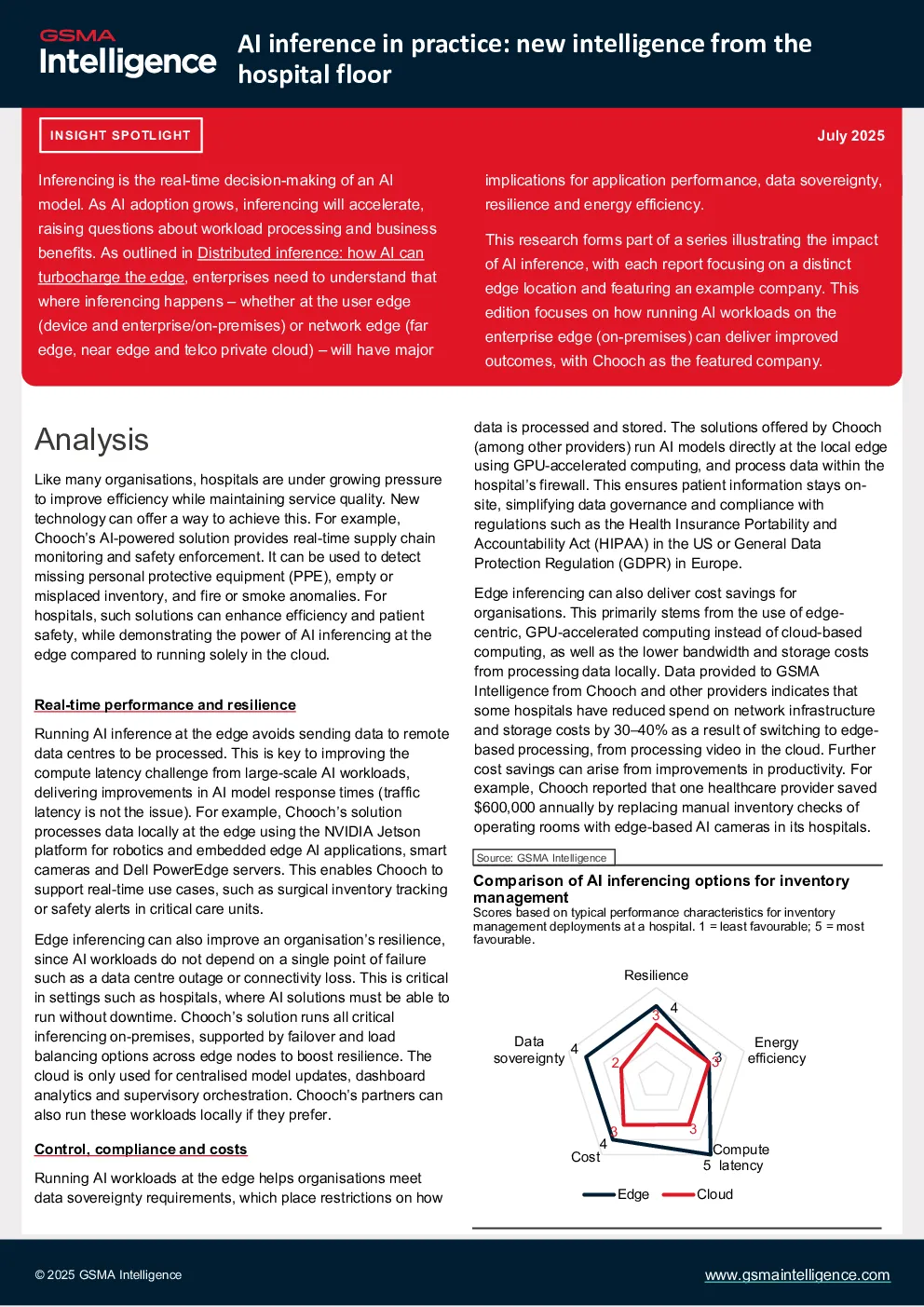
AI inference in practice: new intelligence from thehospital floor INSIGHT SPOTLIGHT Inferencing is the real-time decision-making of an AImodel. As AI adoption grows, inferencing will accelerate,raising questions about workload processing and businessbenefits. As outlined inDistributed inference: how AI can implications for application performance, data sovereignty, This research forms part of a series illustrating the impactof AI inference, with each report focusing on a distinctedge location and featuring an example company. This data is processed and stored. The solutions offered by Chooch(among other providers) run AI models directly at the local edgeusing GPU-accelerated computing, and process data within thehospital’s firewall. This ensures patient information stays on-site, simplifying data governance and compliance with Analysis Like many organisations, hospitals are under growing pressureto improve efficiency while maintaining service quality. Newtechnology can offer a way to achieve this. For example,Chooch’s AI-powered solution provides real-time supply chainmonitoring and safety enforcement. It can be used to detectmissing personal protective equipment (PPE), empty or Edge inferencing can also deliver cost savings fororganisations. This primarily stems from the use of edge-centric, GPU-accelerated computing instead of cloud-basedcomputing, as well as the lower bandwidth and storage costsfrom processing data locally. Data provided to GSMAIntelligence from Chooch and other providers indicates thatsome hospitals have reduced spend on network infrastructure Real-time performance and resilience Running AI inference at the edge avoids sending data to remotedata centres to be processed. This is key to improving thecompute latency challenge from large-scale AI workloads,delivering improvements in AI model response times (trafficlatency is not the issue). For example, Chooch’s solutionprocesses data locally at the edge using the NVIDIA Jetson Source: GSMA Intelligence Comparison of AI inferencing options for inventorymanagement Scores based on typical performance characteristics for inventorymanagement deployments at a hospital. 1 = least favourable; 5 = most Edge inferencing can also improve an organisation’s resilience,since AI workloads do not depend on a single point of failuresuch as a data centre outage or connectivity loss. This is criticalin settings such as hospitals, where AI solutions must be able torun without downtime. Chooch’s solution runs all criticalinferencing on-premises, supported by failover and load Control, compliance and costs Running AI workloads at the edge helps organisations meetdata sovereignty requirements, which place restrictions on how Implications Mobile operators Network equipment vendors •Right network, right place– In several countries, a first-moveradvantage remains for operators seeking to monetise theenterprise segment using AI inference. The on-premisesenvironment is a localised setting often requiring networkcapabilities for high-grade enterprise applications. Edge inferenceplays to this objective by reducing compute latency and pound- •AI-RAN is coming– Edge inferencing is part of a widerstory of AI becoming part of the telco network fabric. Inpractice, this means a unified RAN and edge AI capabilityknown as AI-RAN – see NVIDIA’sWhat is AI-RAN?This isevident from the product upgrades from all the globalnetwork equipment makers (e.g. Ericsson, Nokia, Huawei, •Competitive positioning– The infrastructure business ischanging. 4G and early 5G sales five years ago werelargely based on the notion that evolutionary upgradeswould be sufficient to underpin a new revenue growth storyfor telco customers. This has played out only marginally,and is still primarily driven by 5G consumer upgradesfeeding through the base over time, rather than a productreset in enterprise. GenAI and inference therefore come at •Know your vertical– It pays to understand individual customersegments. The dialogue on selling into enterprises isunfortunately often generalised, with verticals viewed as part of asingle group, despite often having very different operatingenvironments and digital maturities. Dell and NVIDIA haveenterprise expertise, showing how best to apply what are a •Sales strategy– The complex value chain for selling inferencecapabilities to enterprise buyers means operators would be wellserved to review and (in some cases) redesign sales incentiveprogrammes. These should encompass the full spectrum of sales,including pre-sales, customer value, customer success andchannel partners. Finally, a more flexible pricing approach playing This Spotlight forms part of a GSMA Intelligence researchseries on AI inference in the telecoms industry,supported by Dell Technologies (seeDell AI for Telecom) Related reading Authors Tim Hatt, Head of Research and ConsultingJames Joiner, Lead Analyst AI inference in practice: time is moneyAI inference in practice: choosing the