您的浏览器禁用了JavaScript(一种计算机语言,用以实现您与网页的交互),请解除该禁用,或者联系我们。 [巴克莱银行]:美国信用阿尔法:行情延续 - 发现报告

美国信用阿尔法:行情延续

2025-10-24 Bradley Rogoff 巴克莱银行 极度近视
报告封面

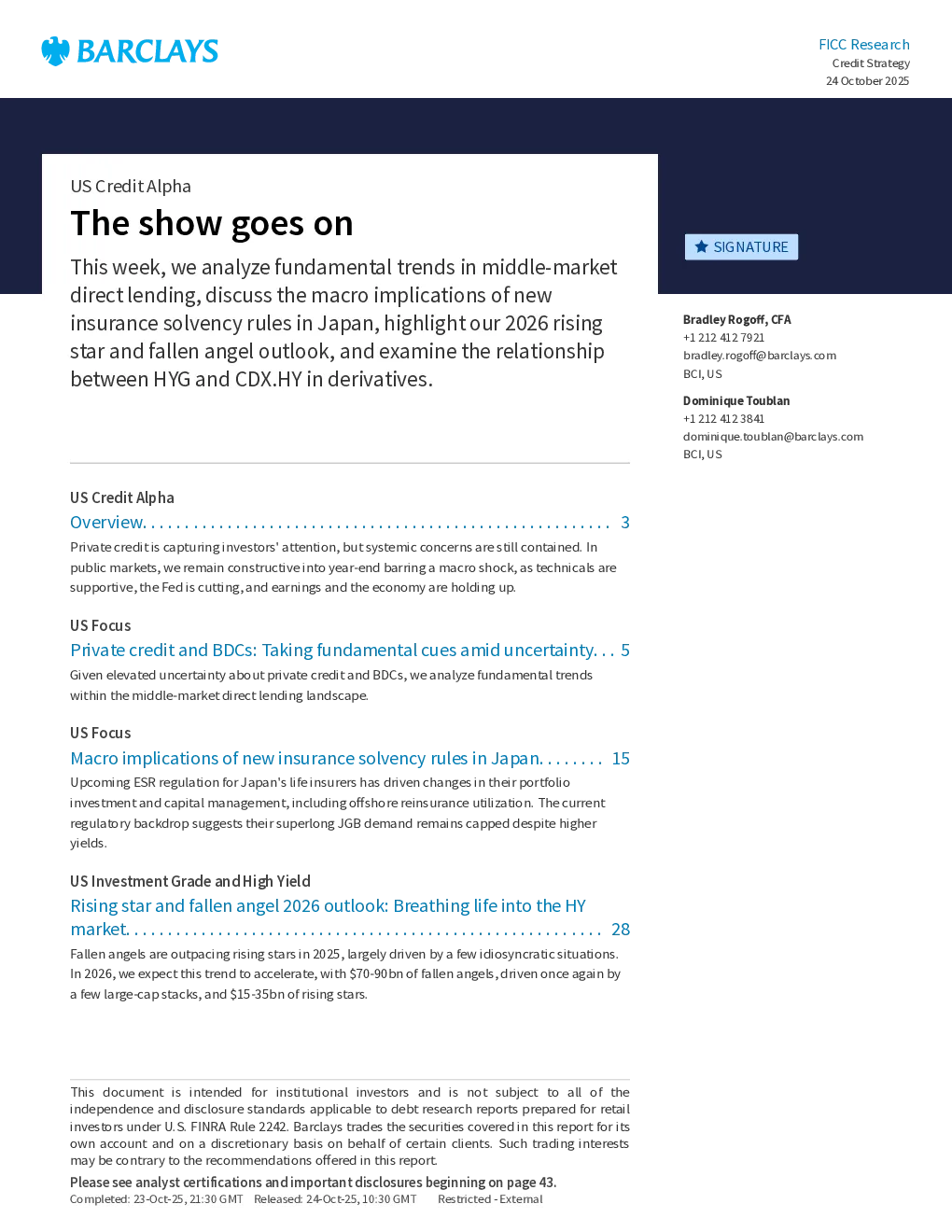
The show goes on This week, we analyze fundamental trends in middle-marketdirect lending, discuss the macro implications of newinsurance solvency rules in Japan, highlight our 2026 risingstar and fallen angel outlook, and examine the relationshipbetween HYG and CDX.HY in derivatives. BradleyRogoff,CFA+1 212 412 7921bradley.rogoff@barclays.comBCI, US Dominique Toublan+1 212 412 3841dominique.toublan@barclays.comBCI, US US Credit Alpha Overview. . . . . . . . . . . . . . . . . . . . . . . . . . . . . . . . . . . . . . . . . . . . . . . . . . . . . . . . 3 Private credit is capturing investors' attention, but systemic concerns are still contained. Inpublic markets, we remain constructive into year-end barring a macro shock, as technicals aresupportive, the Fed is cutting, and earnings and the economy are holding up. US Focus Private credit and BDCs: Taking fundamental cues amid uncertainty. . . 5 Given elevated uncertainty about private credit and BDCs, we analyze fundamental trendswithin the middle-market direct lending landscape. US Focus Macro implications of new insurance solvency rules in Japan. . . . . . . . 15 Upcoming ESR regulation for Japan's life insurers has driven changes in their portfolioinvestment and capital management, includingoffshorereinsurance utilization. The currentregulatory backdrop suggests their superlong JGB demand remains capped despite higheryields. US Investment Grade and High Yield Rising star and fallen angel 2026 outlook: Breathing life into the HYmarket. . . . . . . . . . . . . . . . . . . . . . . . . . . . . . . . . . . . . . . . . . . . . . . . . . . . . . . . . 28 Fallen angels are outpacing rising stars in 2025, largely driven by a few idiosyncratic situations.In 2026, we expect this trend to accelerate, with $70-90bn of fallen angels, driven once again bya few large-cap stacks, and $15-35bn of rising stars. Thisdocument is intended for institutional investors and is not subject to all of theindependence and disclosure standards applicable to debt research reports prepared for retailinvestors under U.S. FINRA Rule 2242. Barclays trades the securities covered in this report for itsown account and on a discretionary basis on behalf of certain clients. Such trading interestsmay be contrary to the recommendationsofferedin this report. Please see analyst certifications and important disclosures beginning on page 43.Completed: 23-Oct-25, 21:30 GMTReleased: 24-Oct-25, 10:30 GMTRestricted - External US Credit Derivatives and MacroBuy HYG and buy CDX.HY protection. . . . . . . . . . . . . . . . . . . . . . . . . . . . . .39We recommend going long HYG and buying CDX.HY protection to position for a reversal of theHYG spread underperformance so far in October. US Credit Alpha Overview Private credit is capturing investors' attention, but systemicconcerns are still contained. In public markets, we remainconstructive into year-end barring a macro shock, astechnicals are supportive, the Fed is cutting, and earningsand the economy are holding up. BradleyRogoff,CFA+1 212 412 7921bradley.rogoff@barclays.comBCI, US Dominique Toublan+1 212 412 3841dominique.toublan@barclays.comBCI, US The show goes on Credit spreads were moderatelysofterw/w.Investment grade cash widened 2bp (October15-22), to 79bp, which is the recent wide, while high yield widened 9bp, to 291bp, in line with itsbeta versus IG butoffthe 304bp wide reached two weeks ago. Locally, the decline in long-endTreasury yields likely put some pressure on investment grade spreads, as the IG all-in yield isnow close to its lowest since August 2022, at 4.69%,afterdeclining 12bp since the beginning ofthe month. With yields 3-4bp higher across the curve on Thursday, credit felt more constructive. But recent spread moves have created some interesting dislocations.For instance, webelieve that HYG is now trading too wide to CDX.HY. We are looking for a mean reversion to theirrelationship over the past year, as HYG is now trading 26bp/three standard deviations too wide.See this week's credit derivatives section for more details. The overall view from investors is that spreads will remain tight or tighten more in the near term. Investors who we've spoken with in the past couple of weeks expect technicals todominate, with robust inflows continuing. This is corroborated by the mutual fund and ETF flowdata for investment grade, which has had 25 consecutive weeks of inflows, the longest streaksince 2021, with more than $3bn this week alone. However, high yield and leveraged loanmutual funds and ETFs have now posted two consecutive weeks of outflows (totaling $1.0bnand $1.5bn, respectively). Note that structural changes areaffectinginvestment grade demand -eg, for Japanese life insurers, with recent changes in regulations potentially reducing theirappetite for US IG bonds (see here). That constructive view is supported by the strength of 3Q earnings so far.About 25% of theSP500 has reported so far, and 86% of those comp