AI智能总结
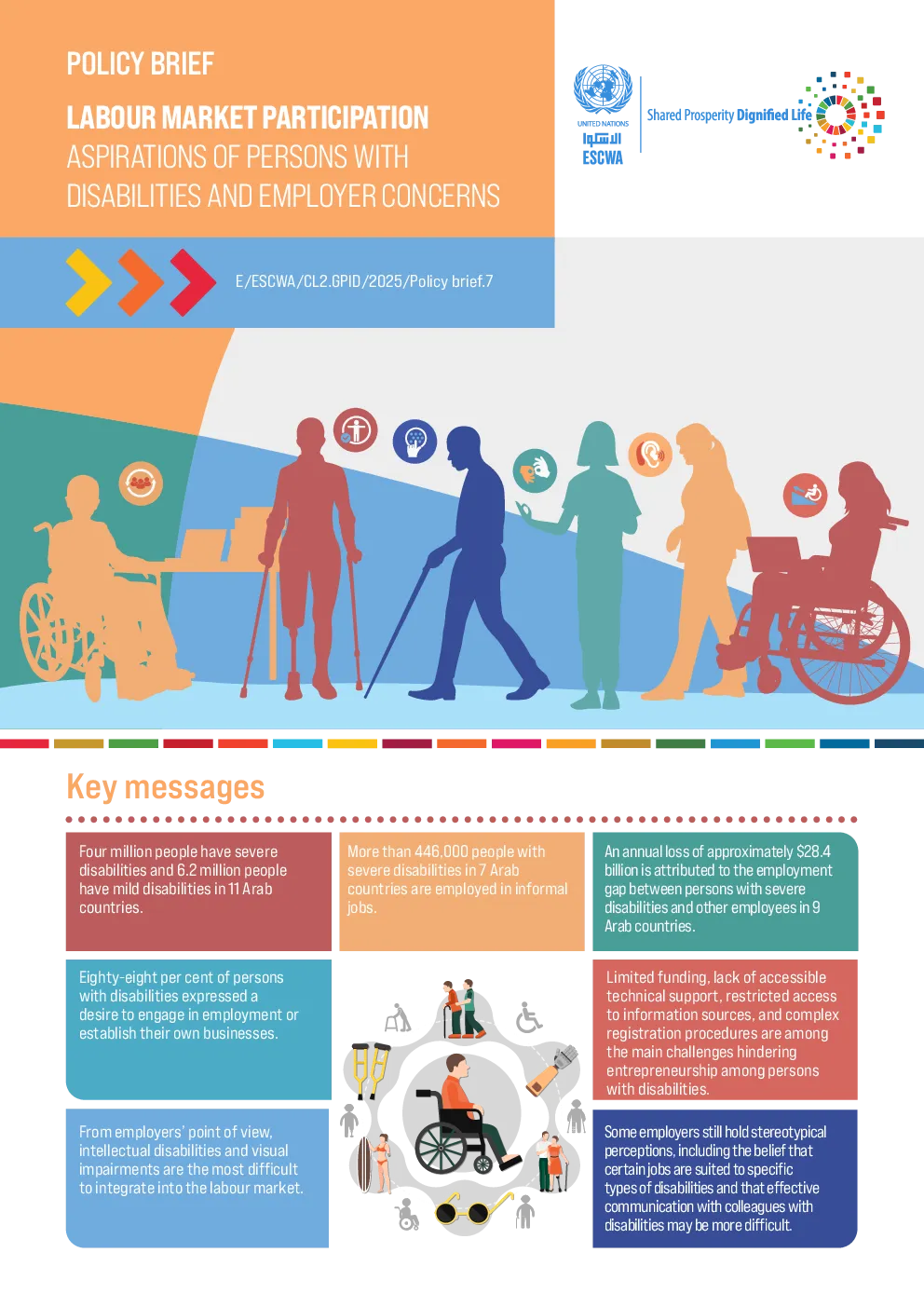
LABOUR MARKET PARTICIPATIONASPIRATIONS OF PERSONS WITHDISABILITIES AND EMPLOYER CONCERNS E/ESCWA/CL2.GPID/2025/Policy brief.7 Key messages More than 446,000 people withsevere disabilities in 7 Arabcountries are employed in informaljobs. An annual loss of approximately $28.4billion is attributed to the employmentgap between persons with severedisabilities and other employees in 9Arab countries. Four million people have severedisabilities and 6.2 million peoplehave mild disabilities in 11 Arabcountries. Limited funding, lack of accessibletechnical support, restricted accessto information sources, and complexregistration procedures are amongthe main challenges hinderingentrepreneurship among personswith disabilities. Eighty-eight percent of personswith disabilities expressed adesire to engage in employment orestablish their own businesses. From employers’ point of view,intellectual disabilities and visualimpairments are the most difficultto integrate into the labour market. Some employers still hold stereotypicalperceptions, including the belief thatcertain jobs are suited to specifictypes of disabilities and that effectivecommunication with colleagues withdisabilities may be more difficult. Introduction Approximately 2.8 percent of the population in11 Arab countries have severe disabilities, which isequivalent to 4 million people, while 4.5 percent of thepopulation, or approximately 6.2 million people, havemild disabilities.1Limited access to education is one ofthe key challenges that persons with disabilities face,particularly those with severe disabilities, hinderingtheir entry into the labour market. The illiteracy rateamong this group in 9 countries is 60 percent, witheven higher rates recorded among young people.2InMorocco, for example, the proportion of young personswith severe disabilities who are not in education,employment or training stands at 77 percent in urbanareas and 82 percent in rural areas.3 in four people with severe disabilities is unemployed,or about 117,000 people.5Of those who are employed,a total of 446,000 are engaged in informal work,reflecting the difficulty of finding decent work andaccessing social protection.6 The impact of exclusion from the labour market isnot limited to persons with disabilities but affectsthe national economy as a whole. According toESCWA estimates, the employment gap betweenpersons with severe disabilities and their peerswithout disabilities in nine Arab countries resultsin economic losses of up to $28.4 billion annually,equivalent to 1.9 percent of the gross domesticproduct (GDP).7 Denial of education undermines the ability of personswith disabilities to participate in the labour market,with employment rates for persons with severedisabilities of working age (15–64 years) not exceeding17 percent, compared to 38 percent among theirpeers without disabilities.4Within the labour force, one This policy brief examines labour marketparticipation from the perspective of persons withdisabilities as well as that of employers, using datafrom surveys conducted in four Arab countries,namely Jordan, Lebanon, Morocco and Tunisia.8 1. Labour market participation from the perspective ofpersons with disabilities A. Entrepreneurship B. Employment •Eighty-nine percent of persons with disabilities9expressed a desire to start a business, but only 8percent participated in entrepreneurial activities.Half of those interested in starting a business (51percent) have been seeking employment for morethan six months, suggesting that entrepreneurshipis a potential way out of long-term unemployment. •Gap between acquired skills and availableopportunities: 88 percent of persons withdisabilities express a desire to work, 53 percenthave been seeking employment for more than6 months, and a quarter of job seekers have auniversity or postgraduate degree. •A disinterest in employment does not reflect alack of personal motivation but rather the absenceof an enabling environment: one fifth of personswith disabilities attribute their disinterest inemployment to the difficulty of leaving their home,and 13 percent to societal discrimination. •Physical or motor disabilities are the most prevalentamong those interested in starting a business(53 percent). •Entrepreneurship remains more prevalent amongmen, although more than one third of thoseinterested in starting a business are women. •Discrimination against persons with disabilitiesin job-seeking efforts: 85 percent facedchallenges, namely recruitment processes thatdid not take their needs into consideration,discrimination in treatment and negativeattitudes during the interview. •Securing funding is one of the key challenges facedby persons with disabilities interested in starting abusiness, followed by lack of information on how tostart a business, and lack of training opportunitiesthat take into account their needs. business start-up, implementation and evaluation(9 percent), rights support (9 percent) andemployment support