您的浏览器禁用了JavaScript(一种计算机语言,用以实现您与网页的交互),请解除该禁用,或者联系我们。[世界卫生组织]:评估报告撰写指导 - 发现报告

评估报告撰写指导

AI智能总结
查看更多
评估报告撰写指导

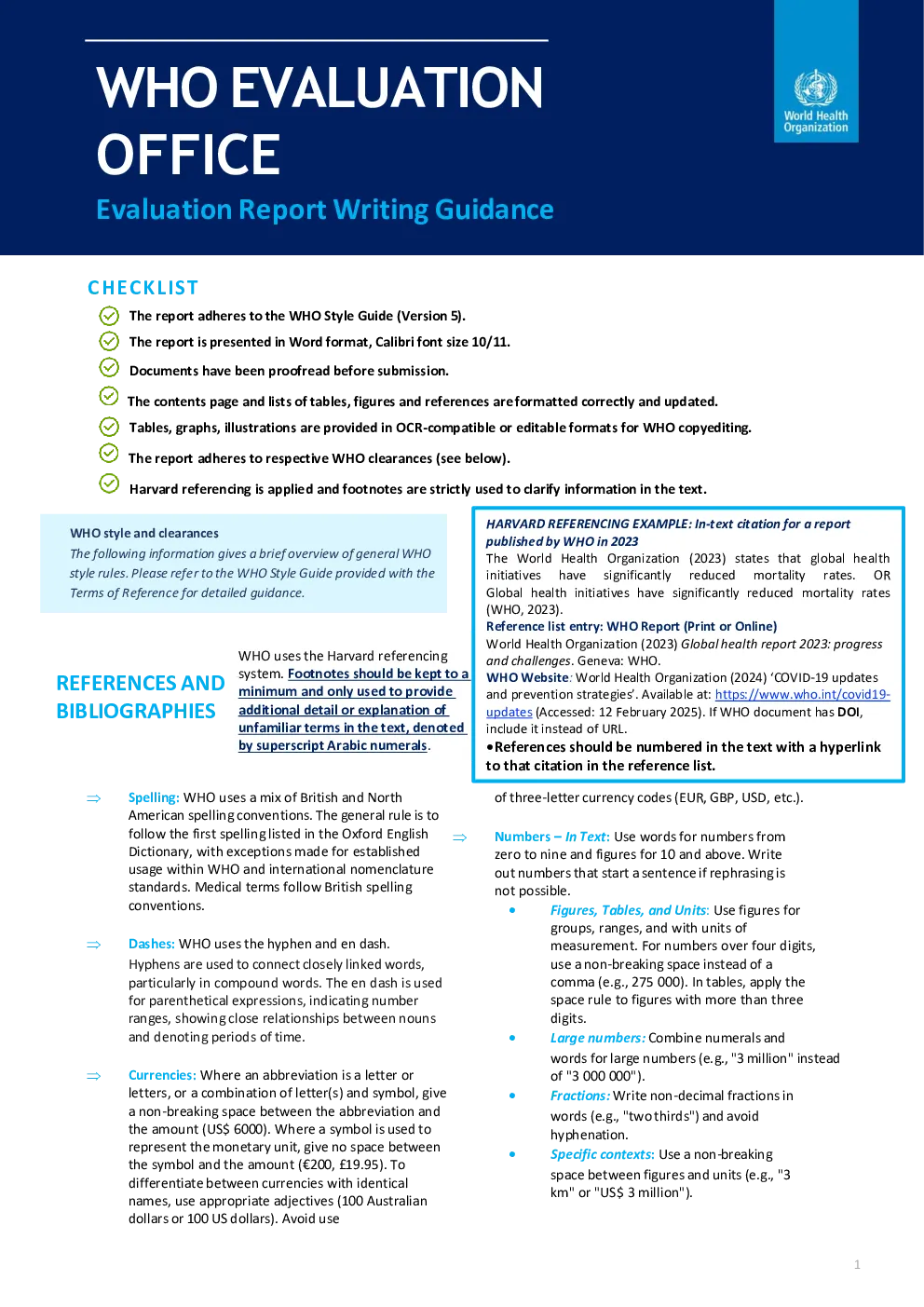
EvaluationReportWritingGuidance CHECKLIST ThereportadherestotheWHOStyleGuide(Version5). ThereportispresentedinWordformat,Calibrifontsize10/11. Documents have been proofread before submission. Thecontentspageandlistsoftables,figuresandreferencesareformattedcorrectlyandupdated. Tables, graphs, illustrations are provided in OCR-compatibleor editable formatsforWHOcopyediting. The report adheres to respective WHO clearances (see below). HARVARD REFERENCINGEXAMPLE: In-text citation for a reportpublished by WHO in 2023TheWorld Health Organization(2023)states that global health WHOstyleandclearances ThefollowinginformationgivesabriefoverviewofgeneralWHOstylerules.PleaserefertotheWHOStyleGuideprovided with theTerms of Reference for detailed guidance. initiativeshavesignificantlyreducedmortalityrates.ORGlobal health initiatives have significantly reduced mortality rates(WHO, 2023).Reference list entry: WHO Report (Print or Online)World Health Organization (2023)Global health report 2023: progressand challenges. Geneva: WHO.WHOWebsite:World Health Organization (2024) ‘COVID-19 updatesand prevention strategies’. Available at:https://www.who.int/covid19-updates(Accessed: 12 February 2025). If WHO document hasDOI,include it instead of URL.•References should be numbered in the text with a hyperlinkto that citation in the reference list. WHO uses the Harvard referencingsystem.Footnotesshouldbekepttoaminimum and only used to provideadditionaldetail orexplanationofunfamiliartermsinthetext,denotedbysuperscriptArabicnumerals. REFERENCESANDBIBLIOGRAPHIES Spelling:WHO uses a mix of British and NorthAmericanspellingconventions.Thegeneralruleis tofollow the firstspelling listed in the Oxford EnglishDictionary, with exceptions made for establishedusage within WHO and international nomenclaturestandards. Medical terms follow British spellingconventions. ofthree-lettercurrencycodes(EUR,GBP, USD, etc.). Numbers–InText:Usewordsfornumbersfromzero to nine and figures for 10 and above. Writeoutnumbersthatstartasentenceifrephrasingisnot possible.•Figures,Tables,andUnits:Usefiguresfor groups, ranges, and with units ofmeasurement. For numbers over four digits,useanon-breakingspaceinsteadof acomma (e.g., 275 000). In tables, apply thespace rule to figures with more than threedigits.•Largenumbers:Combinenumeralsandwordsforlargenumbers(e.g.,"3million" insteadof "3 000 000").•Fractions:Writenon-decimalfractionsinwords(e.g.,"twothirds")andavoidhyphenation.•Specificcontexts:Useanon-breakingspacebetweenfiguresandunits(e.g.,"3km" or "US$ 3 million"). Dashes:WHOusesthehyphenandendash.Hyphensareusedtoconnectcloselylinkedwords,particularly in compound words. The en dash is usedfor parenthetical expressions, indicating numberranges, showing close relationships between nounsand denoting periods of time. Currencies:Where an abbreviation is a letter orletters, or a combination of letter(s) and symbol, givea non-breaking space between the abbreviation andthe amount (US$ 6000). Where a symbolisusedtorepresentthemonetaryunit,give no space betweenthe symbol and the amount(€200,£19.95).Todifferentiatebetweencurrencies with identicalnames, use appropriate adjectives (100Australiandollarsor100USdollars).Avoiduse thesecondnumber(e.g.,"0.15–0.20g"). •Ranges:Use either words (e.g., "from...to" or"between...and") or anen rule(e.g., "16–18October")toexpressranges.Donotmixwordswithenrules(e.g.,"from16–18"isincorrect).Usewordsfor ranges with negative numbers.Ensurenumbersinarangeareconsistent(e.g.,"60–70million").•Unitsofmeasurement:Whenusingfullunitnames, Maps:All maps used in WHO and externalpublicationsshouldfollowUNpracticeregardingtherepresentation of international boundaries. Mapsmustbebasedonthetemplatemapoftheworldorregions from WHO or UN sources, withoutmodification. If a map is used from another source inthe report, itmustbe cleared by WHO Office of theLegal Counsel (LEG). In this instance, please consultthe evaluation manage givethe unit after the second number (e.g., "28 to49 live births"). When usingabbreviations orsymbols, repeat the unit with prepositions (e.g., "15kmand 18 km"). With an en rule, give the unit onceafter GlobalHealthObservatoryandUNGeospatial,LocationDataWHOorUNcopyrightnotice anddisclaimer for maps should be included as a footnote under each map.WHOfollows theterminology used by the UN, particularly regarding the names of Member States.GuidanceonthecorrectnamesforMemberStates,countries,areas,orterritoriesis available intheWHO style guide. APPROVEDMAPSOURCES Country Data:All data sources should be referencedfromofficial/reliablesources.WHOhas internalclearance procedures for national/country dataused (for example, achievement of SDG indicators).In such cases, pleasecontacttheEvaluationManagerforfurtherguidance. accompaniedbyareferencebelow,including datasources ifreproduced from another publication(with permission). Tables:Presentdata in rows and columns. Theyshould be numbered with Arabic numerals andtitl