您的浏览器禁用了JavaScript(一种计算机语言,用以实现您与网页的交互),请解除该禁用,或者联系我们。[招银国际]:中国致力于科技自立自强和经济发展,在“十四五”规划中实现转型 - 发现报告

中国致力于科技自立自强和经济发展,在“十四五”规划中实现转型

2025-10-24Bingnan YE、Frank Li招银国际郭***
中国致力于科技自立自强和经济发展,在“十四五”规划中实现转型

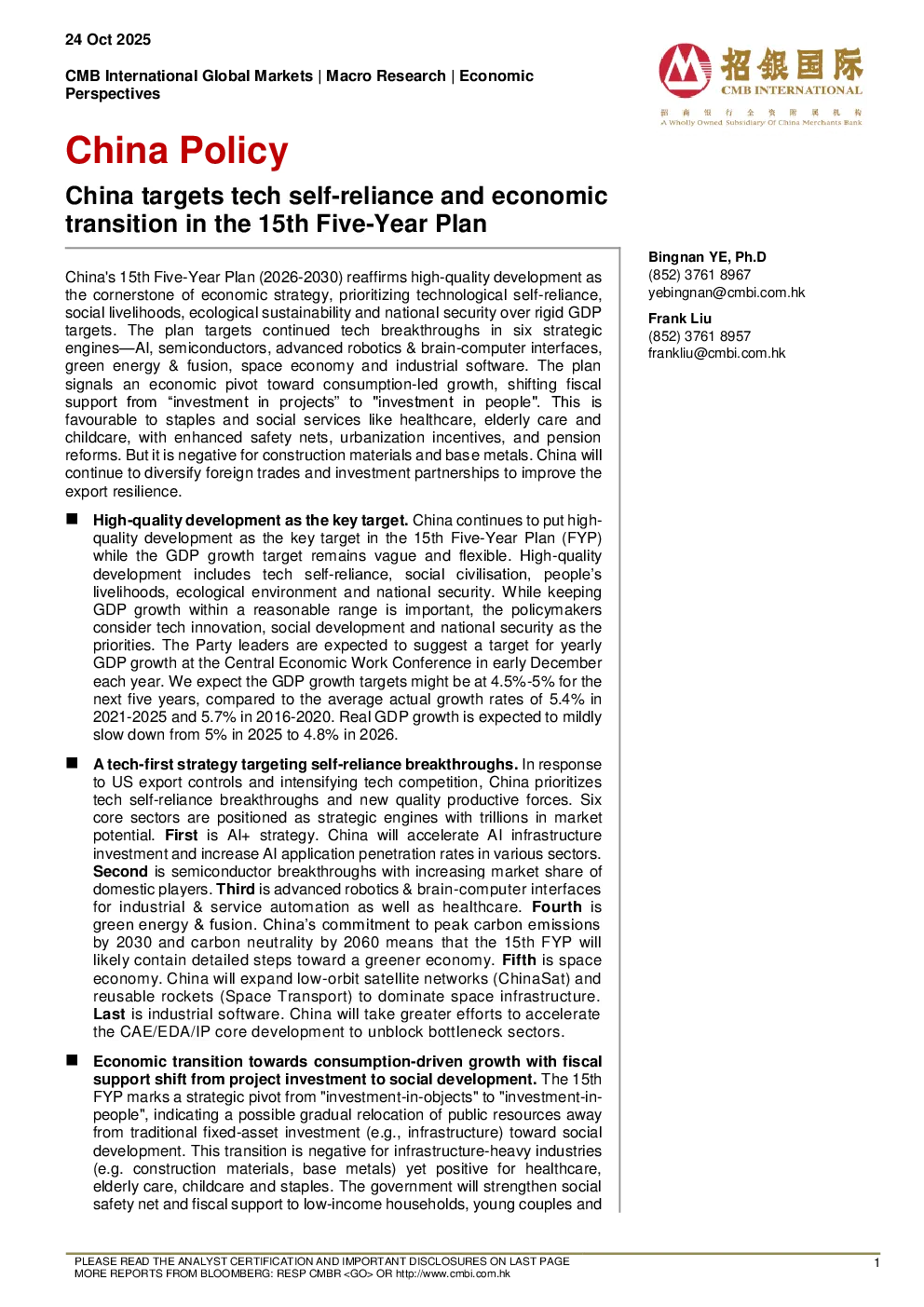
China targets tech self-reliance and economictransition in the 15thFive-YearPlan Bingnan YE, Ph.D(852) 3761 8967yebingnan@cmbi.com.hk China's 15th Five-Year Plan (2026-2030) reaffirmshigh-quality development asthe cornerstone of economic strategy, prioritizing technological self-reliance,social livelihoods, ecological sustainability and national security over rigid GDPtargets.The plan targets continued tech breakthroughs in six strategicengines—AI, semiconductors, advanced robotics & brain-computer interfaces,green energy & fusion, space economy and industrial software. The plansignalsan economic pivot toward consumption-led growth,shifting fiscalsupportfrom“investment in projects”to"investment in people".This isfavourable tostaples and social services like healthcare, elderly care andchildcare, with enhanced safety nets, urbanization incentives, and pensionreforms. But it is negative for construction materials and base metals. China willcontinue to diversify foreign tradesand investment partnershipsto improve theexport resilience. Frank Liu(852) 3761 8957frankliu@cmbi.com.hk High-quality development as the key target.China continuesto put high-quality development as the key target in the 15thFive-Year Plan(FYP)whilethe GDP growth target remains vague and flexible. High-qualitydevelopmentincludes tech self-reliance,social civilisation,people’slivelihoods, ecological environment and national security.While keepingGDP growth within a reasonable range is important,the policymakersconsidertech innovation, social development and national securityas thepriorities. TheParty leaders are expected to suggest a target for yearlyGDP growth at the Central Economic Work Conference in early Decembereachyear. We expect the GDP growth targets might be at 4.5%-5% forthenext five years,compared to the average actual growth rates of5.4% in2021-2025 and 5.7% in 2016-2020. Real GDP growth is expected to mildlyslow down from 5% in 2025 to 4.8% in 2026. A tech-first strategy targeting self-reliance breakthroughs.In responseto US export controls and intensifying tech competition, China prioritizestech self-reliance breakthroughs and new quality productive forces. Sixcore sectors are positioned as strategic engines with trillions in marketpotential.First is AI+ strategy. China will accelerate AI infrastructureinvestment and increase AI application penetration rates in various sectors.Secondis semiconductor breakthroughs with increasing market shareofdomestic players.Thirdis advanced robotics &brain-computer interfacesfor industrial & service automation as well as healthcare.Fourth isgreen energy & fusion. China’s commitment to peak carbon emissionsby 2030 and carbon neutrality by 2060 meansthat the 15th FYP willlikely contain detailed steps toward a greener economy.Fifthis spaceeconomy. China will expand low-orbit satellite networks (ChinaSat) andreusable rockets (Space Transport) to dominate space infrastructure.Lastis industrial software. China will take greater efforts to acceleratethe CAE/EDA/IP core development to unblock bottleneck sectors. Economic transition towards consumption-driven growthwith fiscalsupport shift from project investment to social development.The 15thFYPmarks a strategic pivot from "investment-in-objects" to "investment-in-people", indicating a possible gradual relocation ofpublic resources awayfrom traditionalfixed-asset investment (e.g.,infrastructure) toward socialdevelopment.This transition isnegative forinfrastructure-heavy industries(e.g.construction materials,base metals)yet positive for healthcare,elderly care, childcare and staples. The government will strengthen socialsafety net and fiscal support to low-income households, young couples and farmers. China will continue to facilitate the urbanisation process with moreentrepreneurship and job opportunities, better subsidized housing systemand lower living costs.With China facing demographic challenges such asa declining birthrate and a rapidly aging population, the 15th FYP mayinclude stronger family support policies, pension reforms, and incentivesfor elderlycare innovation. Foreign trade and investment diversification.Amid escalating US-Chinatensions, China is acceleratingtrade and investment diversification, forgingdeeper ties with Asia, Europe,the Middle East,Latin Americaand Africa.This strategy mitigates risks, boosting RMB internationalization and supplychain resilience.Chinese companies in technologies, telecommunicationservices, energy, EVs, construction services and capital goods mightbenefit from the trade and investment diversification strategy. Source: Wind, CMBIGM Source: Wind, CMBIGM Source: Wind, CMBIGM Source: Wind, CMBIGM Source: Wind, CMBIGM Source: Wind, CMBIGM Source: Wind, CMBIGM Source: Wind, CMBIGM Source: Wind, CMBIGM Source:Wind, CMBIGM Source:Wind, CMBIGMNote: CG–central government, LG–local government Source: Wind, CMBIGM Source: Wind, CMBIGM Source:Wind, CMBIGM Source:Wind, CMBIGM Source: Wind