您的浏览器禁用了JavaScript(一种计算机语言,用以实现您与网页的交互),请解除该禁用,或者联系我们。[ADB]:亚开行-道路投资对生命周期碳排放影响的调查 - 发现报告

亚开行-道路投资对生命周期碳排放影响的调查

交通运输2025-10-21ADB�***
AI智能总结
查看更多
亚开行-道路投资对生命周期碳排放影响的调查

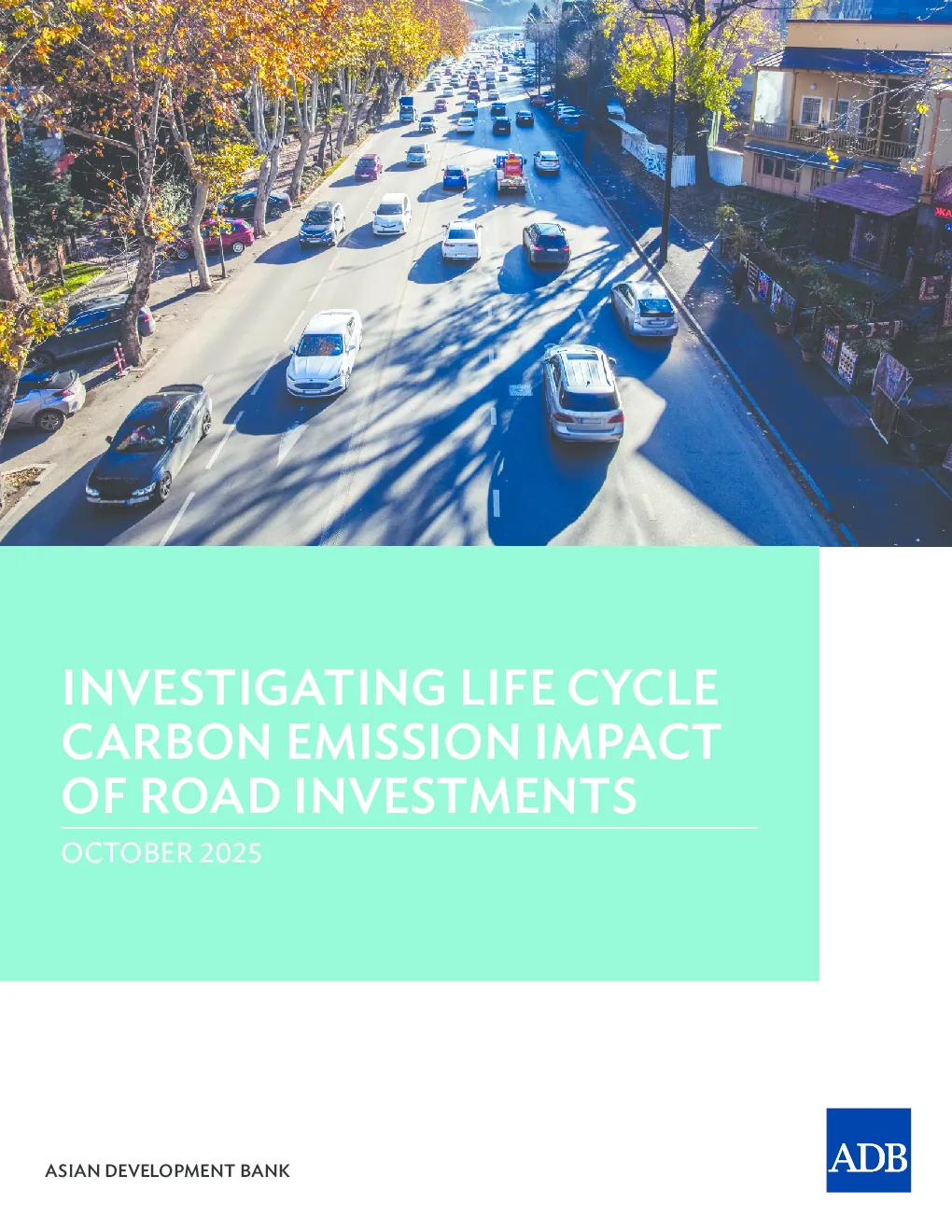
OCTOBER 2025 INVESTIGATING LIFE CYCLECARBON EMISSION IMPACTOF ROAD INVESTMENTS OCTOBER 2025 Creative Commons Attribution 3.0 IGO license (CC BY 3.0 IGO) © 2025 Asian Development Bank6 ADB Avenue, Mandaluyong City, 1550 Metro Manila, PhilippinesTel +63 2 8632 4444; Fax +63 2 8636 2444www.adb.org Some rights reserved. Published in 2025. ISBN 978-92-9277-420-2 (print); 978-92-9277-421-9 (PDF); 978-92-9277-422-6 (ebook)Publication Stock No. TCS250338-2DOI: http://dx.doi.org/10.22617/TCS250338-2 The views expressed in this publication are those of the authors and do not necessarily reflect the views and policiesof the Asian Development Bank (ADB) or its Board of Governors or the governments they represent. ADB does not guarantee the accuracy of the data included in this publication and accepts no responsibility for anyconsequence of their use. The mention of specific companies or products of manufacturers does not imply that theyare endorsed or recommended by ADB in preference to others of a similar nature that are not mentioned. By making any designation of or reference to a particular territory or geographic area in this document, ADB does notintend to make any judgments as to the legal or other status of any territory or area. This publication is available under the Creative Commons Attribution 3.0 IGO license (CC BY 3.0 IGO)https://creativecommons.org/licenses/by/3.0/igo/. By using the content of this publication, you agree to be boundby the terms of this license. For attribution, translations, adaptations, and permissions, please read the provisionsand terms of use at https://www.adb.org/terms-use#openaccess. This CC license does not apply to non-ADB copyright materials in this publication. If the material is attributedto another source, please contact the copyright owner or publisher of that source for permission to reproduce it.ADB cannot be held liable for any claims that arise as a result of your use of the material. Please contact pubsmarketing@adb.org if you have questions or comments with respect to content, or if you wishto obtain copyright permission for your intended use that does not fall within these terms, or for permission to usethe ADB logo. Corrigenda to ADB publications may be found at http://www.adb.org/publications/corrigenda. Notes: In this publication, “$” refers to United States dollars.ADB recognizes “China” as the People’s Republic of China and “Kyrgyzstan” as the Kyrgyz Republic. On the cover:Vehicles on the road in Georgia.Vehicles passing through Zviad Gamsakhurdia (Right Bank) Streetin Tbilisi (photo by ADB). TABLES AND FIGURESFOREWORDACKNOWLEDGMENTSABBREVIATIONSWEIGHTS AND MEASURES ivvviviiviii 1INTRODUCTION1 Context1Purpose2The Approach2Findings and Recommendations3 2METHODOLOGY Overview4Carbon Dioxide Equivalent5Calculations6Estimating Non-HDM-4 Input Parameters8Offsetting Emissions15Typical Applications16 3POLICIES AND CASE STUDIES19 Road Decarbonization Policies19Case Studies22 ANNEX: THE TOOL KIT APPENDIX75 REFERENCES77 TABLES AND FIGURES TABLES 1IPCC Sixth Assessment Report on Global Warming Potentials52Grid Factor by Country93ADB Social Cost of Carbon104Vehicle Manufacture Emissions115Summary of CO2e Estimates in HDM-4 Vehicle Classes136Road Works Emission Factors147CO2Sequestration Rates from Planting Trees158Example Types of Analysis and the Need to Re-Run HDM-4189Example Road Decarbonization Policies19 FIGURES 1Increase in Transport Sector Emissions by Region, 2010–201912Sources of Road-Related Emissions53Energy Used in Production144Options for Greener Road Infrastructure Development and Management165Pathways to Low Vehicle Emissions17 FOREWORD Globally, transport is and will continue to be dominated by road-based modes. Within Asia and the Pacific,substantial road investment is needed to address the infrastructure gap and respond to a growing demandfor mobility and increasing vehicle ownership. This provides the opportunity to improve and expandroad networks, and to address negative externalities by ensuring greener, safer, climate-resilient, andadaptive designs. Sector emissions, both local and global, are projected to substantially increase over the coming years.Stringent efforts should be made to reduce emissions and support new pathways to lower and to ultimatelydecarbonize the transport sector and clean the air. It is important to recognize that most greenhouse gas emissions from the transport sector come from theuse of transport infrastructure, rather than the provision of the infrastructure itself. There are emissionsrelated to building or maintaining transport assets, but these typically account for a small proportion(often well below 10%) of total life cycle-related emissions. It is not the roads that have climate changeemissions, but the vehicles that use these roads. As such, activities to address the transport sector’s climatechange emissions must take a broad view and aim to address the sector activities that emit the m