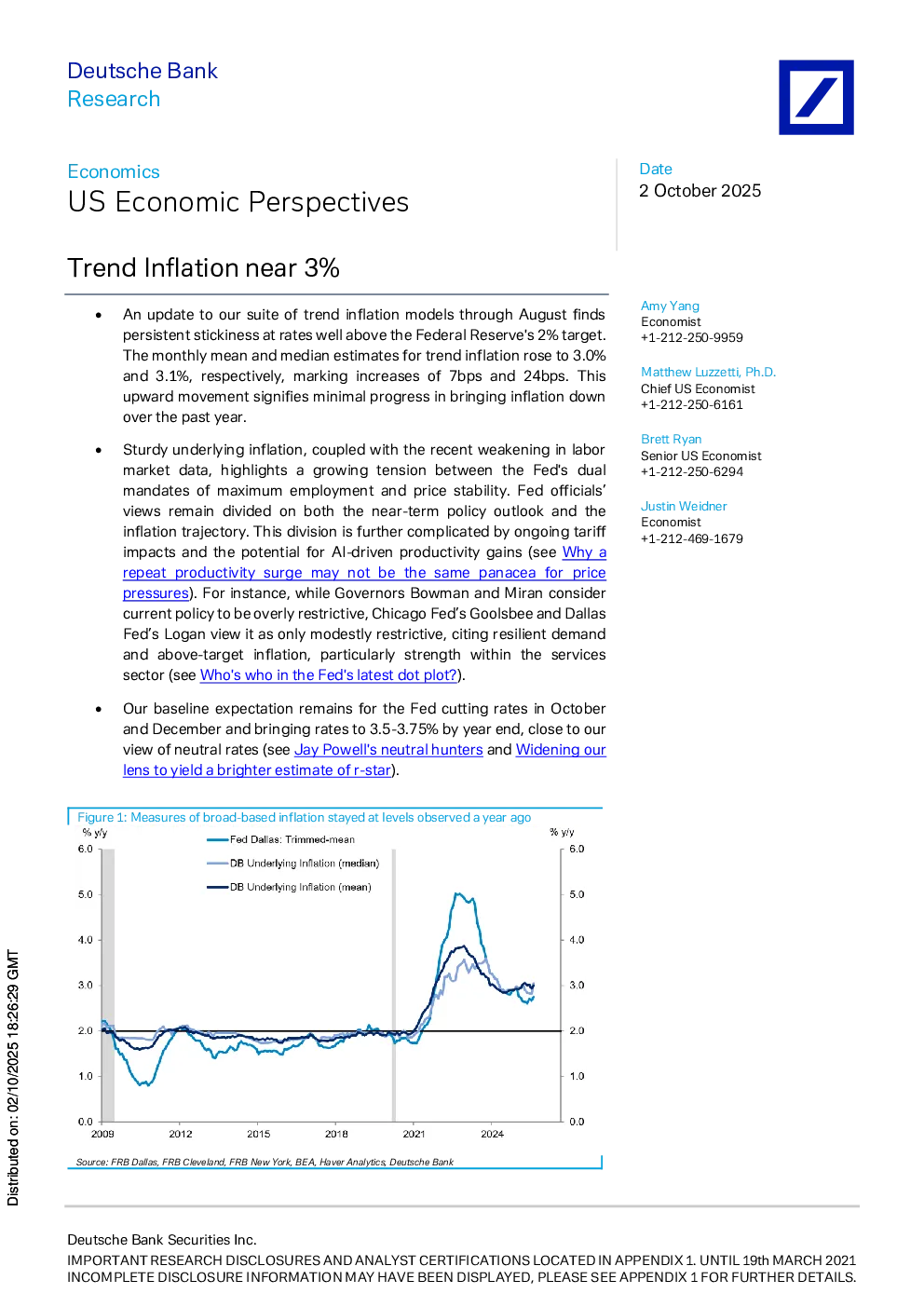
Economics US Economic Perspectives Trend Inflation near 3% Amy YangEconomist+1-212-250-9959 •An update to our suite of trend inflation models through August findspersistent stickiness at rates well above the Federal Reserve's 2% target.The monthly mean and median estimates for trendinflation rose to 3.0%and 3.1%, respectively, marking increases of 7bps and 24bps. Thisupward movement signifies minimal progress in bringing inflation downover the past year. Matthew Luzzetti, Ph.D.Chief US Economist+1-212-250-6161 Brett RyanSenior US Economist+1-212-250-6294 •Sturdy underlying inflation, coupled with the recent weakening in labormarket data, highlights a growing tension betweenthe Fed's dualmandates of maximum employment and price stability. Fed officials’views remain divided on both the near-term policy outlook and theinflation trajectory. This division is further complicated by ongoing tariffimpacts and the potential for AI-driven productivity gains (seeWhy arepeat productivity surge may not be the same panacea for pricepressures). For instance, while Governors Bowman and Miran considercurrent policy to be overly restrictive, Chicago Fed’s Goolsbee and DallasFed’s Logan view it as only modestly restrictive, citing resilient demandandabove-target inflation,particularly strength within the servicessector (seeWho's who in the Fed's latest dot plot?). Justin WeidnerEconomist+1-212-469-1679 •Our baseline expectation remains for the Fed cutting rates in Octoberand December and bringing rates to 3.5-3.75% by year end, close to ourview of neutral rates (seeJay Powell's neutral huntersandWidening ourlens to yield a brighter estimate of r-star). Trend Inflation Update Core PCE inflation remained strong in August, with the monthly rate nearly stableat 23bps and the annual rate rising 6bps to 2.91%. Durable goods pricescontinued their monthly decline, falling by 11bps with mixed evidence in tariff-sensitive categories.While furnishings and equipment (-0.15% month-over-month) and recreational goods (-1.71%) experienced significant price drops inAugust, prices for motor vehicles and parts moved up by 69bps and other durablegoods surged by 2% relative to July, marking the highest monthly pace since1990.The persistence and duration of tariff-induced inflation remain keyconsiderations. Theservice sector contributed 23bps to monthly core inflation,roughlyconsistent with its contribution during the pre-pandemic period. Within services,inflationary pressures were broad-based across housing and utilities (+0.31%month-over-month), transportation (+0.92%), food services and accommodations(+0.54%), as well as financial services (+0.61%). Notably, monthly inflation forshelter took a significant step up to 36bps, its highest level since April. “Super-core” inflation remained firm at 33bps in August, with the 3-month annualizedrate rising 48bps to 3.5% and 6-month annualized rates falling 38bps to 2.7%. With these data, we updated our trend inflation dashboard, which replicates avariety of measures from the Fed staff's past work (seeTransient or persistent? Atrend inflation dashboard for decoding monthly datafor details about thedashboard components).Our preferred approach for interpreting these data is toaverage across the ten models that we track. Our monthly mean and medianestimates edged up by 7bps and 24bps to 3.0% and 3.1%, respectively. Thispersistence suggests a stalling of disinflation progress, with trend inflationremaining at elevated levels observed a year prior. Within the individual measures, trimmed mean PCE inflation rose 8bps to 2.8% inyear-over-year terms while the Cleveland Fed’s median PCE inflation gaugeremained nearly unchanged at 3.3%. The NY Fed’s multivariate core trendmeasure surged by 24bps to 3.1% in August. The rest of our individual measuressaw little change from July, except for one. Inflation expectations from theUniversity of Michigan survey ticked up by 10bps to 3.5% in August, which hadthe effect of raising the Phillips-curve-model-based estimates by a similarmagnitude to 4.0%. Sturdy underlying inflation, coupled with the recent weakening in labor marketdata, highlights a growing tension between the Fed's dual mandates of maximumemployment and price stability. Fed officials’ views remain divided on both thenear-term policy outlook and the inflation trajectory. This division is furthercomplicated by ongoing tariff impacts and the potential for AI-driven productivitygains (seeWhy a repeat productivity surge may not be the same panacea for pricepressures). For instance, while Governors Bowman and Miran consider currentpolicy to be overly restrictive, Chicago Fed’s Goolsbee and Dallas Fed’s Loganview it as only modestly restrictive, citing resilient demand and above-targetinflation, particularly strength within the services sector (seeWho's who in theFed's latest dot plot?). Our baseline expectation remains for the Fed cutting rates in October andDecember and bringing rates to 3.5-3.75% b