您的浏览器禁用了JavaScript(一种计算机语言,用以实现您与网页的交互),请解除该禁用,或者联系我们。 [德意志银行]:美国经济展望趋势通胀仍居首位-117706247 - 发现报告

美国经济展望趋势通胀仍居首位-117706247

金融 2025-09-21 德意志银行 玉苑金山
报告封面

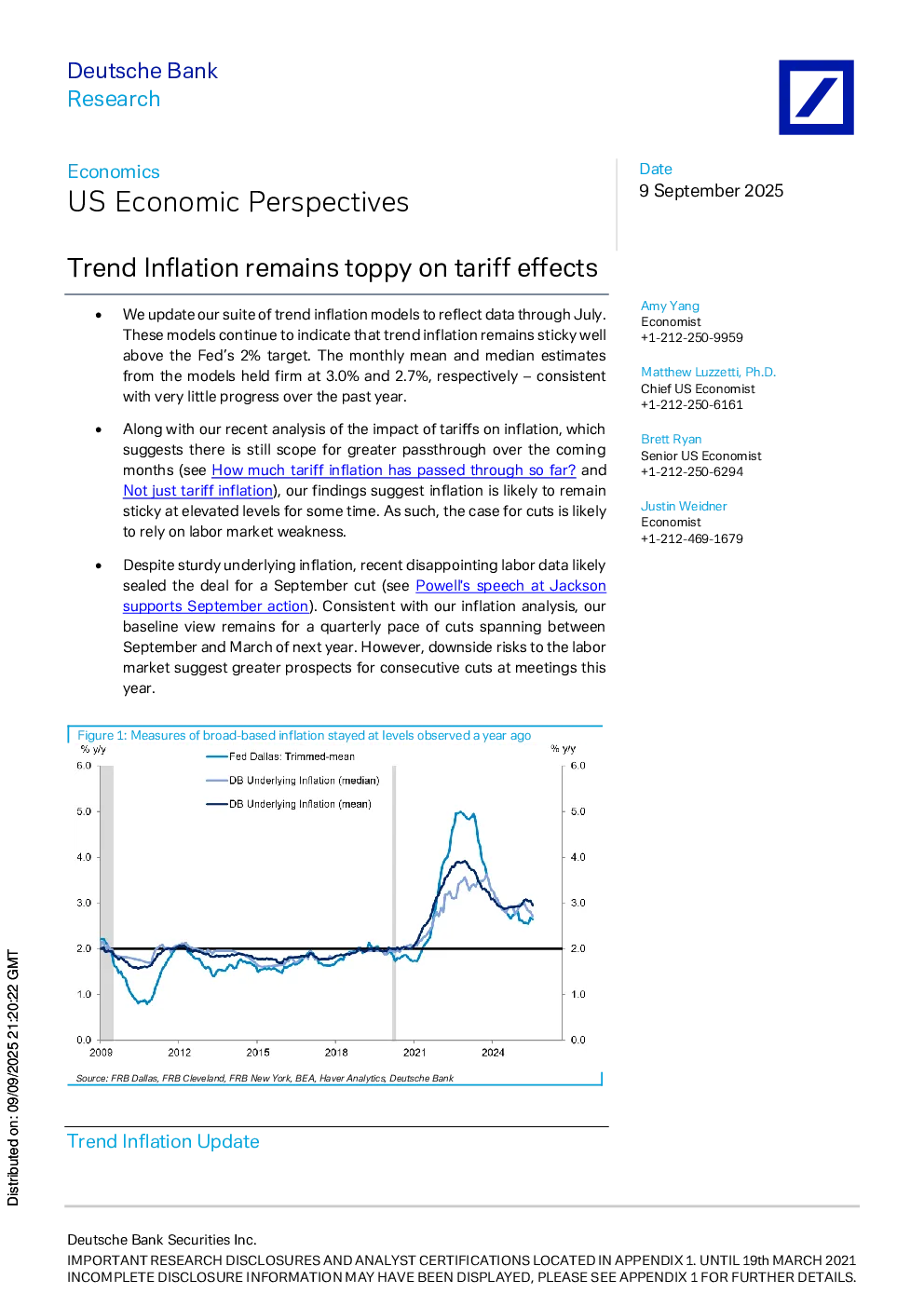
Economics US Economic Perspectives Trend Inflation remains toppy on tariff effects Amy YangEconomist+1-212-250-9959 •We update our suite of trend inflation models to reflect data through July.These models continue to indicate that trend inflation remains sticky wellabove the Fed’s 2%target. The monthly mean and median estimatesfrom the models held firm at 3.0% and 2.7%, respectively–consistentwith very little progress over the past year. Matthew Luzzetti, Ph.D.Chief US Economist+1-212-250-6161 •Along with our recent analysis of the impact of tariffs on inflation, whichsuggests there is still scope for greater passthrough over the comingmonths (seeHow much tariff inflation has passed through so far?andNot just tariff inflation), our findings suggest inflation is likely to remainsticky at elevated levels for some time. As such, the case for cuts is likelyto rely on labor market weakness. Brett RyanSenior US Economist+1-212-250-6294 Justin WeidnerEconomist+1-212-469-1679 •Despite sturdy underlying inflation, recent disappointing labor data likelysealed the deal for a September cut (seePowell's speech at Jacksonsupports September action). Consistent with our inflation analysis, ourbaseline view remains for a quarterly pace of cuts spanning betweenSeptember and March of next year. However, downside risks to the labormarket suggest greater prospects for consecutive cuts at meetings thisyear. Trend Inflation Update Core PCE inflationremained strong in July, with the monthly rate ticking up to27bps and the annual rate rising 11bps to 2.88%. Durable goods prices saw apartial reversal of the previous month's rapid increase, falling by 11 bps. Thisdisinflationwas particularly evident in tariff-sensitive categories,such asfurnishings and equipment (+0.12% month-over-month) and recreational goods(-0.92%). Service sector categories contributed 24bps to monthly core inflation,roughly consistent with its contribution in the pre-pandemic period. Withinservices, inflationary pressures stemmed primarily from housing and utilities(+0.23%month-over-month),healthcare(+0.20%)and financial services(+1.21%), the latter driven by the summer equity market rally. While monthlyrental inflation has stayed within its pre-pandemic range of 20-30 bps since April,super-core inflation (core services excluding housing) reaccelerated to 39bps inJuly, nearly doubling the previous month’s pace. With these data, we updated our trend inflation dashboard, which replicates avariety of measures from the Fed staff's past work (seeTransient or persistent? Atrend inflation dashboard for decoding monthly datafor details about thedashboard components).Our preferred approach for interpreting these data is toaverage across the ten models that we track. Both our monthly mean and medianestimate for trend inflation fell by 10bps and remained firm at 3.0% and 2.7%,respectively. This persistence suggests astalling of disinflation progress, withtrend inflation remaining at elevated levels observed a year prior. Within the individual measures, the trimmed mean PCE inflation remained nearlyunchanged at 2.7% in year-over-year terms while the Cleveland Fed’s medianPCE inflation gauge rose by 2bps to 3.2%. The NY Fed’s multivariate core trendmeasure fell by 10bps to 2.7% in July. The rest of our individual measures sawlittle change from June, except for one. Inflation expectations from the Universityof Michigan survey dropped by another 60bps to 3.4% in July after peaking inApril attributed to tariff shocks. Thishad the effect of reducing the Phillips curvemodel-based estimates by a similar magnitude to 3.9%. Despite sturdy underlying inflation, recent disappointing labor data likely sealedthedeal for a September cut(see Powell's speech at Jackson supportsSeptember action). Consistent with our inflation analysis, our baseline view remains for a quarterly pace of cuts spanning between September and March ofnext year. However, downside risks to the labor market suggest greater prospectsfor consecutive cuts atmeetings this year. Source:BEA, Haver Analytics, Deutsche Bank Source:BEA, Haver Analytics, Deutsche Bank Source:BEA, Univ. of Michigan, FRB Philadelphia, Haver Analytics, DeutscheBank Source:BEA, Univ. of Michigan, FRB Philadelphia, Haver Analytics, Deutsche Bank Appendix 1 Analyst Certification The views expressed in this report accurately reflect the personal views of the undersigned lead analyst(s). Inaddition, the undersigned lead analyst(s) has not and will not receive any compensation for providing a specificrecommendation or view in thisreport. Matthew Luzzetti, Ph.D., Brett Ryan, Justin Weidner, Amy Yang. Important Disclosures Prices are current as of the end of the previous trading session unless otherwise indicated and are sourced from localexchanges via Reuters, Bloomberg and other vendors . Other information is sourced from Deutsche Bank, subjectcompanies, and other sources. For further information regarding disclosures relevant