您的浏览器禁用了JavaScript(一种计算机语言,用以实现您与网页的交互),请解除该禁用,或者联系我们。[世界卫生组织]:使用开源定制基于事件的监控:大规模集会实用指南 - 发现报告

使用开源定制基于事件的监控:大规模集会实用指南

2025-09-02世界卫生组织S***
AI智能总结
查看更多
使用开源定制基于事件的监控:大规模集会实用指南

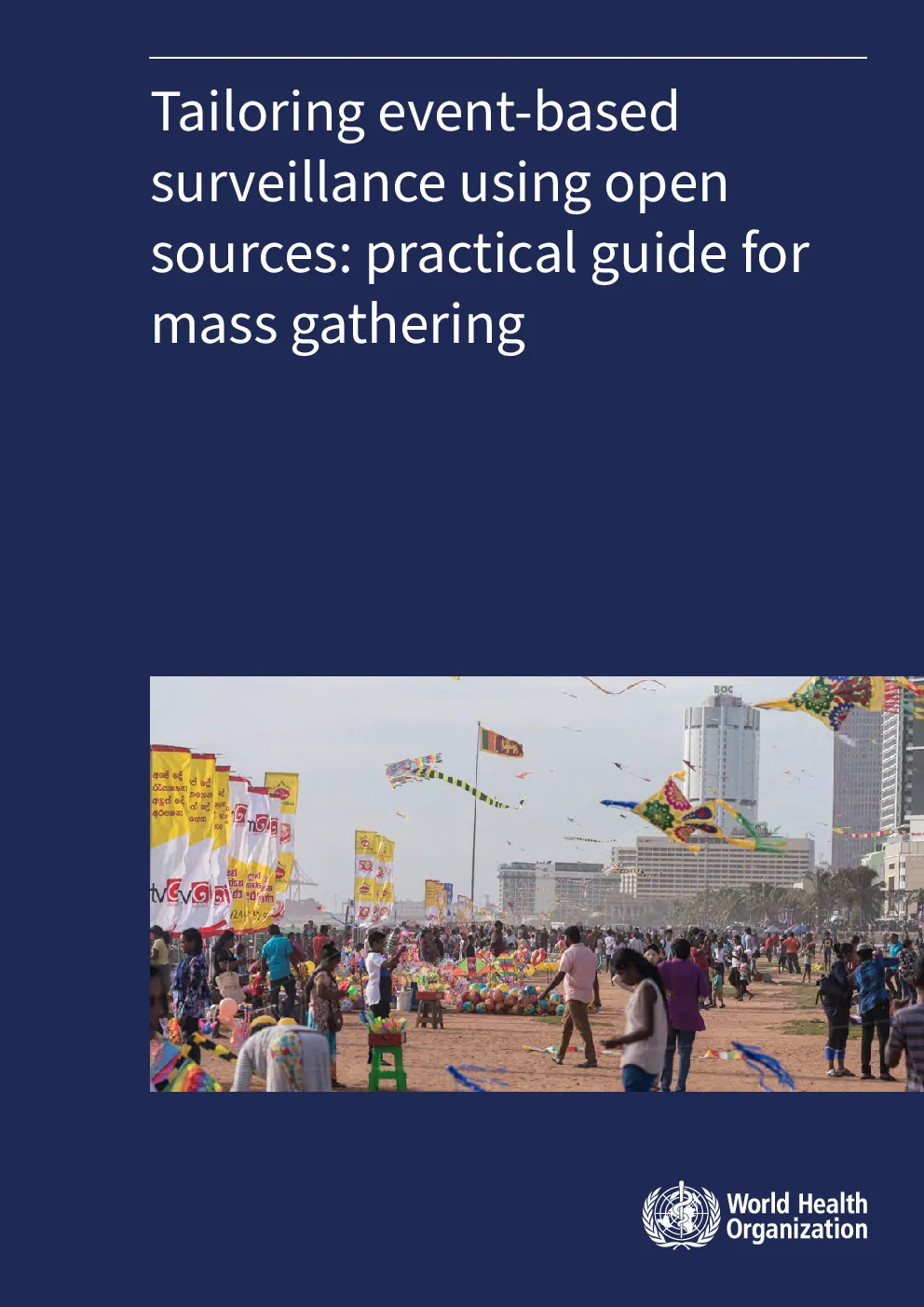
Tailoring event-basedsurveillance using opensources: practical guide formass gathering Tailoring event-based surveillance using open sources: practical guide for mass gathering ISBN 978-92-4-010601-7 (electronic version)ISBN 978-92-4-010602-4 (print version) © World Health Organization 2025 Some rights reserved. This work is available under the Creative Commons Attribution-NonCommercial-ShareAlike 3.0IGO licence (CC BY-NC-SA 3.0 IGO; https://creativecommons.org/licenses/by-nc-sa/3.0/igo). Under the terms of this licence, you may copy, redistribute and adapt the work for non-commercial purposes,provided the work is appropriately cited, as indicated below. In any use of this work, there should be no suggestionthat WHO endorses any specific organization, products or services. The use of the WHO logo is not permitted. If youadapt the work, then you must license your work under the same or equivalent Creative Commons licence. If youcreate a translation of this work, you should add the following disclaimer along with the suggested citation: “Thistranslation was not created by the World Health Organization (WHO). WHO is not responsible for the content oraccuracy of this translation. The original English edition shall be the binding and authentic edition”. Any mediation relating to disputes arising under the licence shall be conducted in accordance with the mediationrules of the World Intellectual Property Organization (http://www.wipo.int/amc/en/mediation/rules/). Suggested citation.Tailoring event-based surveillance using open sources: practical guide for mass gathering.Geneva: World Health Organization; 2025. Licence: CC BY-NC-SA 3.0 IGO. Cataloguing-in-Publication (CIP) data.CIP data are available at https://iris.who.int/. Sales, rights and licensing.To purchase WHO publications, see https://www.who.int/publications/book-orders. Tosubmit requests for commercial use and queries on rights and licensing, see https://www.who.int/copyright. Third-party materials.If you wish to reuse material from this work that is attributed to a third party, such as tables,figures or images, it is your responsibility to determine whether permission is needed for that reuse and to obtainpermission from the copyright holder. The risk of claims resulting from infringement of any third-party-ownedcomponent in the work rests solely with the user. General disclaimers.The designations employed and the presentation of the material in this publication do notimply the expression of any opinion whatsoever on the part of WHO concerning the legal status of any country,territory, city or area or of its authorities, or concerning the delimitation of its frontiers or boundaries. Dotted anddashed lines on maps represent approximate border lines for which there may not yet be full agreement. The mention of specific companies or of certain manufacturers’ products does not imply that they are endorsedor recommended by WHO in preference to others of a similar nature that are not mentioned. Errors and omissionsexcepted, the names of proprietary products are distinguished by initial capital letters. All reasonable precautions have been taken by WHO to verify the information contained in this publication.However, the published material is being distributed without warranty of any kind, either expressed or implied. Theresponsibility for the interpretation and use of the material lies with the reader. In no event shall WHO be liable fordamages arising from its use. Photo cover: The weekend along the promenade of Galle Face Beach in Colombo, Sri Lanka. © WHO / Conor Ashleigh. Contents AcknowledgementsivAbbreviationsvIntroduction1Methodology2Step-by-step guide to tailor EBS using open sources for MGs3Step 1: Assessment of the existing EBS using open sources4Step 2: Prioritization of diseases, syndromes or hazards6Step 3: Identification of information sources and platforms for monitoring7Step 4: Establishment or augmentation of information-sharing mechanism10Step 5: Establishment of standard operating procedures, training and testing11Step 6: Implementation of tailored EBS12Case studies: Examples from previous MGs13References14 Acknowledgments This document was produced by the Border Health andMass Gathering Unit, Country Readiness StrengtheningDepartment of the World Health Organization (WHO)Health Emergencies Programme. The main text waswritten by Amaia Artazcoz Glaria and Manami Yanagawaunder the supervision of Ninglan Wang. The documentgreatly benefited from inputs of the staff of the PublicHealth Intelligence Unit at the Alert and ResponseCoordination Department, who lead both routineand mass gathering (MG)-specific global event-basedsurveillance (EBS) at WHE: Adedoyin Abiola Awofisayo-Okuyelu, Blanche Johanna Greene-Cramer and KajaKaasik-Aaslav under the supervision of Esther Hamblion.We extend our thanks to our colleagues at the Biosafetyand Health Security Protection Unit, Epidemic andPandemic Preparedness and Prevention at WHE: Sophi