美国_兴趣_价格_无需思考_无需担忧
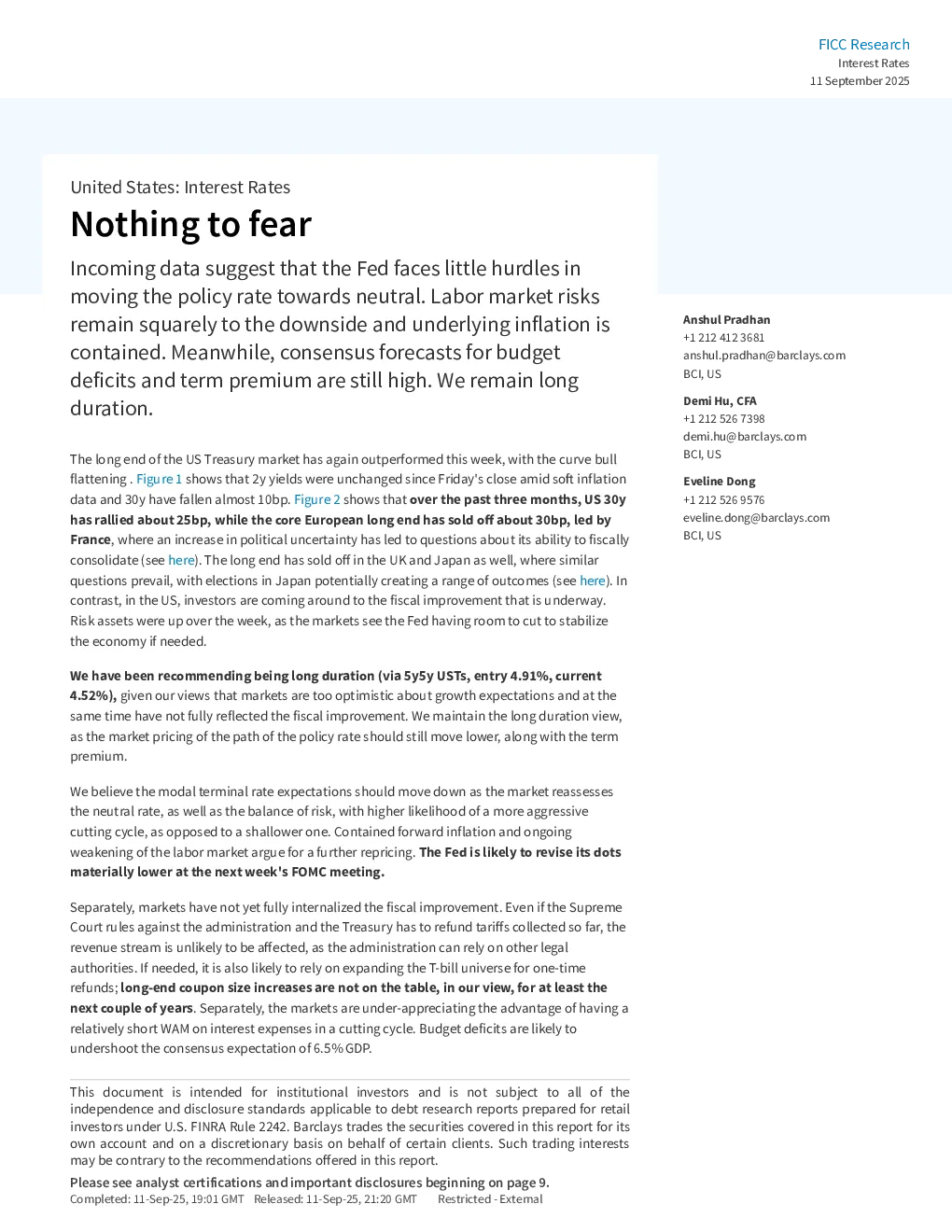
Nothing to fear Incoming data suggest that the Fed faces little hurdles inmoving the policy rate towards neutral. Labor market risksremain squarely to the downside and underlying inflation iscontained. Meanwhile, consensus forecasts for budgetdeficits and term premium are still high. We remain longduration. Anshul Pradhan+1 212 412 3681anshul.pradhan@barclays.comBCI, US Demi Hu, CFA+1 212 526 7398demi.hu@barclays.comBCI, US The long end of the US Treasury market has again outperformed this week, with the curve bullflattening . Figure 1 shows that 2y yields were unchanged since Friday's close amidsoftinflationdata and 30y have fallen almost 10bp. Figure 2 shows thatover the past three months, US 30yhas rallied about 25bp, while the core European long end has soldoffabout 30bp, led byFrance, where an increase in political uncertainty has led to questions about its ability to fiscallyconsolidate (see here). The long end has soldoffin the UK and Japan as well, where similarquestions prevail, with elections in Japan potentially creating a range of outcomes (see here). Incontrast, in the US, investors are coming around to the fiscal improvement that is underway.Risk assets were up over the week, as the markets see the Fed having room to cut to stabilizethe economy if needed. Eveline Dong+1 212 526 9576eveline.dong@barclays.comBCI, US We have been recommending being long duration (via 5y5y USTs, entry 4.91%, current4.52%),given our views that markets are too optimistic about growth expectations and at thesame time have not fully reflected the fiscal improvement. We maintain the long duration view,as the market pricing of the path of the policy rate should still move lower, along with the termpremium. We believe the modal terminal rate expectations should move down as the market reassessesthe neutral rate, as well as the balance of risk, with higher likelihood of a more aggressivecutting cycle, as opposed to a shallower one. Contained forward inflation and ongoingweakening of the labor market argue for a further repricing.The Fed is likely to revise its dotsmaterially lower at the next week's FOMC meeting. Separately, markets have not yet fully internalized the fiscal improvement. Even if the SupremeCourt rules against the administration and the Treasury has to refundtariffscollected so far, therevenue stream is unlikely to beaffected,as the administration can rely on other legalauthorities. If needed, it is also likely to rely on expanding the T-bill universe for one-timerefunds;long-end coupon size increases are not on the table, in our view, for at least thenext couple of years. Separately, the markets are under-appreciating the advantage of having arelatively short WAM on interest expenses in a cutting cycle. Budget deficits are likely toundershoot the consensus expectation of 6.5% GDP. Thisdocument is intended for institutional investors and is not subject to all of theindependence and disclosure standards applicable to debt research reports prepared for retailinvestors under U.S. FINRA Rule 2242. Barclays trades the securities covered in this report for itsown account and on a discretionary basis on behalf of certain clients. Such trading interestsmay be contrary to the recommendationsofferedin this report. Please see analyst certifications and important disclosures beginning on page 9.Completed: 11-Sep-25, 19:01 GMTReleased: 11-Sep-25, 21:20 GMTRestricted - External We therefore continue to recommend being long duration. FOMC: On the move Incoming data suggest the economy hasdownshifted,whether one looks at GDP growth,payroll gains or measures of slack. Inflation data have also beensofterthan expected;underlying inflation and expectations point to inflation reverting to close to target next year. Inthat context, the Fed is likely to be more concerned about downside risks to the labor marketthan inflation persistence and signal a gradual move towards neutral at the upcoming meeting. Figure 3 shows the evolution of quarterly real GDP growth rates. The US economy is expected togrow at about 1.5% in 2025 up to Q3, as opposed to 2.5% in 2024. Private domestic final sales(excluding inventory, net exports and the government sector) paint a story of a sustainedshiftlower from about 2.5pp to 1.5pp (in contribution terms). Forward-looking measures are notpointing to a material rebound. For one, the payroll proxy (product of employment * hours *earnings) has slowed dramatically. It grew at just 0.3% in nominal terms in August and likelyclose to nil in real terms (Figure 4). Income growth barely keeping up with inflation does notbode well for the personal consumption outlook.Tariffuncertainty should eventually subside,but into an outcome far worse than was expected earlier in the year. As for labor markets, the latest data, along with potential benchmark revisions, also point to jobgains having moderated dramatically. Figure 5 shows that over the past three, six and 12months, job gains have averaged 30K,