AI智能总结
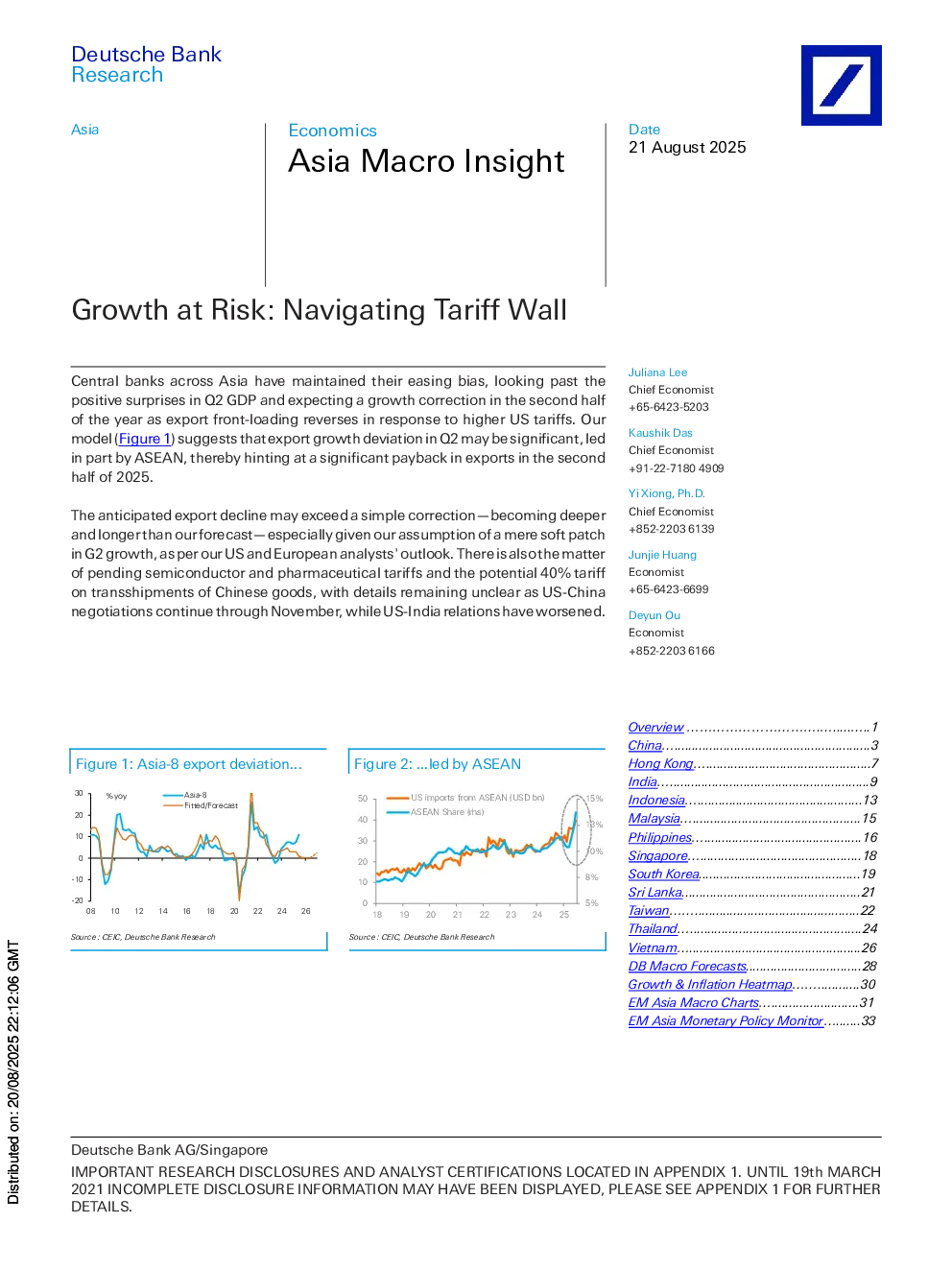
EconomicsAsia Macro Insight Asia Growth at Risk: Navigating Tariff Wall Juliana LeeChief Economist+65-6423-5203 Central banks across Asia have maintained their easing bias, looking past thepositive surprises in Q2 GDP and expecting a growth correction in the second halfof the year as export front-loading reverses in response to higher US tariffs. Ourmodel (Figure 1) suggests that export growth deviation in Q2 may be significant, ledin part by ASEAN, thereby hinting at a significant payback in exports in the secondhalf of 2025. Kaushik DasChief Economist+91-22-7180 4909 Yi Xiong, Ph.D.Chief Economist+852-2203 6139 The anticipated export decline may exceed a simple correction—becoming deeperand longer than our forecast—especially given our assumption of a mere soft patchin G2 growth, as per our US and European analysts' outlook. There is also the matterof pending semiconductor and pharmaceutical tariffs and the potential 40% tariffon transshipments of Chinese goods, with details remaining unclear as US-Chinanegotiations continue through November, while US-India relations have worsened. Junjie HuangEconomist+65-6423-6699 Deyun OuEconomist+852-2203 6166 Overview ………………………….….....…..1China…........................................................3Hong Kong…...............................................7India….........................................................9Indonesia…...............................................13Malaysia…................................................15Philippines….............................................16Singapore…..............................................18South Korea..............................................19Sri Lanka...................................................21Taiwan……...............................................22Thailand….................................................24Vietnam….................................................26DB Macro Forecasts.................................28Growth & Inflation Heatmap……............30EM Asia Macro Charts….........................31EM Asia Monetary Policy Monitor….......33 Source : CEIC, Deutsche Bank Research Source : CEIC, Deutsche Bank Research The US tariff shock arrives as several economies already contend with significantcompetitive pressure from Chinese producers, both for global market share andwithintheir domestic markets.ASEAN's global export market share ofmanufactured goods edged up by 0.6 percentage points to 8.3% in 2024 relative topre-Covid levels, while Taiwan's share saw a smaller 0.4 percentage point increase.These gains were modest compared to China, which saw its market share surge 2.7percentage points to 20.5%. Juliana LeeJunjie Huang Asia is at a critical juncture, facing the choice between allowing its growth potentialto be hamstrung as global trade reconfigures, and embarking on ambitious pathsto cultivate new growth engines and boost productivity. In the near term, theprojected slowdown in Asia's growth to 4.7% in 2026 from 5% in 2025 and 5.2% in2024 may prove too optimistic. Asia's monetary policymakers have acted preemptively to support growth amidelevated uncertainties, as recently exemplified by Bank of Thailandand BankIndonesia. They have delivered an average of approximately 75 bps in rate cuts thiscycle so far, with some moving ahead of the US Federal Reserve amid benigndomestic inflation and FX conditions. We expect another approximately 35 bps ofrate cuts across the region in this cycle. Source : UNCTAD, Deutsche Bank Research Source : Haver Analytics, Deutsche Bank Research China nChina's growth is slowing. We estimate real GDP growth dropped by0.8ppt, to 4.9% YoY in July from 5.7% in June. Leading the slowdown wasa sharp drop in fixed asset investment , while Industrial production growthalso slowed, likely reflecting the impact of "anti-involution" measures tocurb excess supply. Meanwhile, services sector activity appeared robust,while exports also stayed resilient. The extension of US-China tariff truce by90 days and potential further de-escalations could pose upside risksexports relative to our annual 3% exports forecast. nMeanwhile, producer prices showed early signs of improvementon theback of "anti-involution" measures to curb price competition and reduceproduction. High-frequency data suggest producer prices have started torise in late-July amid intensifying "anti-involution" measures. Policy actionhas been gaining momentum recently, with additional announcements ofcurbing production in products such as lithium and pork. nThe July Politburo meeting suggest Chinese policymakers are broadlysatisfied with recent economic developments and are shifting their focusto longer term reforms. The CPC 4th plenum will be held in October todiscuss the main parameters of China's 15th Five-Year Plan (2026-2030).Consumption remains a key focus for the government, while no strongpolicy commitment was made on further supporting the property sectordespite its recent softeni