高物价与消费:关注家庭消费篮子和金融资产的异质性影响
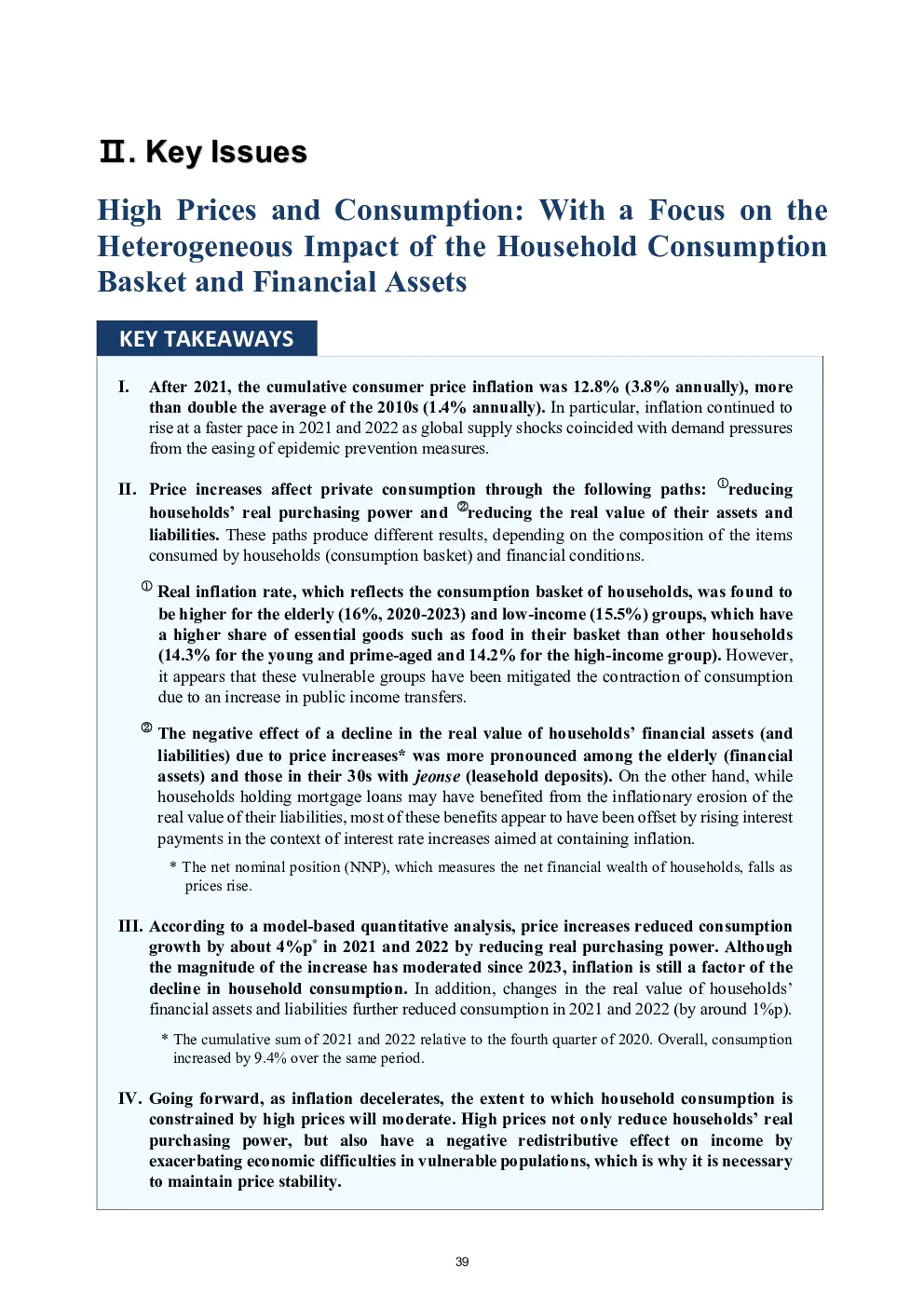
High Prices and Consumption: With a Focus on theHeterogeneous Impact of the Household ConsumptionBasket and Financial Assets KEY TAKEAWAYS I.After 2021, the cumulative consumer price inflation was 12.8% (3.8% annually), morethan double the average of the 2010s (1.4% annually).In particular, inflation continued torise at a faster pace in 2021 and 2022 as global supply shocks coincided with demand pressuresfrom the easing of epidemic prevention measures. II.Price increases affect private consumption through the following paths:ⓛreducinghouseholds’ real purchasing power and②reducing the real value of their assets andliabilities.These paths produce different results, depending on the composition of the itemsconsumed by households (consumption basket) and financial conditions. ⓛReal inflation rate, which reflects the consumption basket of households, was found tobe higher for the elderly (16%, 2020-2023) and low-income (15.5%) groups, which havea higher share of essential goods such as food in their basket than other households(14.3% for the young and prime-aged and 14.2% for the high-income group).However,it appears that these vulnerable groups have been mitigated the contraction of consumptiondue to an increase in public income transfers. ②The negative effect of a decline in the real value of households’ financial assets (andliabilities) due to price increases* was more pronounced among the elderly (financialassets) and those in their 30s withjeonse(leasehold deposits).On the other hand, whilehouseholds holding mortgage loans may have benefited from the inflationary erosion of thereal value of their liabilities, most of these benefits appear to have been offset by rising interestpayments in the context of interest rate increases aimed at containing inflation. * The net nominal position (NNP), which measures the net financial wealth of households, falls asprices rise. III.According to a model-based quantitative analysis, price increases reduced consumptiongrowth by about 4%p*in 2021 and 2022 by reducing real purchasing power. Althoughthe magnitude of the increase has moderated since 2023, inflation is still a factor of thedecline in household consumption.In addition, changes in the real value of households’financial assets and liabilities further reduced consumption in 2021 and 2022 (by around 1%p). * The cumulative sum of 2021 and 2022 relative to the fourth quarter of 2020. Overall, consumptionincreased by 9.4% over the same period. IV.Going forward, as inflation decelerates, the extent to which household consumption isconstrained by high prices will moderate. High prices not only reduce households’ realpurchasingpower,but also have a negative redistributive effect on income byexacerbating economic difficulties in vulnerable populations, which is why it is necessaryto maintain price stability. I.Background 1. Although consumption, which has been sluggish since the pandemic, is showing signs of recoverythis year, it remains well below its historical trend.In particular, the consumption of goods, which peakedin the third quarter of 2021 and then began to decline, has been sluggish, leading to an overall slowdown inprivate consumption. While some structural factors99 are likely to have contributed to this lacklusterconsumption of goods, the repeated disruptions to global supply chains since 2021 and accumulation of highprices due to extreme weather and other factors are likely to have had a significant impact. In general, wheninflation is stable, smooth economic activity increases consumption and prices rise (virtuous cycle of risingprices and consumption). However, if a negative supply shock to the economy causes jitters in inflationexpectations, inflation rises and consumption falls (rising prices and falling consumption). 2. For individual households, the actual magnitude of price increases may vary depending on theirconsumption items and the composition of their assets and liabilities, which are likely to have differenteffects on the change in consumption.This section examines:①whether consumption has been affectedby price increases by reviewing the recent evolution of inflation and private consumption and②thedifferentialimpact of price rises on different household consumption baskets and asset/liabilitycompositions to determine which households have been most affected. In doing so, it assesses③the impactof price increases on consumption and derives implications. Post-pandemic consumption has shown weakrecovery, with recent signs of resumingrecovery Goods consumption continues to fall, whileservices consumption is approaching thetrend line Note: 1) Dotted line is the trend for 2015 to 2019.Source: Bank of Korea. Ⅱ. Inflation and Consumption after the Pandemic 3. Consumer price inflation has risen sharply since 2021, more than doubling its pace in the 2010s.Inparticular, in 2021 and 2022, prices remained elevated due to the overlapping of various inflationarypressures, including higher commod