亚洲宏观战略报告更新我们的增长指标-116628003
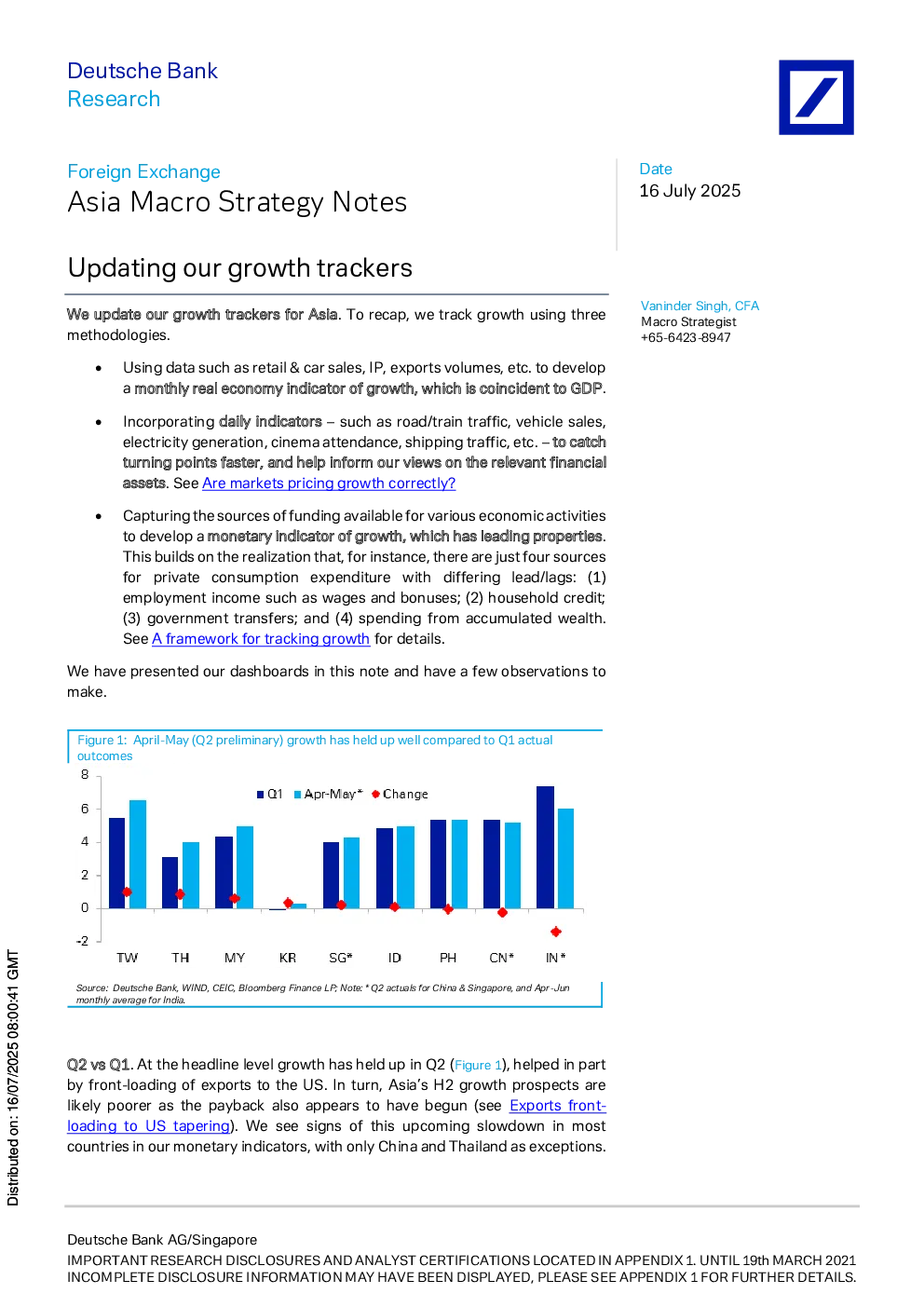
Asia Macro Strategy Notes Updating our growth trackers We update our growth trackers for Asia. To recap, we track growth usingthreemethodologies. •Usingdatasuch as retail & car sales, IP, exports volumes, etc. to developamonthly real economy indicator of growth, which is coincident to GDP. •Incorporatingdaily indicators–such as road/train traffic, vehicle sales,electricity generation, cinema attendance, shipping traffic, etc.–to catchturning points faster,and help inform our views on the relevantfinancialassets. SeeAre markets pricing growth correctly? •Capturingthe sources of funding available for various economic activitiesto develop amonetary indicator of growth, which has leading properties.This builds on the realization that, for instance, there are just four sourcesforprivate consumption expenditure with differing lead/lags:(1)employment income such as wages and bonuses; (2) household credit;(3) government transfers; and (4) spendingfrom accumulated wealth.SeeA framework for tracking growthfor details. We have presented our dashboards in this note and have a few observations tomake. Q2 vs Q1. At the headline level growth has held up in Q2(Figure1), helpedin partby front-loading of exports to the US. In turn, Asia’s H2 growth prospects arelikely poorer as the payback also appears to have begun (seeExports front-loading to US tapering). We see signs of this upcoming slowdown in mostcountries in our monetary indicators,withonly China and Thailand asexceptions. •China. Strong policy support–with; (1) augmented fiscal deficit impulseat +4.3% of nominal GDP; and (2) TSF impulse at +4%–bufferinggrowthagainst likely US tariffs-related impact(Figure2). Without a sharperslowdown, imminent monetary easing is likely not on the table for now.•India. Growth, per our coincident monthly data, appears to be taking asteplower,with industrial activities slowing and support fromgovernment spending starting to fade. Our monetary indicator suggestsIndia macro may already be past peak support from money-availability(Figure3). Indeed, our daily indicator is not detecting any signs of arecovery yet. We continue to expect markets to price in further rate cutsfrom the RBI and remainreceived 2Y OIS.•Indonesia.(1)Weakening fiscal impulse;alongside(2)worseningconsumer sentiment; are starting to weigh more heavily on growthprospects(Figure4). This is coming through even as the impact of poordomestic financial market performance–and the attendant wealth effect–is yet to show up in the data. BI is likely to remain on its easing path, solong as the rupiah remains well-behaved.•SouthKorea. Coincident real economy growth took another step down inMay(Figure5), with continuing suppressed tracking on our daily indicatoras well. Our monetary indicator has picked up recently, largely onmortgage loan growth. However, given this credit uptake is largelydirectedtowards central Seoul–rather than new construction–economic support from this is likely to be limited. Whilestronger fiscalsupport in the coming months remains likely, we expect the BoK to stepup monetary support as well in the coming meetings, including seeingAugust as alive meeting. We remainreceived 2Y rates swaps.•Malaysia. While Malaysia’s on-year GDP-tracking has been holding upabove-4%, growth’s sequential pace has fallen sub-4% since earlier thisyear(Figure6). This likely prompted BNM to cut the policy rate. We are notseeing any pick-up in our monetary indicator either yet, suggesting anegative output gap could open in the coming months–promptinglikelyanother easing from the central bank.•Philippines. Weak coincident real economy growth(Figure7)–and poormonetary indicator tracking–suggest further easing from the BSPshould remain the base-case. Indeed, the Governor has guided foranother50bp of further rate cutsbefore year-end.•Singapore. In contrast to the surprisingly strong preliminary Q2 GDP, wedetect substantial weakness in our monetary indicators(Figure8). Thiscombined with the give-back from past exports front-loading, shouldkeep MAS on an easing path. We expect the slope to be set to neutralfrom 0.5% ann. at the upcoming July announcement.•Thailand. Growth is holding up well, and money availability is supportivetoo(Figure9). Nonetheless, further BoT rate cuts are likely on the tabledepending on the government’s pick for the central bank’s governor.•Taiwan. The strongest sign offront-loading of exportsto the US in Asiahave been in Taiwan–and this has shown up in the coincident realeconomy growth numbers as well(Figure10). However, (1) the recentstepping down of shipping activity; and (2) weak electronics outlook ascaptured by the 6M ahead PMI at 43.8 vs. spot electronics PMI at 55.5;may bode poorly for growth prospects into year-end. Indeed, Taiwan’s monitoring index has steadily climbed down to 31 from “red” 38 at end-2024. Appendix 1 Analyst Certification The views expressed in this report accurately reflect the personal views of the undersigned lead analyst(s)