AI智能总结
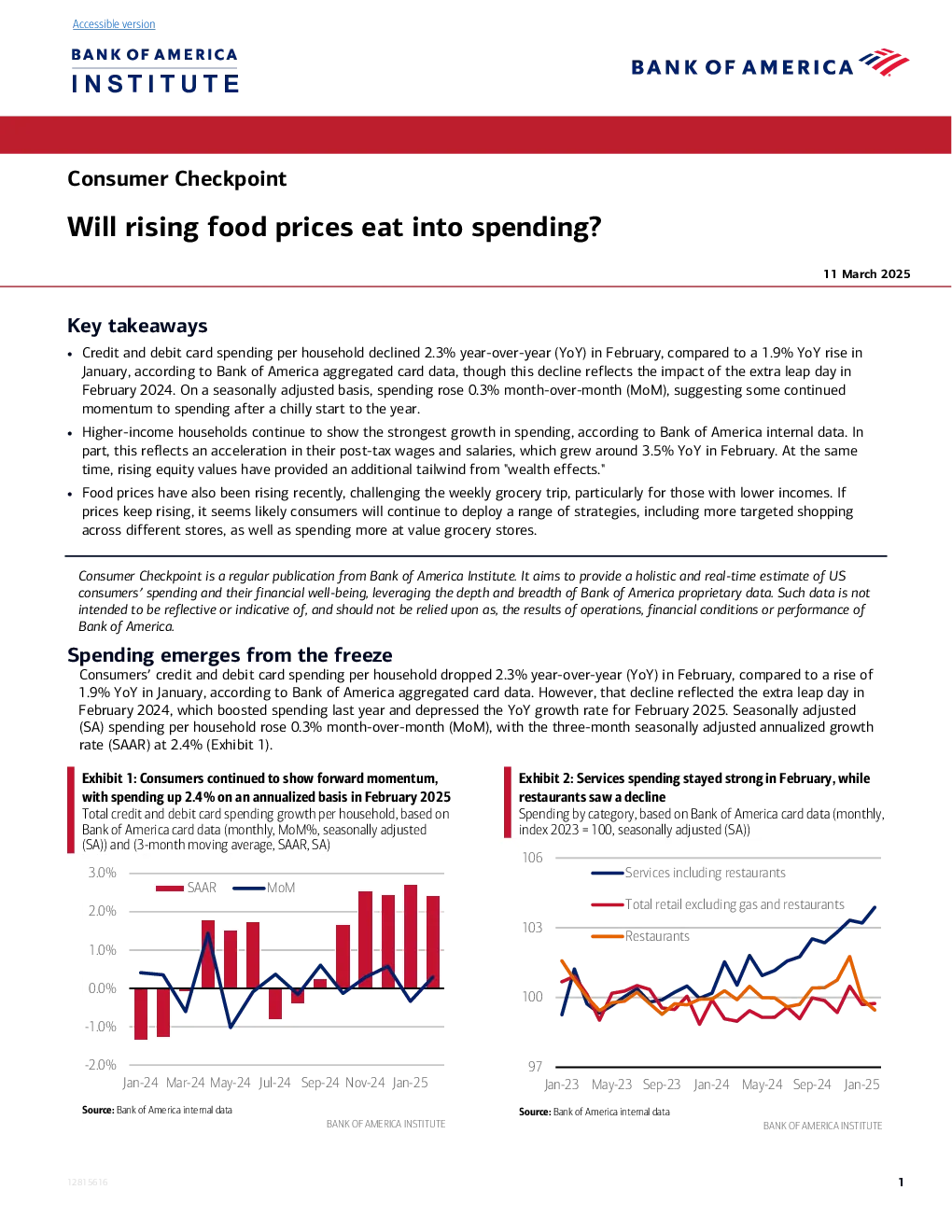
Will rising food prices eat into spending? 11 March 2025 Key takeaways •Credit and debit card spending per household declined 2.3% year-over-year (YoY) in February, compared to a 1.9% YoY rise inJanuary, according to Bank of America aggregated card data, though this decline reflects the impact of the extra leap day inFebruary 2024. On a seasonally adjusted basis, spending rose 0.3% month-over-month (MoM), suggesting some continuedmomentum to spending after a chilly start to the year. •Higher-income households continue to show the strongest growth in spending, according to Bank of America internal data. Inpart, this reflects an acceleration in their post-tax wages and salaries, which grew around 3.5% YoY in February. At the sametime, rising equity values have provided an additional tailwind from "wealth effects." •Food prices have also been rising recently, challenging the weekly grocery trip, particularly for those with lower incomes. Ifprices keep rising, it seems likely consumers will continue to deploy a range of strategies, including more targeted shoppingacross different stores, as well as spending more at value grocery stores. Consumer Checkpoint is a regular publication from Bank of America Institute. It aims to provide a holistic and real-time estimate of USconsumers’spending and their financial well-being, leveraging the depth and breadth of Bank of America proprietary data. Such data is notintended to be reflective or indicative of, and should not be relied upon as, the results of operations, financial conditions or performance ofBank of America. Spending emerges from the freezeConsumers’credit and debit card spending per household dropped 2.3% year-over-year (YoY) in February, compared to a rise of 1.9% YoY in January, according to Bank of America aggregated card data. However, that decline reflected the extra leap day inFebruary 2024, which boosted spending last year and depressed the YoY growth rate for February 2025. Seasonally adjusted(SA) spending per household rose 0.3% month-over-month (MoM), with the three-month seasonally adjusted annualized growthrate (SAAR) at 2.4% (Exhibit 1). Exhibit2:Services spending stayed strong in February, whilerestaurants saw a declineSpending by category, based on Bank of America card data (monthly, Exhibit1:Consumers continued to showforwardmomentum,with spending up 2.4% on an annualized basis in February 2025Total credit and debit card spending growth per household, based onBank of America card data (monthly, MoM%, seasonally adjusted(SA)) and (3-month moving average, SAAR, SA) index 2023 = 100, seasonally adjusted (SA)) Spending continued to be strong in services in February on a MoM basis (Exhibit 2), though there was a continued decline inrestaurant spending. Additionally, retail spending (ex- gas and restaurants) was flat MoM, after declining in January. In our view, the consumer is still demonstrating some underlying forward momentum in these early months of the year, thoughat a more measured pace. This is particularly the case as the weather may be responsible for some weakness in the data. Januarywas a cold month, with snow and ice in the South and Northeast. February also brought winter storms to the midwestern andsouthern US, evident in slowing spending growth in Texas in mid-month, although spending recovered toward the end ofFebruary (Exhibit 3). Card spending growth also weakened in the D.C. area in February, possibly due to the significant snow received during the thirdweek of February. However, other major cities in the eastern portion of the US also received winter snowstorms and theyexperienced a spending growth recovery (Exhibit 4). So, it could also be that recent announcements and actions to reduce thesize of the federal workforce may be weighing on spending throughout the DC area. Exhibit3: Card spendinggrowthweakened in Texas in mid-February, as cold weather hit, but recovered to end the monthup 5% YoY Exhibit4:In February, MoM card spendinggrowthremainednegative in Washington DC, but recovered in other eastern UScities Total credit and debit card spending growth per household by selectstates (7-day moving average, YoY%) Aggregated credit and debit card spending growth per household forWashington DC and select eastern cities (monthly, MoM%) Higher-income spenders continue to leadLooking at spending across income cohorts, the top-third of households by income category have largely had higher card spending growth than middle- or lower-income peers since February 2024. This contrasts with 2023 when the opposite was true(Exhibit 5). One reason for the recovery in spending growth in the higher-income cohort appears to be stronger after-tax wage and salarygrowth, which accelerated over 2024 after a period of weakness in 2023. In February 2025, after-tax wage and salary growth forthis cohort accelerated further, up 3.5% YoY, compared to a slowdown in growth for lower-income households, up 2.4% YoY,according to Bank of Amer