不断上涨的水电费会增加消费者的负担吗?
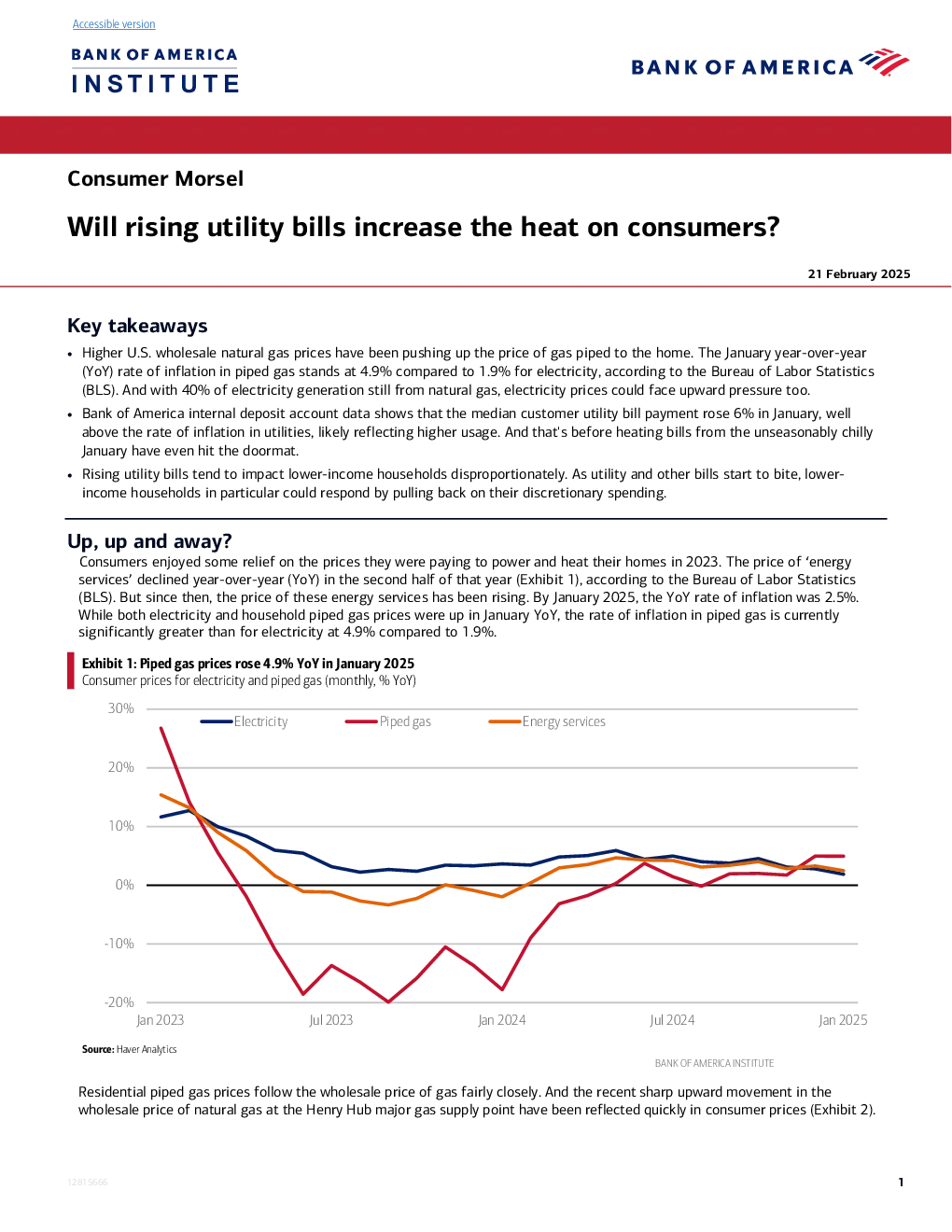
Will rising utility bills increase the heat on consumers? 21 February 2025 Key takeaways •Higher U.S. wholesale natural gas prices have been pushing up the price of gas piped to the home. The January year-over-year(YoY) rate of inflation in piped gas stands at 4.9% compared to 1.9% for electricity, according to the Bureau of Labor Statistics(BLS). And with 40% of electricity generation still from natural gas, electricity prices could face upward pressure too. •Bank of America internal deposit account data shows that the median customer utility bill payment rose 6% in January, wellabove the rate of inflation in utilities, likely reflecting higher usage. And that's before heating bills from the unseasonably chillyJanuary have even hit the doormat. •Rising utility bills tend to impact lower-income households disproportionately. As utility and other bills start to bite, lower-income households in particular could respond by pulling back on their discretionary spending. Up, up and away?Consumers enjoyed some relief on the prices they were paying to power and heat their homes in 2023. The price of‘energy services’declined year-over-year (YoY) in the second half of that year (Exhibit 1), according to the Bureau of Labor Statistics(BLS). But since then, the price of these energy services has been rising. By January 2025, the YoY rate of inflation was 2.5%.While both electricity and household piped gas prices were up in January YoY, the rate of inflation in piped gas is currentlysignificantly greater than for electricity at 4.9% compared to 1.9%. Consumer prices for electricity and piped gas (monthly, % YoY) Residential piped gas prices follow the wholesale price of gas fairly closely. And the recent sharp upward movement in thewholesale price of natural gas at the Henry Hub major gas supply point have been reflected quickly in consumer prices (Exhibit 2). Exhibit3:Natural gas accounts for around 40% of US electricitygenerationShare of US electricity generation in 2024 by source (%) Exhibit2:In January, consumer gas prices have followed a30%YoY rise in wholesale natural gas pricesConsumer prices for electricity and piped gas (% YoY, rhs) and the Henry Hub price of natural gas (% YoY, $/one million British thermalunits, lhs) Despite the rise of renewables, a large portion of electricity is still generated using natural gas (Exhibit 3), so electricity prices oftenfollow the wholesale gas price too, albeit with a longer lag. The implications are that unless wholesale gas prices drop backsignificantly, retail electricity prices may face near-term upward pressure at the very least. The US Energy Information Administration(EIA), for example, currently projects US residential electricity prices to average around 3% higher in 2025 than in 2024. And bills are outrunning rising pricesWhen we look at households’overall utilities payments–covering electricity, gas and also water utilities–in Bank of America aggregated deposit account data (Exhibit 4), it appears they are actually growing faster than the consumer price of energyservices might imply. In January 2025, the YoY increase was 6%, 3.5 percentage points faster than the rise in the price of energyservices in the Consumer Price Index (CPI). Exhibit4:In January 2025overallutility payments percustomer were up 6% YoY, while water was up 7.5%Median monthly overall utility payments per customer and water Exhibit5:Residential electricity consumption rose 2.7% in2024, with natural gas down 4.3%% YoY change in residential natural gas (bn cubic ft per day) and utility payments, based on Bank of America deposit data (three-month moving average, YoY%) electricity consumption (bn Kiliowatthours) Why are these payments rising faster than prices? One contributory factor appears to be water utility payments. While we can’teasily separate customer payments for electricity and gas with Bank of America data, as they are often supplied by the samefirm, we can separate some water utility payments. When we do this, we find the median water payment is showing a YoY riseof around 7.5%, adding upward pressure to overall utility payment growth. However, the absolute dollars spent on water bills aretypically significantly less than on energy, so this on its own is not enough to account for why overall utility payments are risingso briskly. But another significant reason for the increase is that households are consuming more electricity. The EIA estimates thatresidential electricity consumption rose 2.7% in 2024, while natural gas consumption declined 4.3% (Exhibit 5). For consumerbills, it’s the rise in electricity consumption that matters more because the average household spends over three times as muchon electricity than on gas. The EIA forecasts a further rise in electricity demand in 2025, potentially leading to more upwardpressure on bills. Turning up the thermostat may add to the squeezeLooking at the rise in median utility payments across the country to date there has