您的浏览器禁用了JavaScript(一种计算机语言,用以实现您与网页的交互),请解除该禁用,或者联系我们。[美国银行]:把握消费者健康脉搏 - 发现报告

把握消费者健康脉搏

商贸零售2025-04-01美国银行记***
AI智能总结
查看更多
把握消费者健康脉搏

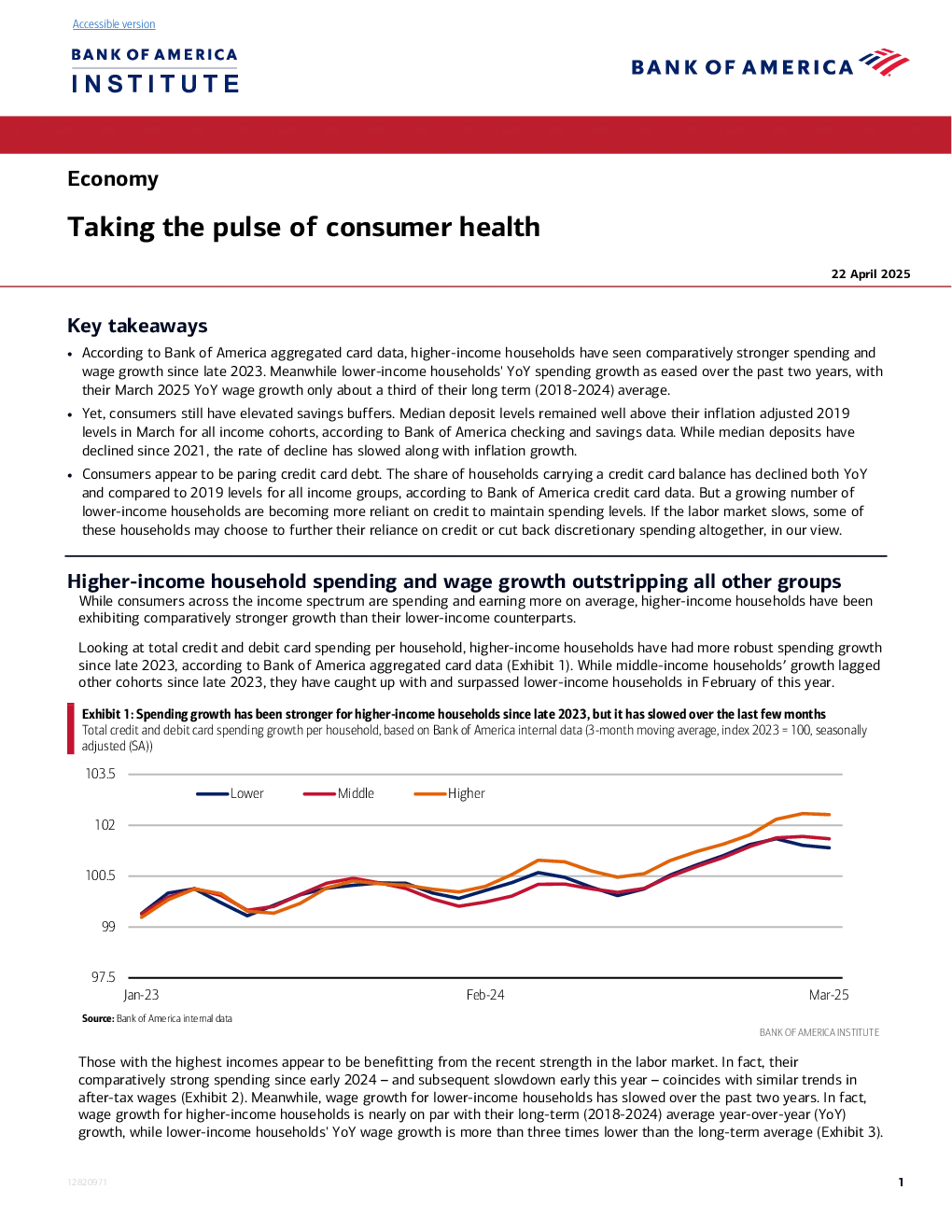
Taking the pulse of consumer health Key takeaways •According to Bank of America aggregated card data, higher-income households have seen comparatively stronger spending andwage growth since late 2023. Meanwhile lower-income households' YoY spending growth as eased over the past two years, withtheir March 2025 YoY wage growth only about a third of their long term (2018-2024) average. •Yet, consumers still have elevated savings buffers. Median deposit levels remained well above their inflation adjusted 2019levels in March for all income cohorts, according to Bank of America checking and savings data. While median deposits havedeclined since 2021, the rate of decline has slowed along with inflation growth. •Consumers appear to be paring credit card debt. The share of households carrying a credit card balance has declined both YoYand compared to 2019 levels for all income groups, according to Bank of America credit card data. But a growing number oflower-income households are becoming more reliant on credit to maintain spending levels. If the labor market slows, some ofthese households may choose to further their reliance on credit or cut back discretionary spending altogether, in our view. Higher-income household spending and wage growth outstripping all other groupsWhile consumers across the income spectrum are spending and earning more on average, higher-income households have been exhibiting comparatively stronger growth than their lower-income counterparts. Looking at total credit and debit card spending per household, higher-income households have had more robust spending growthsince late 2023, according to Bank of America aggregated card data (Exhibit 1). While middle-income households’growth laggedother cohorts since late 2023, they have caught up with and surpassed lower-income households in February of this year. Exhibit1:Spending growthhas beenstronger for higher-income households sincelate2023, but it has slowed over the last few monthsTotal credit and debit card spending growth per household, based on Bank of America internal data (3-month moving average, index 2023 = 100, seasonallyadjusted (SA)) Those with the highest incomes appear to be benefitting from the recent strength in the labor market. In fact, theircomparatively strong spending since early 2024–and subsequent slowdown early this year–coincides with similar trends inafter-tax wages (Exhibit 2). Meanwhile, wage growth for lower-income households has slowed over the past two years. In fact,wage growth for higher-income households is nearly on par with their long-term (2018-2024) average year-over-year (YoY)growth, while lower-income households' YoY wage growth is more than three times lower than the long-term average (Exhibit 3). Exhibit2:Wage growth for higher-income households eased backto 2.6% YoY in March, while it slowed for lower-incomehouseholds to 1.4% YoY Exhibit3:YoY wage growth for lower-income households is muchlower than the long-term (2018-2024) average for this groupAfter-tax wage and salary growth by household income terciles, based on Bank of America aggregated consumer deposit data (3-monthmoving average, YoY%, SA) compared to (2018 to 2024 YoY monthlyaverage, SA) After-tax wage and salary growth by household income terciles, basedon Bank of America aggregated consumer deposit data (3-monthmoving average, YoY%, SA) Households’ buffers have declined, but remain in good shapeBeyond earnings and expenditure growth, how is the financial health of consumers? Overall, it appears they are in good shape through March, based on Bank of America internal data on households’deposits and credit levels. While household median deposit levels have declined since 2021, they increased across the income spectrum last month andremain at least 40% higher than 2019 levels on a nominal basis and 15% above inflation adjusted levels, according to Bank ofAmerica checking and savings account data (Exhibit 4). Exhibit4:Median checking and savings deposit balances havedeclined over the past year for all income cohorts, but remainabove inflation-adjusted 2019 levelsMonthly median household savings and checking balances by income Exhibit5:Deposit balances are declining, but through March 2025the rate of decline has eased over the past yearMonthly median household savings and checking balances by income for a fixed group of households through March 2025 (YoY%, monthly) for a fixed group of households through March 2025 (monthly, indexed2019 = 100) Additionally, the rate of decline in deposits is significantly slower compared to two years ago, reflecting easing inflation over thesame period. This is especially true for lower-income households. While median deposits fell around 3% YoY in March, that’s anoteworthy improvement from the 15% YoY decline that occurred three years ago (Exhibit 5). While BofA Global Research is not forecasting a recession, they anticipate prices will start increasing at a faster rate in the nearfuture, as