汽车:油箱里还剩多少汽油?
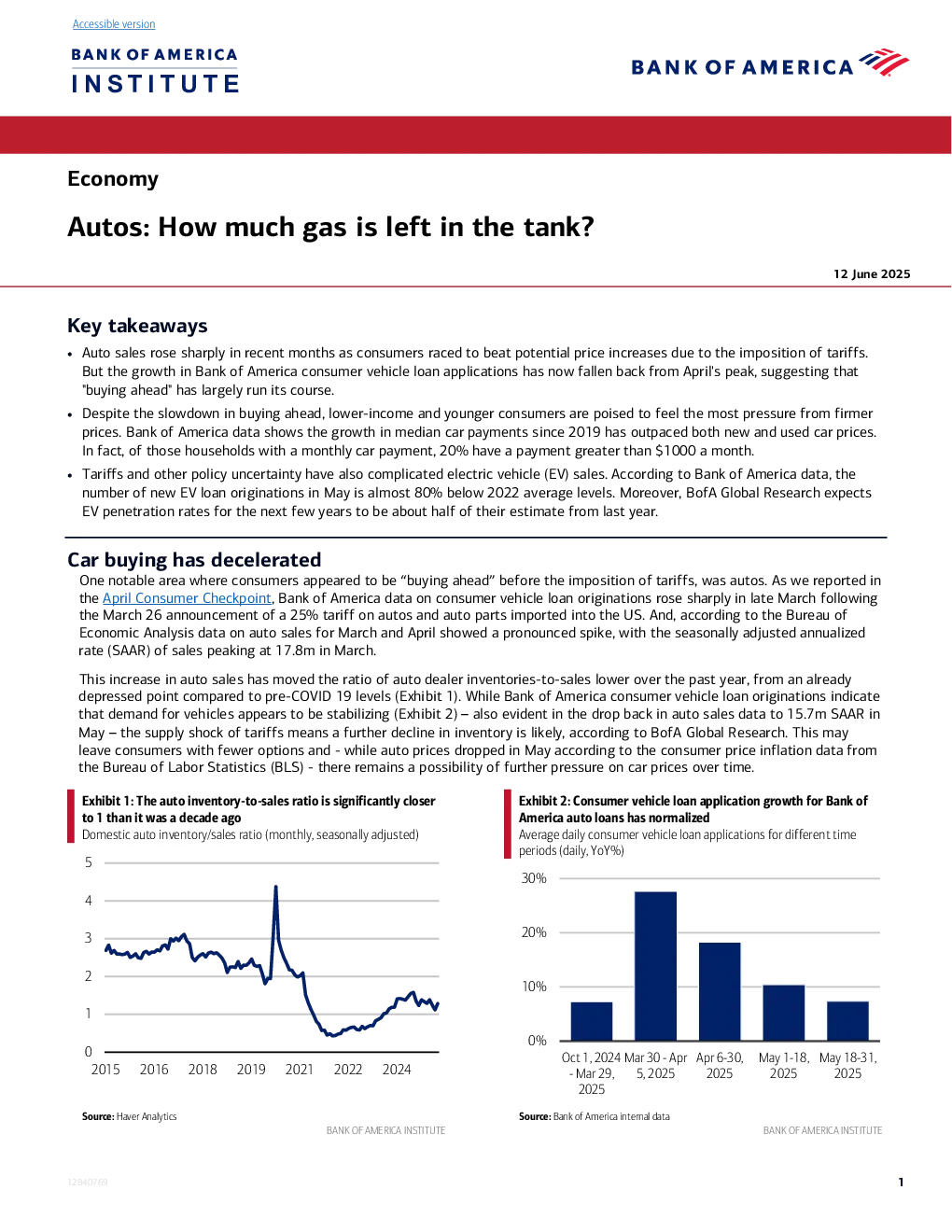
Autos: How much gas is left in the tank? Key takeaways •Auto sales rose sharply in recent months as consumers raced to beat potential price increases due to the imposition of tariffs.But the growth in Bank of America consumer vehicle loan applications has now fallen back from April's peak, suggesting that"buying ahead" has largely run its course. •Despite the slowdown in buying ahead, lower-income and younger consumers are poised to feel the most pressure from firmerprices. Bank of America data shows the growth in median car payments since 2019 has outpaced both new and used car prices.In fact, of those households with a monthly car payment, 20% have a payment greater than $1000 a month. •Tariffs and other policy uncertainty have also complicated electric vehicle (EV) sales. According to Bank of America data, thenumber of new EV loan originations in May is almost 80% below 2022 average levels. Moreover, BofA Global Research expectsEV penetration rates for the next few years to be about half of their estimate from last year. Car buying has deceleratedOne notable area where consumers appeared to be“buying ahead”before the imposition of tariffs, was autos. As we reported in theApril Consumer Checkpoint, Bank of America data on consumer vehicle loan originations rose sharply in late March followingthe March 26 announcement of a 25% tariff on autos and auto parts imported into the US. And, according to the Bureau ofEconomic Analysis data on auto sales for March and April showed a pronounced spike, with the seasonally adjusted annualizedrate (SAAR) of sales peaking at 17.8m in March. This increase in auto sales has moved the ratio of auto dealer inventories-to-sales lower over the past year, from an alreadydepressed point compared to pre-COVID 19 levels (Exhibit 1). While Bank of America consumer vehicle loan originations indicatethat demand for vehicles appears to be stabilizing (Exhibit 2)–also evident in the drop back in auto sales data to 15.7m SAAR inMay–the supply shock of tariffs means a further decline in inventory is likely, according to BofA Global Research. This mayleave consumers with fewer options and - while auto prices dropped in May according to the consumer price inflation data fromthe Bureau of Labor Statistics (BLS) - there remains a possibility of further pressure on car prices over time. Exhibit2: Consumer vehicle loan application growth for Bank ofAmerica auto loans has normalizedAverage daily consumer vehicle loan applications for different time Exhibit1:Theauto inventory-to-salesratio is significantly closerto 1 than it was a decade agoDomestic auto inventory/sales ratio (monthly, seasonally adjusted) periods (daily, YoY%) What do we know about those consumers who were buying ahead?Exhibit 3uses Bank of America weekly data on the number ofbank customers making large payments (above $2,000) to auto firms and vehicle finance providers. We use this data to serve asa proxy for new and used sales and show how the share of customers by generation changed from January 2024 to February2025, and March 2025 to May 2025. We find some evidence that buying ahead was skewed towards the young–particularly GenZ and younger Millennials. Similarly, when we look at the same analysis of payments by customer income, we find that buying ahead may have beensomewhat skewed toward lower- and middle-income customers (Exhibit 4), though the differences compared to the January2024-February 2025 income shares are not large. Exhibit4: By income, buying ahead appears concentrated onlower- and middle-income customersThe change in the share of large* customer auto payments by income, Exhibit3: Buying ahead was little skewed towards younger buyersThe change in the share of large* customer auto payments by generation, March-May 2025 compared to January 2024-February 2025(percentage points) March-May 2025 compared to January 2024-February 2025 (percentagepoints) Auto costs are gaining speedIf auto prices rise due to tight inventory and tariffs, how much additional strain could be placed on consumers’wallets? Bank of America payments data shows that overall median car payments are already more than 30% higher than the 2019 average andhave now outpaced both new and used car prices, possibly as there is a push towards more expensive cars (Exhibit 5). In May,Bank of America monthly car payments accounted for 13% of households’median deposit balances. Exhibit5:Bank of America median car payments have outpacedboth used and new vehicle pricesNew and used vehicle prices (monthly, indexed, 2019 average = 100) and Exhibit6:The number of households whowerepaying more eachmonth on their car payment is greater than those paying lessDistribution of monthly average car payment by the change in amount,June 2024-May 2025 compared to June 2022 -May 2023 (%) median car payments (monthly, indexed, 2019 average = 100) In fact, from June 2024 to May 2025, the share of households whose monthly average car payment increased by