AI智能总结
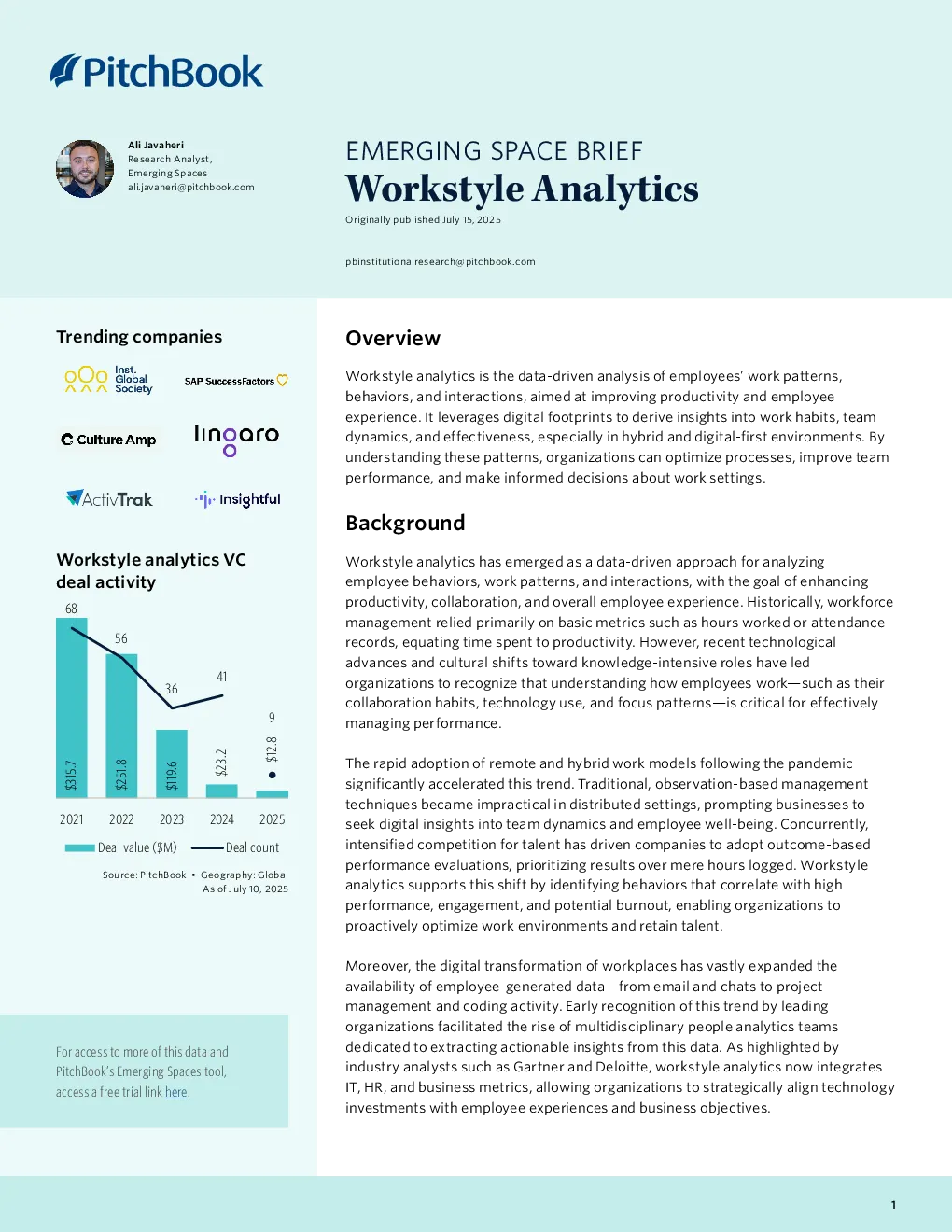
EMERGING SPACE BRIEFWorkstyle Analytics Ali JavaheriResearch Analyst,Emerging Spacesali.javaheri@pitchbook.com Originally published July 15, 2025 pbinstitutionalresearch@pitchbook.com Overview Trending companies Workstyle analytics is the data-driven analysis of employees’ work patterns,behaviors, and interactions, aimed at improving productivity and employeeexperience. It leverages digital footprints to derive insights into work habits, teamdynamics, and effectiveness, especially in hybrid and digital-first environments. Byunderstanding these patterns, organizations can optimize processes, improve teamperformance, and make informed decisions about work settings. Background Workstyle analytics has emerged as a data-driven approach for analyzingemployee behaviors, work patterns, and interactions, with the goal of enhancingproductivity, collaboration, and overall employee experience. Historically, workforcemanagement relied primarily on basic metrics such as hours worked or attendancerecords, equating time spent to productivity. However, recent technologicaladvances and cultural shifts toward knowledge-intensive roles have ledorganizations to recognize that understanding how employees work—such as theircollaboration habits, technology use, and focus patterns—is critical for effectivelymanaging performance. The rapid adoption of remote and hybrid work models following the pandemicsignificantly accelerated this trend. Traditional, observation-based managementtechniques became impractical in distributed settings, prompting businesses toseek digital insights into team dynamics and employee well-being. Concurrently,intensified competition for talent has driven companies to adopt outcome-basedperformance evaluations, prioritizing results over mere hours logged. Workstyleanalytics supports this shift by identifying behaviors that correlate with highperformance, engagement, and potential burnout, enabling organizations toproactively optimize work environments and retain talent. Moreover, the digital transformation of workplaces has vastly expanded theavailability of employee-generated data—from email and chats to projectmanagement and coding activity. Early recognition of this trend by leadingorganizations facilitated the rise of multidisciplinary people analytics teamsdedicated to extracting actionable insights from this data. As highlighted byindustry analysts such as Gartner and Deloitte, workstyle analytics now integratesIT, HR, and business metrics, allowing organizations to strategically align technologyinvestments with employee experiences and business objectives. For access to more of this data andPitchBook’s Emerging Spaces tool,access a free trial linkhere. Technologies and processes Digital twins and simulation Applications Workstyle analytics offers a diverse range of applications that provide actionableinsights across critical business functions, including: Workforce planning and capacity management:This involves using analytics toforecast staffing needs, identify workload imbalances, and inform strategic hiringdecisions. Organizations can also utilize scenario modeling to predict the impact ofworkforce changes, such as reorganizations or shifts in work distribution. Employee engagement and well-being:By monitoring behavioral indicators likereduced collaboration or signs of burnout, workstyle analytics enables managers toproactively intervene. This supports continuous validation of workplace initiatives,fostering an environment that prioritizes employee health and engagement. Performance optimization and productivity improvement:Companies cananalyze workflow data to identify inefficiencies, bottlenecks, and best practices. Theinsights gained lead to targeted improvements, ultimately enhancing individual andteam productivity through streamlined processes and informed decision-making. Organizational design and collaboration:Analytics tools can visualize informalcommunication structures using network analysis. This allows organizations to design more effective structures, improve integration after mergers or acquisitions,and foster better cross-team collaboration. Understanding these dynamics alsosupports effective change management. Workforce performance and accountability:Workstyle analytics providesobjective data for performance reviews and accountability assessments. It supportstransparency and development-focused evaluations, always emphasizing ethicalusage that complements human judgment rather than replacing it. The aim is toalign employee behaviors with organizational objectives while promoting fairnessand continuous feedback. Limitations Employee privacy concerns:The inherent nature of workstyle analytics involvesmonitoring employee behavior, which can raise significant privacy concerns.Employees may view this as “Big Brother” surveillance, particularly if trackingextends to keystrokes, screenshots, or webcam activity. Legal precedents, such as aDutch court ruling against man