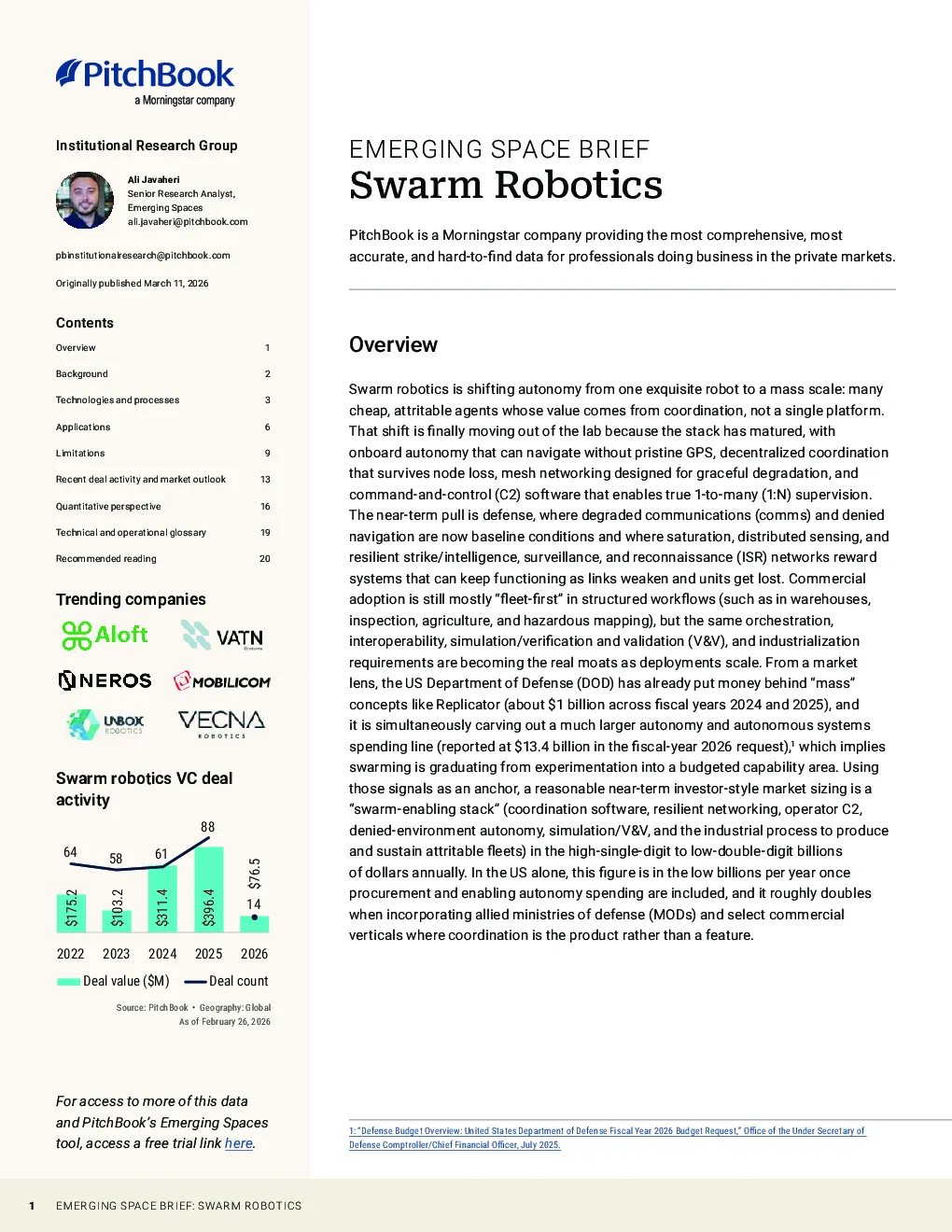
EMERGING SPACE BRIEFSwarm Robotics Institutional Research Group Ali JavaheriSenior Research Analyst,Emerging Spacesali.javaheri@pitchbook.com PitchBook is a Morningstar company providing the most comprehensive, mostaccurate, and hard-to-find data for professionals doing business in the private markets. pbinstitutionalresearch@pitchbook.com Originally published March 11, 2026 Contents Overview Swarm robotics is shifting autonomy from one exquisite robot to a mass scale : manycheap, attritable agents whose value comes from coordination, not a sin gle platform.That shift is finally moving out of the lab because the stack has matured, withonboard autonomy that can navigate without pristine GPS, decentralized coordinationthat survives node loss, mesh networking designed for graceful degradation, andcommand-and-control (C2) software that enables true 1-to-many (1:N) supervision.The near-term pull is defense, where degraded communications (comms) and deniednavigation are now baseline conditions and where saturation, distributed sensing, andresilient strike/intelligence, surveillance, and reconnaissance (ISR) networks rewardsystems that can keep functioning as links weaken and units get lost. Commercialadoption is still mostly “fleet-first” in structured workflows (such as in warehouses,inspection, agriculture, and hazardous mapping), but the same orchestration,interoperability, simulation/verification and validation (V&V), and industrializationrequirements are becoming the real moats as deployments scale. From a marketlens, the US Department of Defense (DOD) has already put money behind “mass”concepts like Replicator (about $1 billion across fiscal years 2024 and 2025), andit is simultaneously carving out a much larger autonomy and autonomous systemsspending line (reported at $13.4 billion in the fiscal-year 2026 request),1which impliesswarming is graduating from experimentation into a budgeted capability area. Usingthose signals as an anchor, a reasonable near-term investor-style market sizing is a“swarm-enabling stack” (coordination software, resilient networking, operator C2,denied-environment autonomy, simulation/V&V, and the industrial process to produceand sustain attritable fleets) in the high-single-digit to low-double-digit billionsof dollars annually. In the US alone, this figure is in the low billions per year onceprocurement and enabling autonomy spending are included, and it roughly doubleswhen incorporating allied ministries of defense (MODs) and select commercialverticals where coordination is the product rather than a feature. For access to more of this dataand PitchBook’s Emerging Spacestool, access a free trial linkhere. Background Swarm robotics represents a fundamental shift in design philosophy: moving fromone exquisite robot (a single, high-cost, high-performance platform) to many cheap,attritable agents—systems designed to be inexpensive enough that they can be lostin action. In this model, capability is derived from the coordination of the group, ratherthan the sophistication of any single unit. While the concept traces back to “swarmintelligence” research in the late 80s—inspired by the way bees or ants work together—it matured through early multirobot experiments that proved decentralized control(where no single “leader” robot is required) could work in controlled lab environments. For decades, these systems failed to move into the real world. Swarms thatlooked efficient in computer simulations often fell victim to the “sim-to-real” gap,failing the moment they encountered the messy variables of wind, lighting, oradversarial interference. The stall was structural. As the number of robots increases, the coordination overhead(the “tax” the system pays to stay organized) grows nonlinearly. Communicationsbecome a primary bottleneck: The radio spectrum is saturated like a crowded roomwhere everyone is shouting, links drop, and latency (the delay in data transfer)becomes unpredictable. Without perfect connectivity, a collective often fragments intouncoordinated subgroups. Historically, these systems also relied heavily on global navigation satellite systems(GNSS) such as GPS for positioning. This created a single point of failure; in modern“contested” environments, jamming or spoofing makes satellite-dependent systemsa liability. Furthermore, emergent behavior—the complex, unprogrammed patternsthat arise from simple individual rules—is notoriously difficult for regulators to certifyfor safety. Because the traditional “one operator per robot” command model does notscale, early swarms remained too brittle and labor-intensive for real-world deployment. The reason swarms are returning to the forefront is that demand has shifted fromtheoretical to urgent. Defense sectors are now prioritizing distributed sensing(spreading sensors across many platforms) and saturation tactics (overwhelmingan enemy’s capacity to respond). In this new reality, degraded communications anddenied navigation a