您的浏览器禁用了JavaScript(一种计算机语言,用以实现您与网页的交互),请解除该禁用,或者联系我们。[麦肯锡]:为什么学习编程仍然很重要(英) - 发现报告

为什么学习编程仍然很重要(英)

文化传媒2025-07-01麦肯锡晓***
AI智能总结
查看更多
为什么学习编程仍然很重要(英)

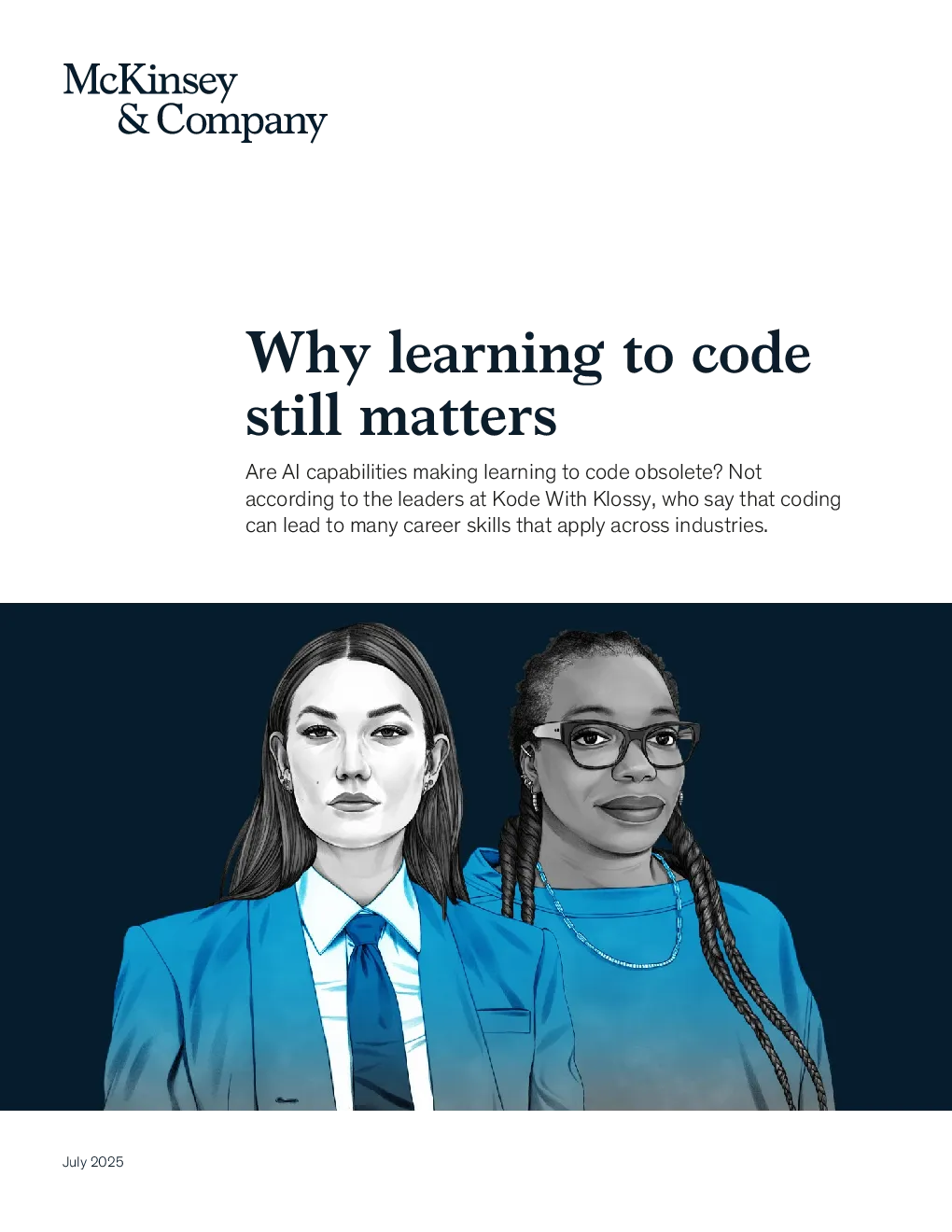
Karlie Kloss, founderof Kode With Klossy (KWK), and Osi Imeokparia, KWK’s CEO, say theprocess of coding builds more career skills than knowing how to write instructions for acomputer. On this episode ofAt the Edgepodcast, they speak with McKinsey Senior PartnerLareina Yee about how KWK’s programs teaching 13-to-18-year-old young women and gender-expansive teens how to code help enable the students to develop critical thinking skills, improvetheir problem-solving abilities, and participate confidently in tech careers and beyond.The following transcript has been edited for clarity and length.The wonderful world of codingLareina Yee:Karlie, when we met, you told me the most amazing story. Can you share thatmoment, from more than a decade ago, about when you first connected with coding and tech?Karlie Kloss:It all started because I was—and remain—super curious about what is happeningin the world. Kode With Klossy is a community of like-minded people who are passionate andcurious in a lot of directions. It was curiosity that led me to a coding class more than a decadeago. That entry point was a catalyst to learning how the software and hardware of tech is built,how creative coding is, and how important it is to have people ofalllived experiences buildingcode, because technology is transforming our lives and world now more than ever.I also realized back then that in tech spaces, there isn’t an accurate reflection of the diversity inour world, especially of women. That’s a problem. So Kode With Klossy was born out of my ownnerdy interests, and then to bring other young women into these spaces through coding camps.It started simply. I put out a scholarship on my Instagram. I thought a couple of other nerdy girlslike me would be excited about it. Turns out, we had thousands of applications for those 21scholarships, and it’s snowballed from there. Now, a decade later, we have more than 11,000young people around the world who are part of our program.Lareina Yee:As you know, Karlie, you’re most famous for being a supermodel. You didn’t needto learn how to code. Youchoseto code. It’s cool to be a nerdy girl, but coding is also a cool skillto have. At the heart of Kode With Klossy is the success of the girls. Osi, tell us why you wentfrom being this amazing tech executive to joining Kode With Klossy, and share some of thesuccesses that the girls are having.Osi Imeokparia:The success of our community members is central to why we do this work: tosee them thrive and have purposeful careers in the world. It’s everybody from a young womannamed Chloe, who’s now a software engineer at Mastercard and who wrote her first lines ofcode with us and found community, a sense of possibility, and a sense of agency—her ability toshape the world around her. It’s folks like Mia, who is now a data science PhD, who also felt thiscall to connect and to make a social impact in the world through her data science skills and herability to use those skills to transform communities.Why learning to code still matters As you hear the stories from our community, you hear central pillars repeat themselves—forexample, the idea that the members of our community view technology not in a vacuum but as atool for creating change in the world. To see that repeated 11,000 times over is rewarding.For me, it’s wonderful to align around a purpose-driven body of work that intersects my love oftechnology, my understanding that it can be a transformational tool, but then also anunderstanding of the lived experience, how there are headwinds in that process and how we canbe of service as an organization to make those headwinds less daunting.Lareina Yee:I love this notion of technology and coding as a transformational tool. Karlie, howhas tech been a tool for transformation for you and the work that you’re doing?Karlie Kloss:The story was always, why is this model in these spaces? Why is she interested incoding? Well, why not? Why can’t I be, and why can’t anyone? And, by the way, vice versa, whycan’t somebody in tech also be interested in fashion or music? A decade ago, that was almostthreatening to people. We’re in a different world now, and I’m so glad for that because peopleare so multifaceted.Our scholars are dynamic. They’re young people trying to find who they want to be in the world.What’s so exciting about the rapid progress of and democratized access to tech tools is that youcan use them any way you want. Last night, I was on a delayed flight, and I was playing aroundwith a new and extraordinary AI deep-research tool. I was building a business model around anidea I had and was just kicking it around.Even if you’re not entrepreneurial, you can still get a thrill out of these tools. That’s the wholepoint. We’re not exclusively trying to make everyone become an engineer. We’re trying to openthe eyes of our scholars to the opportunity to participate in the limitless potential of these tools.We need them to help shape the future—not only of tech but of all the sp