阿联酋政府服务转型
 AI智能总结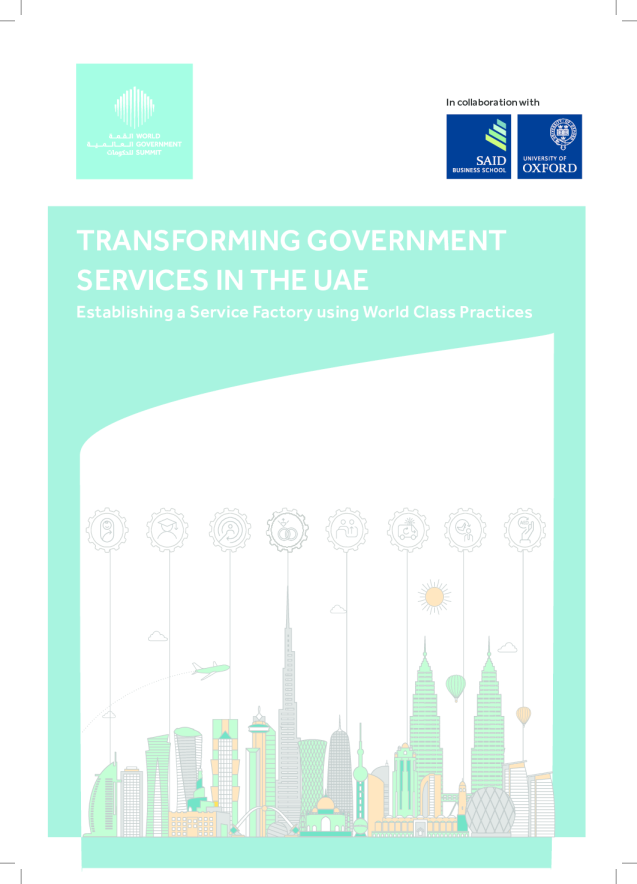
AbstractThe purpose of this paper is twofold: firstly, to take a brief analytical lookat the way in which public service delivery is undergoing transformationthrough customer-centric approaches to service design; and secondly,to summarise the initial work accomplished by the UAE governmentin adopting new innovative forms of service delivery, both for existingcitizens and for people who wish to come to live and work in the UAE.Section Onesets the context for the Service Factory initiative in theUAE, referencing similar work that has already been undertaken inother parts of the world, as well as techniques used by the privatesector that have been adopted by the public sector to bring about aglobal citizen-centric approach to service delivery.Section Twoexamines and summarises the work done to date onpublic service delivery in the UAE, and describes how this workhas developed. Under the Service Factory initiative eight bundlesof public services have been designed and developed to give bothexisting citizens and those who wish to live and work in the UAE asubstantially better service experience than that currently available.All eight bundles now exist in a prototype pilot form.Section Threepresents some general conclusions on improvementsin public service delivery, as well as some specific conclusionsconcerningthe Service Factory initiative;it also gives somerecommendations for the future. INDEX5INTRODUCTION6SECTION 1A VISION FOR THE FUTUREOF GCC CITIES6SOME PERSPECTIVES ONPUBLIC SERVICE DELIVERY6THE PRIMARY CHALLENGEFOR GOVERNMENTSERVICE DELIVERY8EXAMPLES OF INNOVATIVEPUBLIC SERVICE DELIVERY12CUSTOMER-CENTRICPUBLIC SERVICES13UNDERSTANDINGTHE CUSTOMER - LIFESTAGE ANALYSIS ANDSEGMENTATION14TOUCHPOINT ANALYSIS15CUSTOMER JOURNEYMAPPING 15SERVICE DESIGN AND CO-CREATION16SECTION 28 UAE PUBLIC SERVICESBUNDLES19SUMMARY OF SERVICEFACTORY INTIATIVES19MEASUREMENT OFSUCCESS20SECTION 320CONCLUSIONS20RECOMMENDATIONS21BIBLIOGRAPHY Recent years have seen an increasing demandfor improved efficiency in the public sectorand in the delivery of its various services.Citizens are more aware of their rights as aresultof improved access to information,which has nurtured higher expectations oflevels of service.Modern companies in the private sector thathave shown an aptitude for customer-centricservice have also highlighted the shortcomingsof various public services. Citizens now expectthe same standard of service that they receivewhen purchasing a product as customers.AccordingtoPricewaterhouseCoopers,improvementto public services can beaddressed with five core principles: listeningto your customers; breaking down the ‘silos’;enabling a multi-channel service; continuouslyimproving through customer feedback; andsettingcustomer-centric standards(PWC,2016).Improvementsto public service deliveryusing these principles have been shown tobe effective in the past; this paper will brieflyexplore some of these and examine how theycanpotentially improve citizens’levels ofhappiness and satisfaction.Sincethe 1990s various government andpublic service providers have been aware ofthe necessity to improve standards. The end-goal appears to be a common one: to providea ‘one-stop shop’ for delivering public servicesto citizens.The UAE government, under the auspicesof the Prime Minister’s Office (PMO), hasembraced the view that customers shouldbe co-creators of value and become involvedin the analysis and design of public servicedeliverysystems(for the purpose of thispaper a ‘customer’ refers to any UAE citizen orexpatriate resident). To enable this approachto move from an idea to reality, the UAE hasembarkedupon the development of theService Factory initiative, which uses world-class techniques in transforming public servicedeliveryto improving its customers’livesand experiences. This is, as with many of theworld’s top private-sector brands, driven by astrong and aspirational vision – that of ‘UAE2021’.This vision ‘aims to make the UAE among thebest countries in the world by the GoldenJubilee of the Union. In order to translate theVision into reality, its pillars have been mappedinto six national priorities which representthe key focus sectors of government actionin the coming years.’ (Vision 2021, 2016). Thesix national priorities are: a cohesive societyand preserved identity; a safe public and a fairjudiciary; a competitive knowledge economy;afirst-rate education system;world-classhealthcare; and a sustainable environment andinfrastructure.The Service Factory initiative is driven by thePMO and strives to bring into focus how theUAE can deliver more innovative, customer-centric services to enhance people’s lives.In order to become effective at doing so, itmust overcome some of the conventionalchallenges of public service delivery.INTRODUCTION 6TRANSFORMING PUBLIC SERVICES IN THE UAEFor decades private-sector companies havedominated the customer service landscapeby focusing on providing their customers withconsistently excellent experiences. Led by