AI智能总结
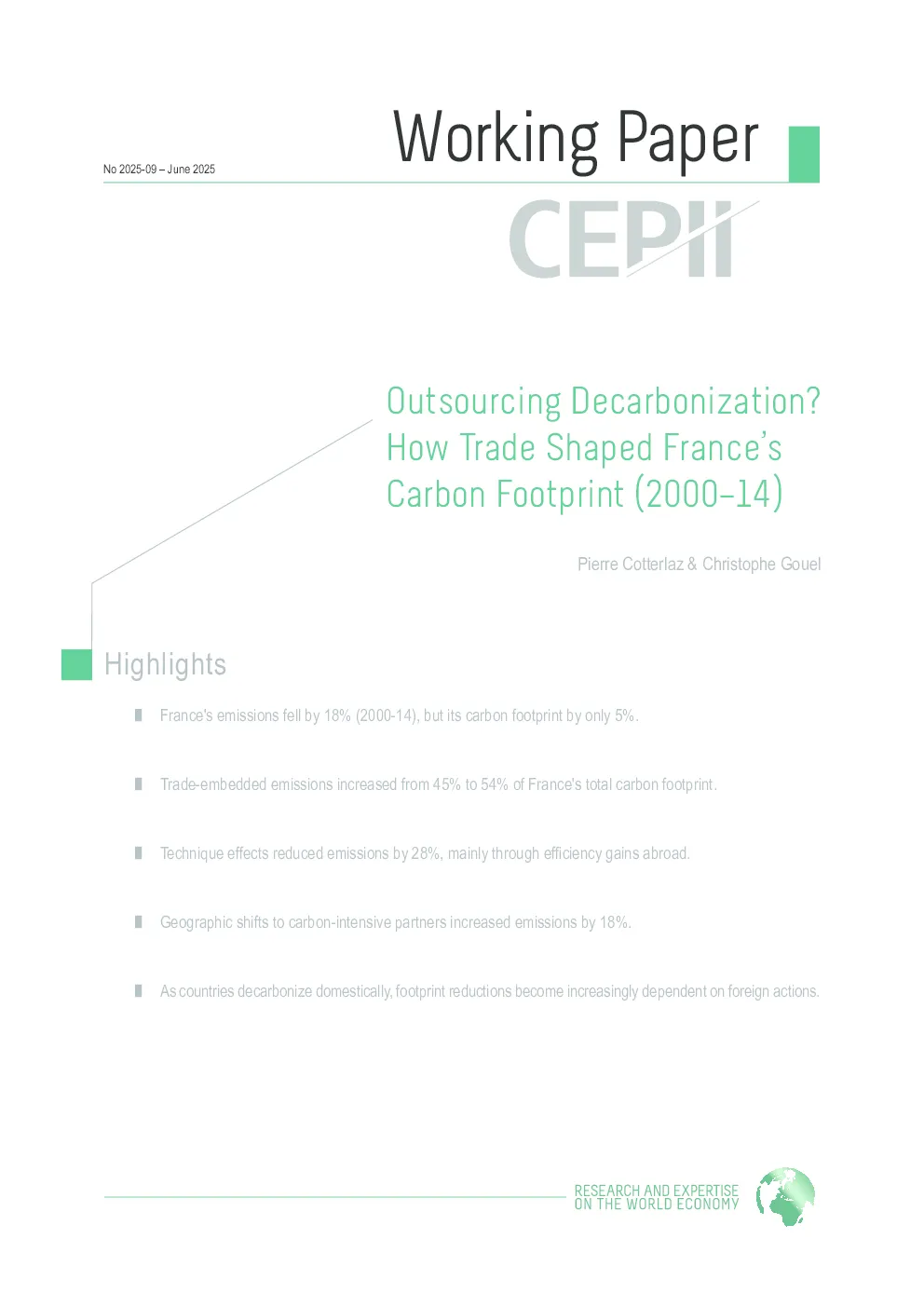
Highlights AbstractThis study examines the evolution of France's carbon footprint from 2000 to 2014, with a particular focus on therole of international trade. During this period, France's territorial emissions decreased by 18%, yet its consumption-basedfootprintdeclinedbyonly5%.Thismodestreductionreflectsanincreaseinemissionsembeddedinimports,which grew from 45% to 54% of the total. Employing a novel structural decomposition analysis, we disentanglethe contributions of scale, composition, and technique effects from a consumption perspective. Our approachadvancestraditionalmethodsbyexplicitlydistinguishingbetweendomesticandforeigninfluencesandbyseparatelyanalyzingtradeopennessandthegeographicreallocationoftradeflows.Theresultsunderscorethedominanceofthetechniqueeffectinreducingemissions(-28%),drivenprimarilybyefficiencyimprovementsabroad.However,the geographic composition effect led to a substantial increase in emissions (+18%), especially due to shifts towardmore carbon-intensive trading partners prior to 2008. This pattern - characterized by a growing reliance on foreignimprovements for emission reductions - likely foreshadows developments in other developed economies as domesticdecarbonization advances. It highlights the need for greater coordination between trade and climate policies.KeywordsCarbon footprint, Structural decomposition analysis, Consumption-based accounting, Scale, composition, andtechnique effects, France.JELF18, Q54, Q56, C67, F64.Working Paper© CEPII, PARIS, 2025Centre d’études prospectiveset d’informations internationales20, avenue de SégurTSA 1072675334 Paris Cedex 07contact@cepii.frwww.cepii.fr–@CEPII_ParisPress contact: presse@cepii.fr CEPII Working PaperContributing to research in internationaleconomicsCEPII (Centre d’Études Prospectiveset d’Informations Internationales) is aFrench institute dedicated to producingindependent, policy-oriented economicresearch helpful to understand theinternational economic environment andchallenges in the areas of trade policy,competitiveness, macroeconomics,international finance and growth.EdItoRIAldIRECtoR:AntoInEBouëtVISuAldESIgnAndPRoduCtIon:lAuREBoIVInISSN 2970-491XJune 2025To subscribe toThe CEPII Newsletter:www.cepii.fr/KeepInformedAll rights reserved. Opinions expressedin this publication are those of theauthor(s) alone. Outsourcing Decarbonization?How Trade Shaped France’s Carbon Footprint (2000–14)Pierre Cotterlaz∗and Christophe Gouel†A persistent gap between production-based emissions inventories and consumption-based carbonfootprints characterizes most developed economies (Peters et al., 2011; Dugast et al., 2024),raising questions about whether domestic decarbonization represents genuine progress or theoutsourcing of emissions to countries with weaker environmental regulations (Levinson, 2023).France offers a particularly instructive case: its relatively low territorial emissions—a result ofearly and extensive reliance on nuclear power and long-standing de-industrialization—stand incontrast to a growing share of trade-embedded emissions in its overall carbon footprint. In thiscontext, analyzing the influence of international trade dynamics provides valuable insights fordesigning effective climate policies in a globalized economy.What forces have shaped the evolution of France’s carbon footprint between 2000 and 2014?Although international trade is often cited as a potential driver of footprint trends, its specificrole remains difficult to distinguish from other factors such as economic growth, sectoral changes,and technological improvements.To address this question, we adopt a consumption-basedperspective and use a decomposition approach to quantify the relative contributions of scale,composition, and technique effects. Our framework explicitly separates domestic and foreigninfluences and differentiates between two key trade-related mechanisms: greater openness totrade and the geographic reallocation of trade flows. Using detailed input-output data from theWorld Input-Output Database (WIOD), we provide an in-depth breakdown of emissions by sector,trade region, and consumption pattern. This approach allows for a nuanced understanding ofhow trade dynamics, in conjunction with other drivers, have shaped the evolution of France’sThe analysis yields three main findings regarding the role of trade in shaping France’s carbonfootprint. First, while France’s territorial emissions declined by 18% between 2000 and 2014, itsconsumption-based footprint decreased by only 5%. This underscores the growing significanceof import-embedded emissions, which increased from 45% to 54% of the total footprint—anunusually high share by international standards. Second, the decomposition reveals that tradeINRAE and CEPII: christophe.gouel@inrae.fr3 1.Introductioncarbon footprint.∗CEPII: pierre.cotterlaz@cepii† acted as a substantial countervailing force to emission reductions. Although technique effects—primarily improvements in emission intensity—reduced Fr